








Hanoi plans to relocate hundreds of thousands of residents from the city centre to the suburbs
An incentive plan has been launched to encourage residents to move from densely populated areas to new developments connected to metro stations. Some of the targeted areas are currently undergoing redevelopment. The capital's new master plan envisions development along a multipolar and multicentric structure, with the Red River as the main ecological and cultural axis.
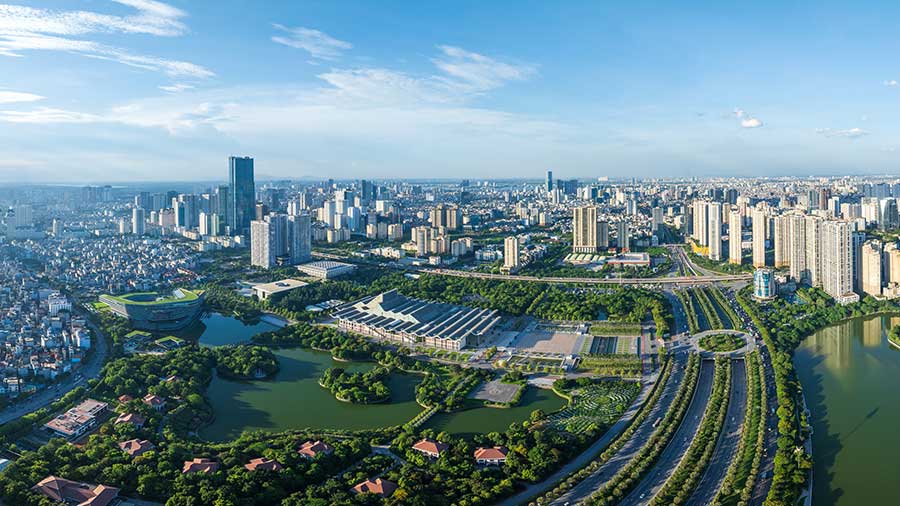
Hanoi (AsiaNews) – The Vietnamese government has approved a long-term urban development strategy aimed at encouraging residents to move from the capital’s densely populated historic centre to new suburban residential developments linked to Hanoi's metro system.
The initiative is part of a long-term master plan, adopted by the city and signed by Hanoi People's Committee Chairman Vũ Đại Thắng, which calls for a gradual relocation.
At least 442,000 residents will move from areas along the Red River (Sông Hồng), around West Lake (Hồ Tây), and several streets in the city centre between 2026 and 2035, followed by another 420,000 from the Old Quarter (Phố cổ Hà Nội) and other areas within Ring Road 3 (Đường Vành đai 3) between 2036 and 2045.
City authorities are using financial and political incentives to attract residents to new urban developments built around metro stations on the outskirts of the capital.
The target areas – including Đông Anh, Gia Lâm, and the Hòa Lạc Hi-Tech Park in the western sector – are being redeveloped under the same plan, with infrastructure designed to integrate housing, transportation, and employment.
The goal is to relieve pressure on the Old Quarter (Phố Cổ), where the most densely populated wards can pack more than 20,000 people per square kilometre, while preserving the architectural character of areas like Hoàn Kiếm and the French Quarter (Khu phố Pháp).
According to estimates by the Hanoi Architects Association, the population living in the Old Quarter has already dropped by 30-50 per cent in the past 20 years due to spontaneous outmigration.
Regarding residential development, Hanoi’s goal is to achieve at least 35 m² of floor space per person between 2026 and 2030, with an ambitious target of 40 m², rising to at least 45 m² per capita between 2031 and 2035.
The housing strategy is linked to a public transport-oriented development (TOD) model that concentrates new construction around metro stations.
Within Ring Road 2, the city will comprehensively redevelop old apartment buildings and dilapidated collective housing blocks, following an integrated Transit-Oriented Development-Central Business District (TOD-CBD) model that combines public transport with commercial and financial hubs.
The capital currently has approximately 2,160 old buildings and collective housing blocks, most of which were built between the 1960s and 1980s. Renovation has progressed slowly, reaching only 2 per cent of the planned level despite years of efforts.
Industry experts say the capital faces a dual challenge: ensuring safety in aging residential complexes while simultaneously meeting housing demand and maintaining a stable real estate market.
Outside of Ring Road 3, Hanoi will develop multipurpose urban zones along the metro corridors, following a compact development model clustered around stations.
Social and worker housing will be prioritised for large-scale, concentrated planning and construction.
Projects must be located on sites that are well connected to the metro network to serve low-income residents and factory workers in the city's industrial parks.
Regarding market management, Hanoi intends to establish financial and planning tools aimed at curbing real estate speculation.
The city is also incentivising the rental housing sector and promoting green and energy-efficient properties integrated into the TOD infrastructure.
The Centennial Master Plan covers the entire administrative area of 3,359 km² and projects the population to grow from the current 8.5 million to 14-15 million by 2035 and to 17-19 million by 2065, with a long-term upper limit of 20 million.
Hanoi will develop along a multi-level and layered, multipolar, and multicentric structure, with the Red River as its main ecological and cultural landscape axis.
By 2035, it aims to achieve a regional GDP of approximately US$ 200 billion and a per capita GDP of more than US$ 18,800, positioning itself as a centre for finance, trade, and innovation.

.png)
28/08/2025 16:59










