








Kashmir: 100 Years of St Joseph’s Church in Baramulla
The Catholic mission commemorates a century of pastoral presence and service. A centre for education and healthcare open to people of all faiths in a region marked by conflict. During the Indo-Pakistani War of 1947–48, it became a place of refuge for displaced people but was also the target of serious violence. Reduced to ruins, it was rebuilt with the help of the local communities: today it is a symbol of dialogue, education and care for thousands of people.
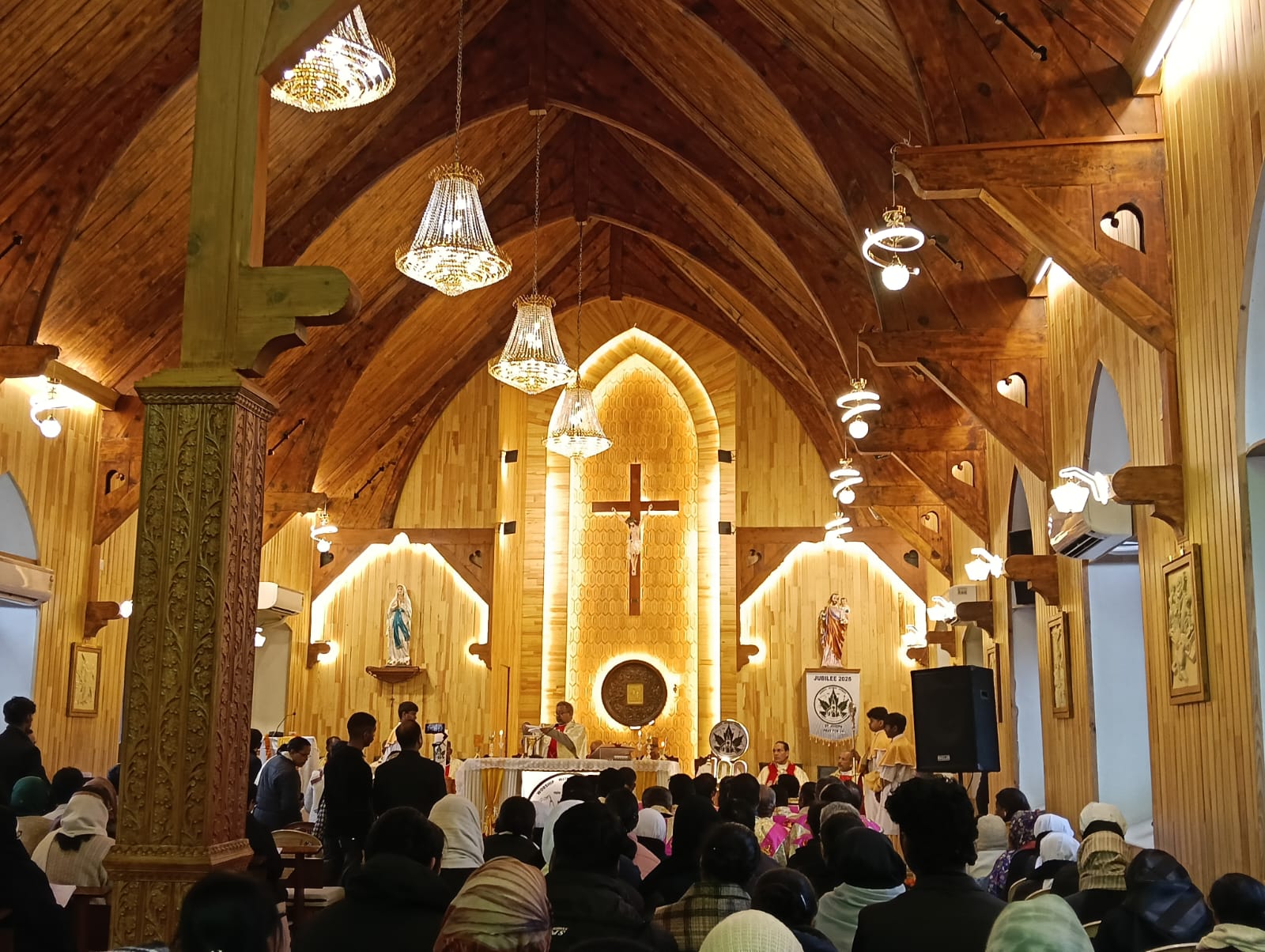
Baramulla (AsiaNews) - St Joseph’s Catholic Church in Baramulla, Jammu and Kashmir, is celebrating its centenary. Local communities are not only commemorating the passage of time, but also recalling many stories of courage, sacrifice and faith.
Founded by missionaries driven by a vision of tireless service, the church soon became more than a place of worship. It transformed into a centre for education and healthcare, providing services to all people from the communities, without distinction.
Today, the Solemnity of St Joseph, a celebration took place at St Joseph’s Campus, attended by public officials, military leaders, religious figures and the local community. Among them was the local government minister, Shri Javid Ahmad Dar. For the occasion, Holy Mass was presided over by the Archbishop of Delhi, Anil Couto.
The students staged a performance depicting the missionaries’ journey: from humble beginnings to a century of humanitarian commitment and faith, in the service of God.
The fruitful presence of St Joseph’s Catholic Church in Jammu and Kashmir is particularly significant. The Kashmir Valley is inhabited by a Muslim majority, accounting for around 90% of the population. Hinduism follows, in a minority by Indian standards, partly due to the exodus caused by terrorist threats. Sikhism, Buddhism and Christianity constitute the smallest communities.
Although the Catholic mission in Baramulla dates back to the late 19th century, the parish is celebrating 100 years of organised presence and pastoral life. A defining moment came during the turmoil of the Indo-Pakistani War of 1947–1948.
When the violence reached Baramulla, the mission compound became a place of refuge and tragedy. Priests, nuns and the faithful chose to remain with the sick and most vulnerable, fully aware of the risks. During the tribal invasion of Baramulla in October 1947, St Joseph’s Mission was attacked, resulting in several deaths among the clergy and parishioners.
Historical accounts also indicate that some women, including nuns and nurses, were victims of sexual violence. However, the exact number of victims of male violence is unknown. What is widely agreed upon is that the attack represented a deeply traumatic episode for the Baramulla community and remains a grim reminder of the vulnerabilities to which civilians, particularly women, are exposed during armed conflicts.
Yet, amidst the violence, stories emerged of residents of other faiths who protected the survivors, offering shelter, assistance and solidarity. These acts of quiet heroism remain etched in the collective memory, bearing witness to the deep, underlying current of shared humanity capable of overcoming divisions.
In the aftermath of the destruction, the future of the mission appeared uncertain. Much of the church and its associated institutions lay in ruins. Nevertheless, an extraordinary story of the reconstruction of St Joseph’s Church followed, which was not solely the work of the missionaries; it was sustained by the goodwill of local communities.
This collective effort transformed the place of worship into a shared symbol of resilience: an institution that belonged as much to the people of Baramulla as it did to the Catholic faithful.
Over the decades, the church’s influence has extended far beyond its religious role. Its educational institutions have become places where boys and girls from diverse religious and social backgrounds have studied together, forging bonds destined to last a lifetime.
Generations of students – Muslims, Hindus, Sikhs and Christians – have passed through its classrooms; many of them have gone on to make significant contributions to the good of society. Today, the school has over 70 classrooms and more than 4,000 students.
Equally significant has been the role of the missionary hospital, which has long been a beacon of care for thousands of people. Even during times of unrest and uncertainty, it has remained open to all, offering care without discrimination. For many residents, the church is remembered not only as a place of prayer, but as a haven of healing and compassion.
The centenary celebrations have brought these memories to the surface. People from all communities gathered to celebrate the place, not only as a religious landmark but as a shared cultural and social heritage. Many participants shared stories passed down from generation to generation: of grandparents educated at the mission school, of lives saved at the hospital, of friendships forged across divisions.
Today, St Joseph’s Church remains a symbolic site, far removed from the main pilgrimage circuits or tourist routes. Yet its significance is profound. It stands as a testament to history: it bears the marks of conflict, yet radiates a message of peace and continuity. Its history reminds us that even in regions marked by fragility, institutions rooted in service and compassion can become enduring pillars of unity.

.png)










