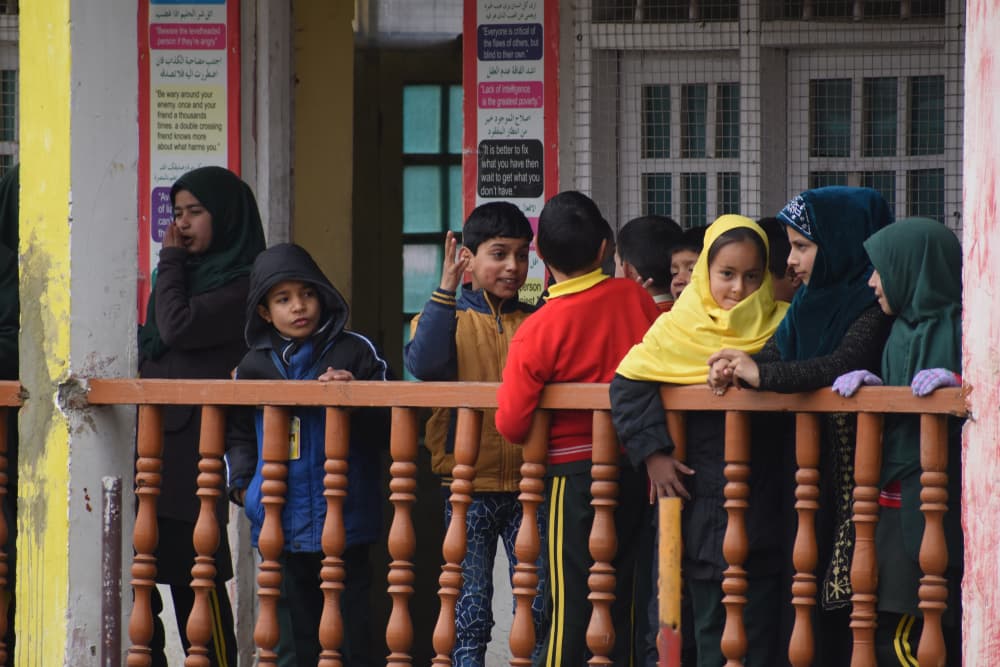
New Delhi (AsiaNews) – One year on from the attack in Pahalgam, Kashmir, in which 28 Indian civilians were killed, the local government under Indian administration has seized 58 private schools suspected of being affiliated with the Jamaat-e-Islami organisation, which India outlawed in 2019. Some unverified videos on social media show armed police officers entering the schools in northern Kashmir, removing staff and prohibiting any filming of the operation.
The decision, taken on 18 April, came a few days before the anniversary of the attack, which falls today, 22 April. A year ago, gunmen opened fire on Indian tourists. A few days later, Delhi – which accuses Pakistan of continuing to fund Islamic extremism (a charge Islamabad denies) – launched Operation Sindoor, sparking a brief war. At the same time, India has stepped up efforts to dismantle networks believed to be linked to extremist organisations.
Back in August, the government had already ordered the seizure of over 200 schools in the state, which were also suspected of having links to the organisation. With this latest operation, the number of educational centres brought under state control rises to around 300, a figure that worries observers due to the possible implications for the region’s school system.
Founded in 1948, following the partition of India, Jamaat-e-Islami is a pan-Indian socio-religious organisation active in various fields, including education, social work and politics, with the aim of promoting the principles of Islam. However, whilst some of its branches — such as Jamaat-e-Islami Hind, based in Delhi — operate legally, the branch active in Jammu and Kashmir has been accused of fuelling anti-Indian sentiments, advocating for the region’s independence and maintaining links with terrorist groups, allegations which led to its banning in 2019 under India’s anti-terrorism law, the Unlawful Activities (Prevention) Act.
Since then, the Jamaat has tried unsuccessfully to have the ban lifted, setting up an internal committee to negotiate with the government. In 2024, the central government led by the Bharatiya Janata Party (BJP) attempted to ‘reintegrate’ the group into political life, allowing some of its leaders and activists to stand as candidates in the general election, despite the ban under the anti-terrorism law. On that occasion, some former members of the Jamaat founded a new political party, the Justice and Development Front (JDF), which, however, failed to win any seats. Last year, the leader of the Peoples Conference political party, Sajad Lone, formed an alliance with the JDF, focusing on the restoration of special status for Jammu and Kashmir and on new legislative elections in the territory.
In fact, in 2019, the Indian Parliament also voted to repeal Article 370 of the Constitution and enact the Jammu and Kashmir Reorganisation Act, two laws that radically altered the territory’s structure. Kashmir’s special status, which guaranteed a degree of autonomy, was abolished and the territory was divided into two parts, Jammu and Kashmir, administered directly by the central government. Following these changes, the region and its educational institutions came under the control of the Ministry of Home Affairs.
Before being declared illegal, Jamaat-e-Islami ran a network of around 350 schools in the region through its educational arm, the Falah-a-Aam Trust (FAT), which catered for around 100,000 students, particularly in rural areas.
In recent years, the Indian authorities have refused to grant authorisation to several schools, claiming to have intelligence information suggesting that some members of the governing body had links to the terrorist organisation. The FAT has always declared itself a non-political body, whose aim is to ‘provide education to all students without discrimination’.
According to some human rights activists and sections of public opinion, many of these schools, which have been operating for decades and attended by thousands of students, played a vital role in the region. Many in Kashmir accuse the government of abuse of power and violation of fundamental rights: Article 30 of the Indian Constitution, in fact, guarantees religious and linguistic minorities the right to establish and manage educational institutions of their choice.