

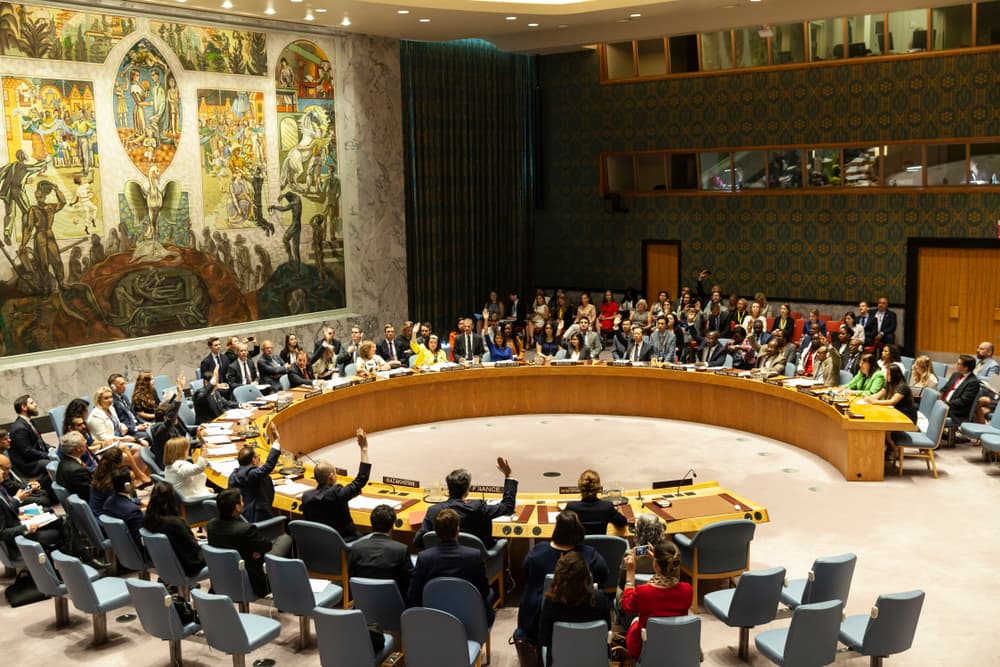
New York (AsiaNews/Agencies) – From 1 January 2027, for the first time in its history, Kyrgyzstan will sit on the UN Security Council. This is the outcome of yesterday’s vote at the UN headquarters in New York, which saw the Central Asian country elected alongside Austria, Portugal, Zimbabwe and Trinidad and Tobago as new non-permanent members for the 2027–2028 term.
Kyrgyzstan pipped the Philippines to the post, with which it was vying for one of the two non-permanent seats reserved for the region – the one currently held by Pakistan (the other, due to expire at the end of 2027, is held by Bahrain, whilst the People’s Republic of China has been a permanent member since 1971 as one of the victorious powers of the Second World War). A somewhat surprising vote, but emblematic of the changes underway in the region.
The Asia-Pacific group often puts forward single nominations to the Assembly. The last real contest took place in 2018, when Indonesia and the Maldives vied for the seat, with Jakarta emerging victorious. This time, the contest was particularly significant as it pitted two very different perspectives on Asia against each other: on the one hand, a former Soviet republic such as Kyrgyzstan – a member of the UN since 1992 – representing a region that is now emerging, namely Central Asia. On the other, the Philippines, which is one of the UN’s founding members (and has previously served on the Security Council four times), whose candidacy was backed by ASEAN, the regional body of South-East Asian nations, as well as by the United States and Japan.
Bishkek had been slightly ahead since the first ballot, but it took no fewer than four rounds to reach a qualified majority: in the final ballot, it secured 142 votes against Manila’s 49. The outcome was certainly influenced by the support of the People’s Republic of China, which in recent years has strengthened its ties with Kyrgyzstan and (conversely) has long been at loggerheads with the Philippines over the issue of disputed waters in the South China Sea, with clashes even taking place on the high seas between its coastguard and that of Manila. Most of the countries of the so-called Global South also voted for Kyrgyzstan, following China’s lead.
Kyrgyzstan is the second Central Asian country to join the Security Council: the only precedent is Kazakhstan, which served on the Council from 2018 to 2019. For its candidacy, Bishkek had chosen the slogan “Building a safer and more prosperous world through cooperation, trust and multilateralism”. As a key strength of its dossier, it highlighted the recent border agreement with Tajikistan, which put an end to a long-running dispute involving a border area stretching over 1,000 kilometres.
Among the priorities declared by Kyrgyzstan are nuclear disarmament and non-proliferation, issues of particular concern in a region that is home to the Central Asian Nuclear-Weapon-Free Zone. Bishkek also promises to pay particular attention to the situation in Afghanistan, as well as to the needs of developing countries, landlocked states and regions vulnerable to climate change, including mountainous areas.













