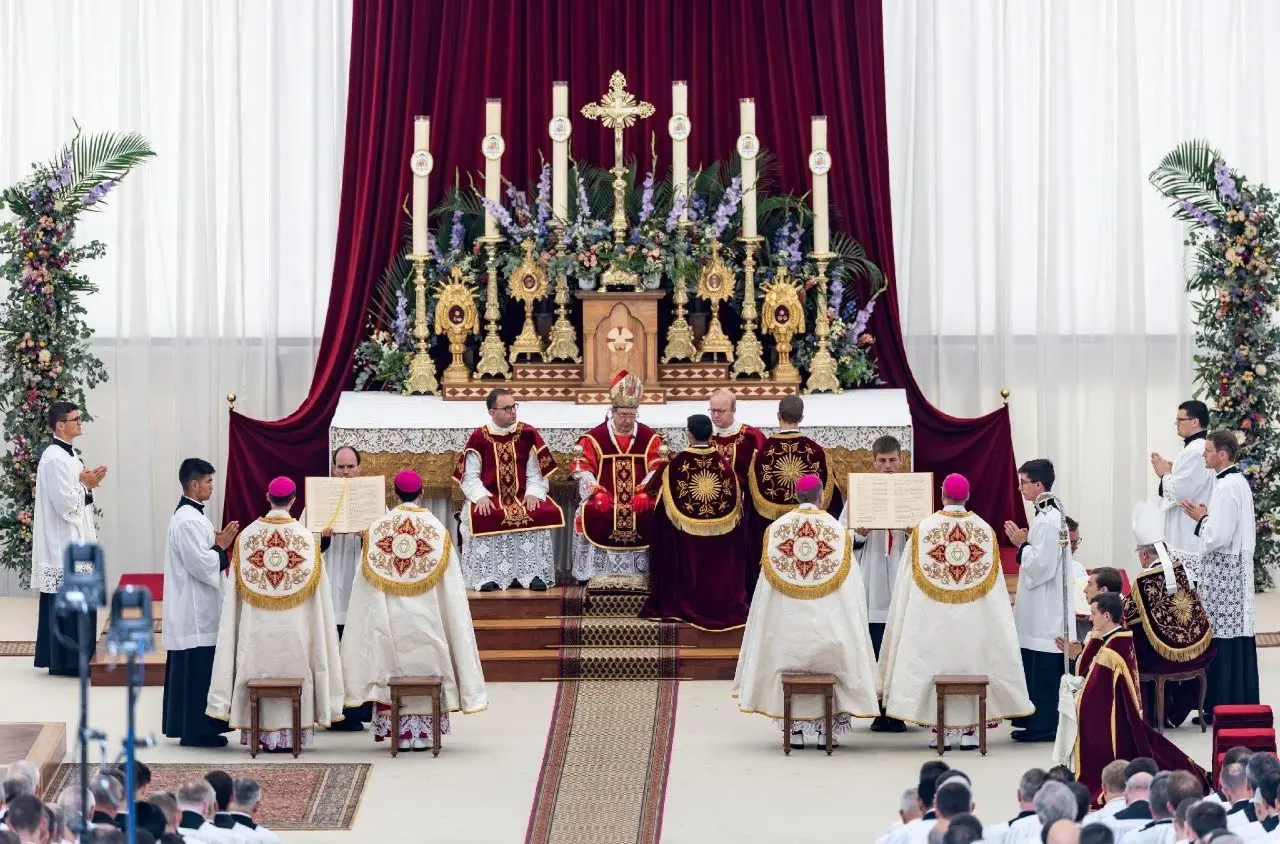
Milan (AsiaNews) – The appeal not “to tear the seamless garment of Christ”, launched again by Pope Leo XIV just two days ago, has fallen on deaf ears. This morning in Écône, Switzerland, the headquarters of the Society of Saint Pius X, the Lefebvrians consecrated four new bishops without a papal mandate, in an act that canon law considers schismatic.
The ceremony was attended by more than a thousand priests, men and women religious, and approximately 15,000 faithful. The event, organised with great publicity and streamed in six languages, took place in a tent next to the Ecône seminary.
The new bishops are Pascal Schreiber of Switzerland, Michael Goldade of the United States, as well as Michel Poinsinet de Sivry and Marc Hanappier of France.
The consecrations were made by Mgr Alfonso de Galarreta and Mgr Bernard Fellay, two of the four bishops ordained in 1988 by the society’s founder, Mgr Marcel Lefebvre, an event that led to the excommunication of the consecrators, later revoked by Pope Benedict XVI in 2009 in an attempt to foster reconciliation.
In his address at the celebration, the current superior of the Society of Saint Pius X, Father Davide Pagliarani, described the situation of the Church as “exceptional”, accusing Church authorities of having departed from tradition and faith since the Second Vatican Council.
For this reason, he argues, the transfer of the episcopate represents “our very duty”; thus, according to this view, any canonical sanctions would be null and void.
In reality, the Holy See, through the prefect of the Dicastery for the Doctrine of the Faith, Cardinal Victor Manuel Fernández, had already defined these ordinations as a schismatic act.
For the Catholic Church, this gesture reopens a deep wound in ecclesial communion.
“The Church,” Pope Leo XIV writes in his latest appeal to Father Pagliarini released yesterday, “recognizes the devotion to liturgical life, commitment to priestly formation, apostolic zeal and desire for fidelity to Tradition that characterize many people and communities connected to your Fraternity. This has motivated the attentive and generous attitude that my Predecessors have consistently shown to you.”
Precisely for this reason, the pontiff added, “I plead with you and ask you with all my heart: please turn back! I urge you to consider carefully the spiritual good of the faithful, because the schismatic act you are about to undertake would deprive them of the licit and, in some cases, even valid reception of the Sacraments, which they love and seek for their sanctification.”
As Father Pagliarani's own words indicate, what is at stake is not simply the question of celebrating the liturgy according to the Tridentine Mass, but the Church's view of communion and the failure to accept the Second Vatican Council, which Pope Leo XIV deemed so important that he devoted his Wednesday general audience catecheses to rereading its documents.
Today's rift involves an organisation that, according to the most recent data released by the Society of Saint Pius X itself, has 1,482 members from about 50 countries, including priests, seminarians, and consecrated persons.
It is also present in Asia, with small communities. In Singapore, the Priory of Saint Pius X on Upper Thomson Road is home to one of the 15 districts in which the Lefebvrian community is organised worldwide.
Father Patrick Summers, an American priest, has led the Society’s 52 chapels across the continent as superior since 2018.
The first community to be established in Asia was in Palayamkottai, in the Indian state of Tamil Nadu, in 1986. It was strongly backed by Archbishop Lefebvre, in one of the regions where Saint Francis Xavier had carried out his missionary apostolate.
Other priories can be found in the Philippines (Manila, Davao, and Iloilo, plus a novitiate for the Oblates of the Society of Saint Pius X). The latest to open in Asia was in Japan, in 2021. Other smaller Lefebvrian communities and missions are active in South Korea, Sri Lanka, Malaysia, Indonesia, and Hong Kong.
Finally, regarding today's ordinations in Écône, it should be noted that any comparison some traditionalists have made with Chinese bishops is completely inappropriate.
While the latter have been ordained without papal mandate and then readmitted into full communion with Rome pursuant to the 2018 Agreement between the Holy See and the People's Republic of China, the circumstances are, in fact, objectively very different.
In China, those ordinations were the result of political imposition by a power external to the Church; today's ordinations, however, represent a breach of ecclesial communion resulting from an act performed in complete freedom.