








Leo XIV, in Bamenda, says ‘No to a world that steals resources and invests them in weapons’
The pope visited today Cameroon’s English-speaking region in the western of the country, scene of a forgotten war that has caused thousands of deaths, destruction, and more than a million refugees in this part of Africa. During his peace meeting with the local community, the pontiff encouraged those working for reconciliation, contrasting their action with what the masters of war do, to “look into each other’s eyes: we are this immense people!”
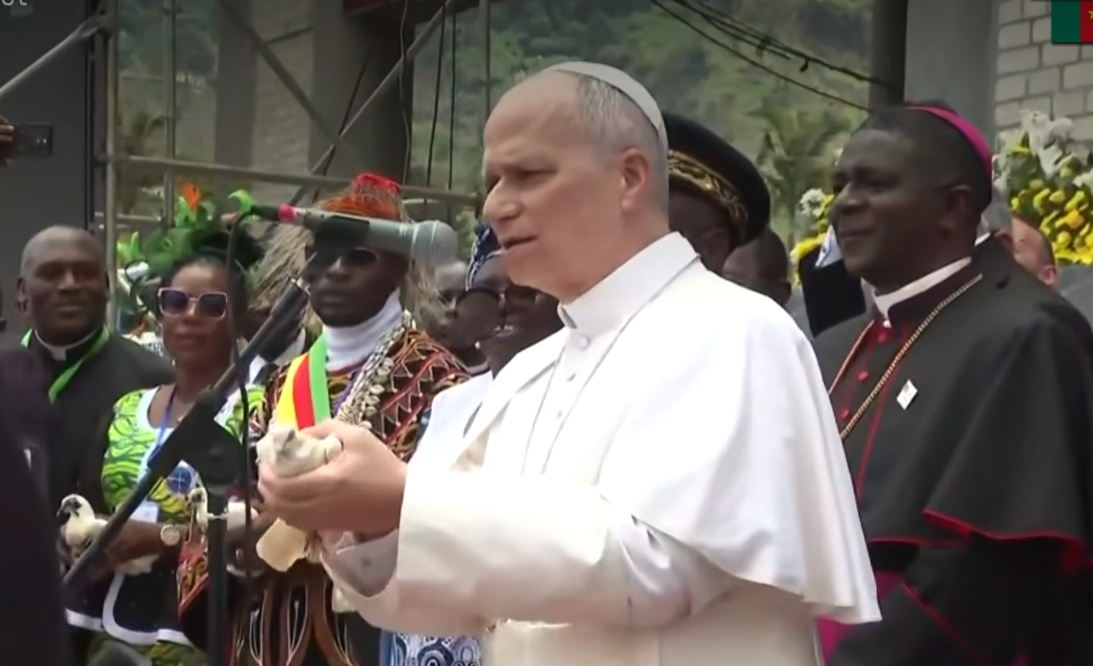
Bamenda (AsiaNews) – Pope Leo XVI travelled today to a peace meeting in Bamenda (Northwest Cameroon), a region affected for ten years by a still-ongoing conflict, which has impacted its southwestern neighbour.
“It is a joy for me to be among you in this tormented region,” Leo said speaking in St Joseph’s Cathedral, a reference to the still-bleeding wound, known as the “Anglophone Crisis”.
This part of Cameroon was placed British rule after World War I and was later united with territories under French control. This union, however, has always left the Anglophone part marginalised and excluded. And eventually popular discontent turned into political opposition.
After large-scale demonstrations were brutally suppressed in 2016, armed struggle followed. In 2017, secessionists proclaimed the birth of the Federal Republic of Ambazonia, which is not internationally recognised state, and is a source of divisions among various groups.
The conflict has caused thousands of deaths, destroyed hundreds of villages, and displaced more than a million people in neighbouring Nigeria. At least 500,000 people remain internally displaced. For nearly five years, schools were closed, and approximately 700,000 children were left without an education. Buildings and infrastructure were destroyed.
More recently, some roads and the airport were repaired and reopened after many years, specifically for the papal visit.
The situation is currently calmer, but not entirely peaceful, with some groups still refusing to abandon the armed struggle and many groups taking advantage of the instability to engage in criminal behaviour, including kidnappings.
For the people in Bamenda and Cameroon’s English-speaking region, the papal visit is a blessing and an enormous source of hope. For Pope Leo, the venue provided the opportunity to issue a strong appeal for peace to the entire world.
“[H]ow beautiful are your feet,” he said, “dusty from this bloodstained yet fertile land that has been mistreated, yet is rich in vegetation and fruit. [. . . ] Your feet have brought you this far, and despite the difficulties and obstacles, they have remained on the path of goodness.”
“I am grateful for your words of welcome, because it is true: I am here to proclaim peace. Yet I find it is you who are proclaiming peace to me, and to the entire world.
“As one of you observed, the crisis impacting these regions of Cameroon has brought Christian and Muslim communities closer than ever before. Indeed, your religious leaders have come together to establish a Movement for Peace, through which they seek to mediate between the opposing sides. [. . .] Blessed are the peacemakers!”
Leo went further, issuing a warning that clearly goes beyond the borders of this region: “But woe to those who manipulate religion and the very name of God for their own military, economic or political gain, dragging that which is sacred into darkness and filth.”
In welcoming the Holy Father, Archbishop Andrew Nkea Fuanya of Bamenda pointed out that, traditional leaders were waiting for him in the cathedral in a very festive and moving atmosphere, as were brothers and sisters from the Protestant Churches, members of the Islamic religion, priests, religious, catechists, seminarians, and lay faithful in Christ, all of whom have experienced the region’s crisis.
“Most Holy Father, you have come to visit us at a time when the people of this ecclesiastical province [. . .] need your presence and your comfort most,” said Archbishop Fuanya.
“We have seen a lot of suffering for the past eight years. Many of our people have suffered a lot from a situation they did not create. Thousands are either internally displaced or escaped as refugees,” he added.
“Businesses were shut down and for about four years, our children were not allowed to go to school. Children were used as a political bait.” What is more, “Many priests, religious and bishops of this province have either been harassed, beaten, kidnapped or even killed in this conflict. Yet, the Church continues to carry the gospel as the light of hope among a traumatized people.”
Imam Mohamad Abubakar of the central mosque of Buea noted how the Muslim community has also been the victim of killings, looting, cattle thefts, attacks on mosques. “We thank God that this crisis has not degenerated into a religious war and we are still trying to love one another despite our religions."
Reverend Fonki Samuel Forba, moderator emeritus of the Presbyterian Church in Cameroon, instead underlined the work of religious leaders who, led by the archbishop of Bamenda, spoke with separatist leaders, trying “to engage the local separatist fighters on the ground in dialogue, convincing them that peace is better than war, and that war can never really solve any conflict.”
“This Anglophone crisis is one of the forgotten crises on the planet earth, but it was brought to the notice of the Vatican, and the Vatican was even willing to facilitate dialogue between the warring factions,” Rev Forba explained.
The peace meeting also heard the deeply moving stories of victims and of those who try to support them, alleviate their pain and heal their wounds.
The member of a displaced family forced to flee told their story. “[F]ive of my neighbors were killed and one of my close friends was also killed,” said the father. “While we were being targeted by the separatist fighters, government soldiers were also burning down houses,” he added. “I escaped with my family out of Mbiame, abandoning all that I ever owned”.
Sister Carine Tangiri Mangu of the Sisters of Saint Anne shared the traumatic experience of her abduction with a fellow nun. “[T]his is the situation under which many consecrated women do their work and live their lives within this war zone.”
Despite everything, like many others, she continues to carry out her pastoral work and provide psychosocial support to those who have suffered trauma. For her, the pope’s presence is a strong encouragement to carry out her apostolate in very difficult circumstances.
Pope Leo used the metaphor of “oil poured out upon the wounds of your brothers and sisters” to soothe the pain. He thanked all those, especially women, both lay and religious, “who care for individuals traumatized by violence. It is an enormous task that goes unseen day by day, and as Sister Carine reminded us, it is also dangerous."
Leo went on to talk about something that transcends Cameroon's borders.
“The masters of war pretend not to know that it takes only a moment to destroy, yet a lifetime is often not enough to rebuild. They turn a blind eye to the fact that billions of dollars are spent on killing and devastation, yet the resources needed for healing, education and restoration are nowhere to be found. Those who rob your land of its resources generally invest much of the profit in weapons, thus perpetuating an endless cycle of destabilization and death.
“It is a world turned upside down, an exploitation of God’s creation that must be denounced and rejected by every honest conscience. We must make a decisive change of course – a true conversion – that will lead us in the opposite direction, onto a sustainable path rich in human fraternity. The world is being ravaged by a handful of tyrants, yet it is held together by a multitude of supportive brothers and sisters!”
The Holy Father ended his speech encouraging all those who, “as numerous as the stars in the sky and the grains of sand on the seashore” carry forward the “paths of peace and reconciliation”.
“Let us look into each other’s eyes: we are this immense people! Peace is not something we must invent: it is something we must embrace by accepting our neighbor as our brother and as our sister.”
“We are one family, inhabiting the same home: this wonderful planet that ancient cultures have cared for across millennia.”
Citing Pope Francis, Leo urged everyone to “walk together, each of us according to our own vocation, stretching the boundaries of our communities, beginning with concrete efforts on the local level, in order to love our neighbor, whomever and wherever he or she may be.
“You are witnesses to this silent revolution! [. . .] Let us move forward courageously, without losing heart, and above all, together, always together!”

.png)
17/04/2026 16:01
13/04/2026 19:34










