








Pope tells Cameroon that it is the time for young people and civil society
Leo XIV arrived in Cameroon, the second stop in his trip to Africa. Speaking to the authorities of a country governed for more than 40 years by the same president, who is now 92, he called for “renewal” and some soul-searching. He also said to “love your neighbor as yourself”, a commandment that is “equally applicable to international relations!” Before leaving Algiers, he visited a local Church-run orphanage.
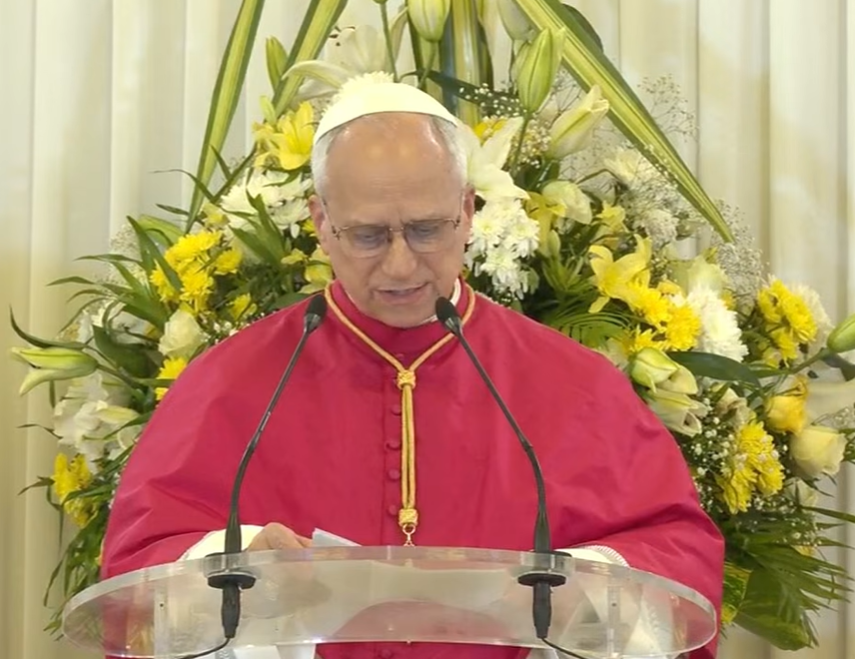
Yaoundé (AsiaNews) – Pope Leo XIV arrived this afternoon in Cameroon from Algiers, the second leg of his apostolic journey to Africa. In his first address, he said that peace needs young people, women, and the trust of civil society, through whom we can respond to the hunger and thirst for justice that pervades the world today.
Speaking to Cameroonian authorities at the presidential palace in Yaoundé, he made a strong appeal to them to build peace by embracing the country's desire for "renewal”.
He began his address in Yaoundé by describing the country as “Africa in miniature” because of the variety and richness of its land, traditions, and languages. “This variety is not weakness but a treasure. It constitutes a promise of fraternity and a solid foundation for building lasting peace”.
This message is particularly relevant at present for “We are living, in fact, at a time when hopelessness is rampant and a sense of powerlessness tends to paralyze the renewal so deeply desired by peoples.”
“There is such a hunger and thirst for justice! A thirst for getting involved, for a vision, for courageous choices and for peace! It is my great desire to reach the hearts of all, especially young people, who are called to help shape a world that is more just, including in the political sphere.”
Such remarks are extremely important in Cameroon, a country where political power has remained firmly in the hands of President Paul Biya, 92, who took power since 1982 and was re-elected last year in a highly controversial election.
Speaking before the president and government officials, Leo XIV mentioned the previous visits to Cameroon by Saint John Paul II, who brought a “message of hope for all the peoples of Africa,” and by Benedict XVI, who “emphasized the importance of reconciliation, justice and peace, as well as the moral responsibility of those in government.”
Addressing Cameroonians, he asked, “where are we now? How has the Word that was proclaimed to us borne fruit? And what remains to be done?”
The day after the visit to Annaba, the Augustinian Pope once again quoted his great master who, 1,600 years ago, in De Civitate Dei, said that, “Those who rule serve those whom they seem to command. [. . .] From this perspective, serving one’s country means dedicating oneself, with a clear mind and an upright conscience, to the common good of all people in the nation,” including “the majority of the population and the minorities, as well as their mutual harmony”.
Speaking about the wounds that currently burden Cameroon, he went on to say that, “The tensions and violence that have afflicted certain regions of the Northwest, Southwest and Far North have caused profound suffering: lives have been lost, families displaced, children deprived of schooling and young people no longer see a future.”
Regarding forgotten wars, he called for unarmed and disarming peace. “Peace,” he explained, “cannot be decreed: it must be embraced and lived. It is a gift from God, which unfolds through patient and collective effort.”
Civil authorities, he added, must understand that to “govern means to love one’s own country as well as neighboring countries.” In fact, the commandment “‘love your neighbor as yourself’ is equally applicable to international relations!” To govern “means truly listening to citizens, valuing their intelligence and their ability to help build lasting solutions to problems.”
Leo also described civil society as “vital force for national cohesion. Cameroon is ready for this transition!” he noted, citing the tasks that fall on associations, women's and youth organisations, trade unions, humanitarian NGOs, traditional and religious leaders, “weaving the fabric of social peace.”
The pontiff stressed especially “the role played by women,” who “are often, unfortunately, the first victims of prejudice and violence, yet they are tireless peacemakers.”
Likewise, the voices of civil society, the pope noted speaking to the elderly leader sitting next to him “must be fully recognized in decision-making processes. In the face of such generous dedication within society, transparency in the management of public resources and respect for the rule of law are essential to restoring trust.”
“It is time to examine our conscience and take a bold leap forward,” Leo said. “Just and credible institutions become pillars of stability. Public authorities are called to serve as bridges, never as sources of division, even when insecurity seems prevalent.”
“Security is a priority, but it must always be exercised with respect for human rights, combining rigor and magnanimity, with particular attention to the most vulnerable. Authentic peace arises when everyone feels protected, heard and respected, when the law serves as a secure safeguard against the whims of the rich and powerful.”
“[T]he chains of corruption – which disfigure authority and strip it of its credibility” must be broken, while “Hearts must be set free from an idolatrous thirst for profit”, which make integral human development all but impossible.
“Cameroon possesses the human, cultural and spiritual resources necessary to overcome trials and conflicts and move toward a future of stability and shared prosperity,” he said. “The common effort in favor of dialogue, justice and integral development must transform the wounds of the past into sources of renewal.”
In front of the 92-year-old president, Leo XIV pointed out the young people who “represent the hope of the country and of the Church”, noting that, “when unemployment and social exclusion persist, frustration can lead to violence.”
Investing in education and entrepreneurship becomes “the only way to curb the outflow of wonderful talent to other parts of the world. It is also the only way to combat the scourges of drugs, prostitution and apathy, which are devastating too many young lives in an increasingly dramatic way.”
“[Y]oung people in Cameroon possess a deep spirituality that still resists the homogenizing influence of the market,” he explained, noting that “religious traditions inspire prophets of peace, justice, forgiveness and solidarity. By fostering interreligious dialogue and involving religious leaders in initiatives of mediation and reconciliation, politics and diplomacy can draw upon moral forces capable of easing tensions, preventing extremism and promoting a culture of mutual esteem and respect.”
In this spirit, “the Catholic Church in Cameroon desires to continue serving all citizens without distinction.”
Before arriving in the central African country, Pope Leo's day began in morning in Algiers with a private Mass celebrated at the Apostolic Nunciature.
On his way to the airport, he made a stop not included in the official program, at the Notre Dame d'Afrique orphanage, run by the Missionaries of Charity, the nuns of Mother Teresa of Calcutta.
The children put on a short show for the pontiff, who greeted them and the nuns at the end. He then travelled to Algiers’s Houari Boumédiéne International Airport where he met again with Algerian President Abdelmadjid Tebboune for the farewell ceremony.
During the nearly five-hour flight that took him to Yaoundé, Leo XIV spoke briefly to journalists, defining his two days in Algeria, as a “special blessing”, as well as a “wonderful opportunity to continue building bridges and promoting dialogue.”
The pope expressed gratitude to Algerian authorities and the “very small but very significant” local Church.
Finally, speaking about his visit to the Great Mosque he said that this moment showed that “although we have different beliefs, different ways of worshiping, and different ways of living, we can live together in peace.”
“I think that to promote this kind of image is something the world needs to hear today,” he said.

.png)
17/04/2026 16:01
14/04/2026 20:48
13/04/2026 19:34










