

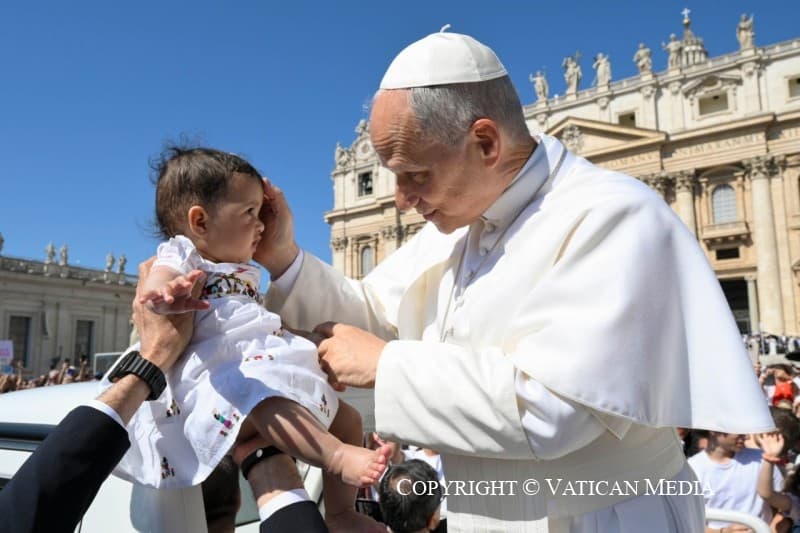
Vatican City (AsiaNews) - “War does not solve problems but exacerbates them. It does not build security but multiplies suffering and hatred”. This is the appeal that Pope Leo XIV reiterated again this morning, at the end of the Wednesday general audience in St Peter’s Square, prompted by the grave concern aroused by the renewed outbreak of conflict in Ukraine.
After a Ukrainian drone attack in recent days on a student dormitory in Starobilsk, in the occupied Luhansk region, in Donbass, had caused 21 deaths and 44 injuries in what the Ukrainian army described as a military target, Moscow responded during the night of Saturday 23rd to Sunday 24th by launching one of the largest attacks on the Ukrainian capital since the start of the war, using 600 drones and 90 missiles.
“I wish to express my closeness,” commented the Pope, “to all those suffering as a result of the recent attacks, including those against civilians. Where missiles and drones fall, hopes are shattered, homes and places of worship are destroyed, and innocent lives are cut short. I entrust all peoples wounded by war to the protection of the Virgin Mary, Queen of Peace.”.
Earlier – in his weekly catechesis dedicated to the documents of Vatican II, continuing his reflection on the constitution on the liturgy, Sacrosanctum Concilium – Pope Leo XIV addressed the specific theme of the liturgical reform promoted by the Council, a subject of much discussion within the Church over the past decades. The Pope recalled how, at that time, “there was a strong sense of the need for a renewal of the ritual forms through which, for centuries, the Church had glorified God and sanctified the Christian people. Thanks to the Liturgical Movement, the conviction had matured – later expressed by Saint John Paul II – that ‘there is a very close and organic link between the renewal of the liturgy and the renewal of the whole life of the Church’”.
Echoing the words of Benedict XVI on the mistaken opposition between tradition and reform, for Leo XIV, Sacrosanctum Concilium clearly distinguished within the liturgy between “an unchangeable part, because of its divine institution”, and the “parts open to change, which over time may or even must vary, should elements less in keeping with the inner nature of the liturgy itself have crept in, or should they have become less appropriate”.
Such changes have always taken place in the history of the Church. “The Church’s worship,” observes the Pontiff, “has been ‘incarnated’ in the cultural forms of each age and has been able to influence them and even transform them. The liturgy has thus been, for centuries, a driving force of evangelisation. Today we need to renew this energy in continuity with the authentic and living Catholic tradition, that is, according to a dynamic aimed at introducing the faithful to the fullness of the truth”.
At the same time, however, for the good of the whole Church, Sacrosanctum Concilium calls for every liturgical reform to be preceded “by careful theological, historical and pastoral research”. The Council – therefore – “calls for the avoidance of confusion among the faithful, dissuading anyone from adding, removing or altering anything in liturgical matters on their own initiative”. For “the progress envisaged by the conciliar Constitution in no way compromises ecclesial communion: rather, it seeks to confirm and foster it”.
“I therefore urge all those called to prepare the celebration of the divine mysteries, in particular priests who exercise the ministry of liturgical presidency,” the Pope concluded, “to always uphold that respect for the texts and regulations of the liturgy which springs from an inner attitude of openness and trust in God, showing humility before His greatness and sincere fidelity to ecclesial communion.”













