








No fuel for Myanmar civilians, but enough for the air force to kill 17 at a monastery
Myanmar’s military junta has introduced new restrictions on fuel, including petrol, while its planes hit a facility housing more than a hundred internally displaced people in Sagaing. Activists have documented how millions of litres of fuel are being diverted to the air force, despite the fuel shortages paralysing the country.
Yangon (AsiaNews) – In Myanmar, the military junta has imposed new restrictions on fuel for civilian use due to the war in the Middle East, but has continued unabated its bombing campaign against civilian targets, reserving the little fuel available to its own planes.
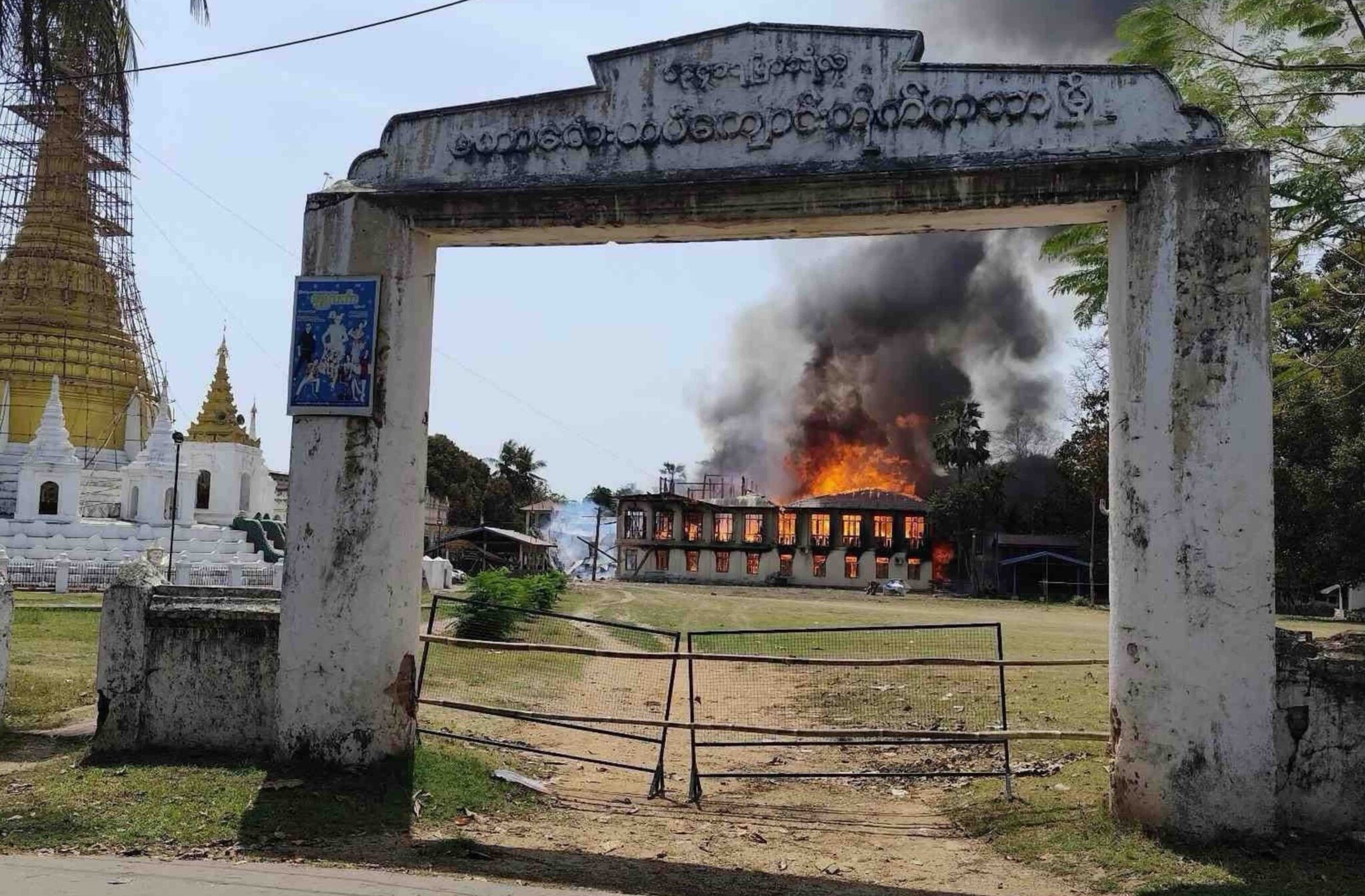
At least 17 civilians were killed on 20 March in an airstrike on a Buddhist monastery in Katha, a township in the northern region of Sagaing. More than a hundred internally displaced people were housed at the site.
According to local sources, the victims included monks who had opened the monastery as a shelter, while approximately 20 people were seriously injured. At the time of the raid, residents and sources linked to resistance groups reported that no fighting was taking place in the area.
The displaced people staying at the monastery were families who had left their villages in December last year due to increasingly violent clashes between the military regime, led by General Min Aung Hlaing, and local armed resistance groups.
Immediately after the attack, the authorities cut off telephone communications and suspended Internet connections to delay the dissemination of information.
Also last week, air force planes struck schools, villages, and other civilian buildings in Kani, Ayadaw, and Myaung, all townships in Sagaing, one of the strongholds of the armed groups fighting Myanmar’s regular army.
Meanwhile, aid organisations have reported a severe shortage of medicines, anaesthetics, and surgical supplies, a situation exacerbated by transportation difficulties caused by the energy crisis affecting the country because of the war the United States and Israel launched against Iran.
Long lines of people could be seen in front of petrol stations trying to get a few litres of petrol, resulting in the stations closing just hours after receiving the fuel.
In Yangon, premium diesel prices jumped in one day from 3,560 (US$ 1.70) to 4,820 kyat (US.30) per litre. On the black market, the price of 92-octane petrol hit 7,000 (US.35) to 10,000 kyat (US$ 4.75) per litre.
The regime, claiming to have national reserves for 50 days, has introduced new restrictions, limiting motorists to a maximum of two fill-ups per week. In the coming weeks, the new step, announced by the Ministry of Information, will replace the "odd-even" rationing system introduced earlier this month.
The workweek for public employees has also been reduced to four days, while the authorities urged the private sector to do the same.
Despite fuel shortages, military operations do not appear to have been affected. In fact, while civilians cannot even fill a motorcycle tank, the regime has enough fuel for its planes to bomb a monastery that houses women and children, as local sources noted.
According to the Blood Money Campaign activist group, in the last three months alone, the air force has consumed over 1.94 million gallons of fuel, or 8.8 million litres, at a cost of over US$ 4.16 million.
The figure emerges from an assessment based on the average hourly consumption of the main aircraft in service with the Myanmar air force, whose fleet includes Russian, Chinese, Pakistani, and Serbian-made aircraft, including Su-30SME, MiG-29, and Yak-130 fighters.
According to the report, the Su-30SME is the most "expensive" in terms of fuel consumption, at about 1,500 gallons per hour, followed by the MiG-29 at 900. Other aircraft such as the JF-17 and the F-7M consumes approximately 600 gallons per hour.
In cost terms, this represents an expense of approximately US$ 500 to US$ 3,500 per flight hour, depending on the type of aircraft.
These estimates are based on an average fuel price of approximately US$ 2.15 per gallon prior to the current international crisis, the assessment notes, and do not include other operating costs such as weapons, maintenance, and logistics.
In other words, while millions of Myanmar citizens face power cuts, price increases, and travel restrictions, the air force remains fully operational, using significant amounts of fuel to support raids against areas controlled by resistance groups.

.png)
28/03/2025 15:48
28/07/2023 18:15
30/07/2025 14:56










