Washington (AsiaNews) – Tariffs, semiconductors, tensions over the island of Taiwan: the confrontation between Washington and Beijing has erased the importance China had in the formation of the United States from collective memory.
Few know that, when the Founding Fathers of the United States signed the Declaration of Independence on 4 July, 250 years ago, its ideas were also inspired by Confucian philosophy, filtered through the European Enlightenment, and brought to the shores of the New World via journals and diplomatic correspondence.
Franklin and Confucius
According to a now surprisingly perceptive essay by historian Dave Wang (published in 2011 in the academic journal Education About Asia), which looked at the cultural debt the Founding Fathers owed to imperial China, Benjamin Franklin was the main source of this influence. After reading The Morals of Confucius during a stay in London between 1724 and 1726, he was so impressed that he published excerpts in his Pennsylvania Gazette in 1737, spreading the Chinese philosopher's ideas among American colonists.
The Confucian vision of moral perfection, from the individual and the family to the state and the empire, found in Franklin a staunch advocate. In his celebrated Poor Richard's Almanack, the virtues of hard work, frugality, and family that Franklin recommended to his readers reflected Confucian ethics.
Franklin also applied these principles to politics. When, after the victory in the War of Independence, some veterans proposed the creation of a hereditary order of knights, Franklin opposed it, citing the Chinese example.
In China, he explained, honour does not descend to the children but ascends to the parents of those who distinguish themselves by virtue, encouraging families to educate their children for the common good.
He wrote: “Thus among the Chinese, the most ancient, and, from long Experience, the wisest of Nations, Honour does not descend but ascends.” European hereditary nobility, by contrast, breeds pride, waste, and poverty.
Thomas Jefferson shared this vision.
Historian Martin Powers, professor emeritus at the University of Michigan, has shown that both Jefferson and Franklin drew inspiration from Chinese systems of government, particularly the concept of a state founded on merit.
Jefferson spoke of a “natural aristocracy”, an elite defined by virtue, education, and talent, opposed to an "artificial aristocracy" anchored to birth and inherited wealth. It was, essentially, the model of the Chinese Mandarin translated into republican terms.
From the start, the United States also favoured trade with China. The first American merchant ship to set sail after independence, the Empress of China, departed New York on 22 February 1784, and headed for Canton.
Jefferson, as Secretary of State in Washington, sought a shorter route to East Asia; during his mandate as president, the number of American ships trading with Canton increased from two in 1785 to forty-two in 1806.
By 1795, just eleven years after the first voyage of the Empress of China, the United States had already surpassed all European rivals, except Great Britain, in the volume of trade with China.
The silent statue
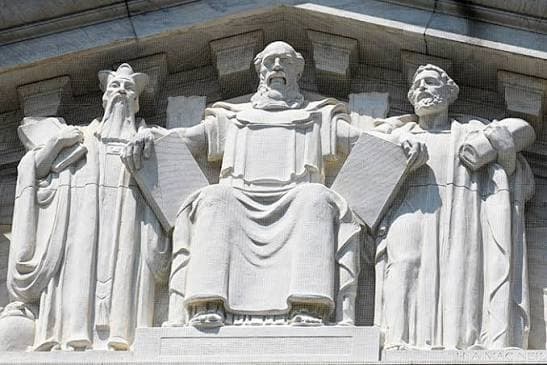
Even today, anyone who climbs the steps of the east entrance of the United States Supreme Court can see the sculpted figure of Confucius along with Moses and the Greek lawgiver Solon.
Sculptor Hermon MacNeil added it in the 1930s at the request of architect Cass Gilbert. MacNeil wanted to represent the idea that true justice must prioritise collective civic virtue and social harmony, not just individual rights.
That statue now stands directly above the window of the Chief Justice's office. It was forgotten for a long time, until President Donald Trump mentioned it during his visit to Beijing, which made headlines last month.
“Founding Father Benjamin Franklin published the sayings of Confucius in his colonial newspaper,” the US leader said, “and today’s sculpture, recognizing that ancient Chinese age, is carved into the face of the United States Supreme Court very proudly.”
According to Chow Chung-yan, editor-in-chief of the South China Morning Post, this is the first time an American president has openly acknowledged this intellectual debt.
The mandate of heaven and the pursuit of happiness
The most fascinating parallel, however, concerns the most famous words in the Declaration of Independence, the right to the "pursuit of happiness”, traditionally attributed to John Locke or Epicurus. Yet, it strikingly reflects the Confucian and Mencian doctrine of the Mandate of Heaven.
Mencius argued that the legitimacy of any government rests on a single criterion: its ability to ensure the well-being and contentment of the people. In his view, if a ruler fails in this task and oppresses his people, he loses the Mandate of Heaven, conferring on the people the right, indeed, the moral duty, to overthrow him.
Jefferson wrote that when a government becomes destructive to the safety and happiness of the people, “it is their right, it is their duty, to throw off such Government”.
The Enlightenment and the great repression
For Chow Chung-yan, the Founding Fathers were children of the European Enlightenment, and the European Enlightenment was, in the 17th and 18th centuries, deeply enamoured with China.
Philosophers seeking to reform societies ravaged by religious wars, monarchical corruption, and clerical dogmatism looked to the East as a model of rational, secular civilisation.
Jesuit missionaries' reports flooded Europe with information about imperial China, and Enlightenment thinkers transformed them into arguments against the Ancien Régime.
Voltaire was so fascinated by Confucianism that he considered it the purest form of deism, a belief in a rational creator grounded in human ethics rather than divine revelation. His writing desk was adorned with Chinese landscapes.
François Quesnay, founder of the French Physiocrats and mentor to Adam Smith, was so obsessed with Chinese government that he was nicknamed the “Confucius of Europe”. It was by drawing on the Taoist concept of wuwei – acting without force – that Quesnay developed the economic doctrine of laissez-faire.
According to Wang, however, Washington and Jefferson wanted to build an America that would distinguish itself from Europe, drawing on different sources, and China, for several decades, was one of those sources.
Then, with the Industrial Revolution, something changed. Western military and technological superiority produced a new generation of thinkers who wrote a new vision of history.
China, until then presented as a model civilisation, was abruptly seen as an “Oriental despotism”, stagnant and immobile, especially by Hegel.
The narrative shift was rapid and systematic, and from the First Opium War in 1839 onward, the West assumed the posture of a stern master attempting to reform China through trade, diplomacy, or military force. The rest is history.