








On Gran Canaria, pope tells migrants that they are people, ‘not just numbers of files’
In the port of Arguineguín, Leo XIV mentioned ‘the fragility of a boat", carrying people “stripped of almost everything, but never of their dignity.” Speaking to women victims of trafficking and exploitation, he said: “Your life belongs to God”. Slamming the “monsters” of the sea, mafias, traffickers and indifference, he stressed that in the Church, “Welcoming migrants cannot be a secondary matter”.
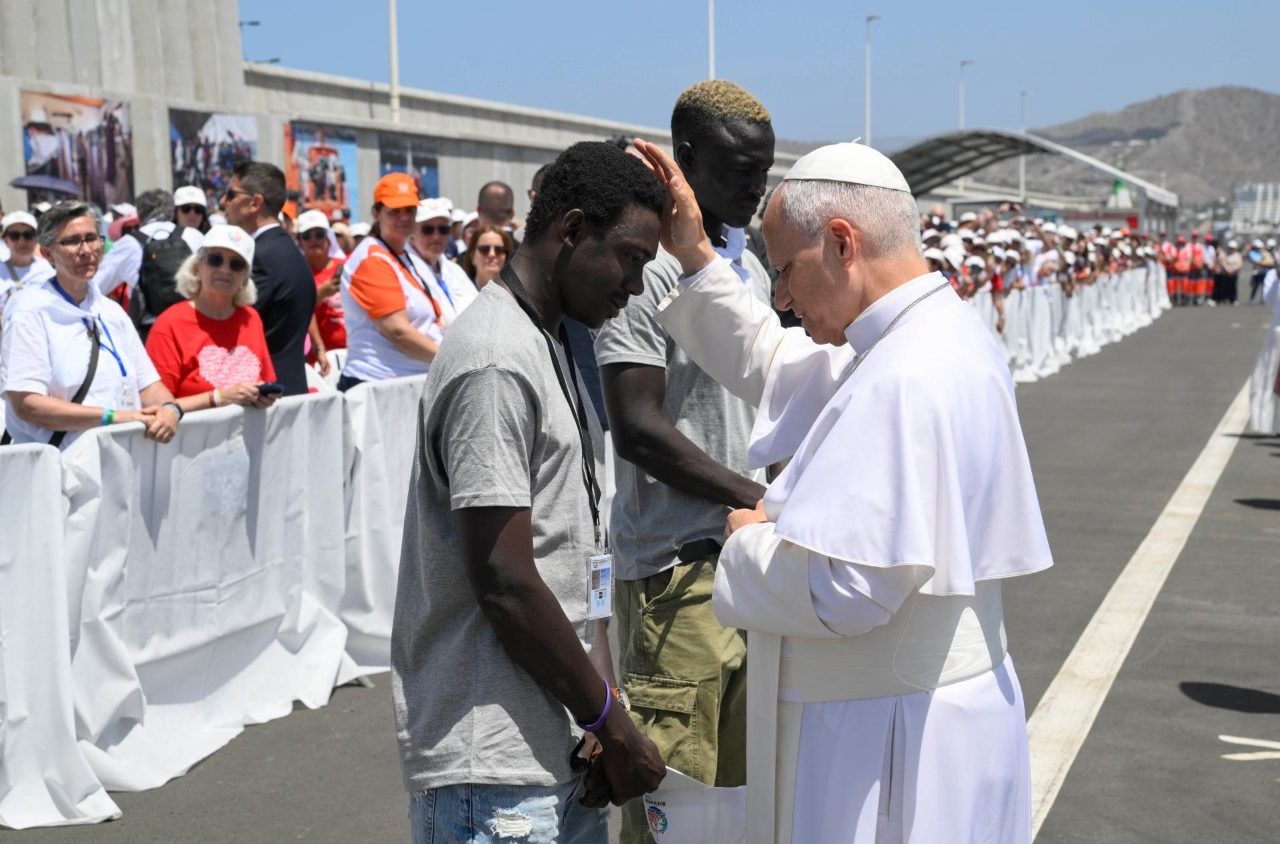
Las Palmas de Gran Canaria (AsiaNews) – Pope Leo XVI continued his apostolic visit to Spain today, travelling to the port of Arguineguín, on the island of Gran Canaria, part of the Canary Islands, off the coast of Morocco, a land migrants long for after clinging for life on the "fragility of a boat.”
“I say to you, what you did not do for one of these least ones, you did not do for me’,” reads one of the "most challenging" passages from the Evangelist Matthew (Mt 25:41-45) that Pope Leo XIV commented on. “Today, by the sea, the word of God becomes concrete: here so many wounded lives arrive, stripped of almost everything, but never of their dignity.”
The pontiff met with those who welcome migrants in the Canary Islands, a place known throughout the world as a privileged tourist destination, boasting unparalleled natural beauty, but also a place of refuge for thousands of people, who try their luck, lashed by the misfortune of being born amid instability and violence, sailing along what is known as the Atlantic Route.
Leo XIV, who was in Barcelona yesterday, was welcomed by approximately 2,000 people, including Prime Minister Pedro Sanchéz, Bishop José Mazuelos Pérez of the Canary Islands, Caritas Canary Islands director Father Gonzalo Marrero Rodríguez, and the delegate for the pastoral care of migrants, Father Víctor Domínguez González.
“Here,” Leo said, “the Gospel pulls us out of our comfortable position as spectators,” and “asks us if we have recognized Christ in those who disembark, marked by fear, hunger and violence, after enduring the desert, the night and the sea.”
Before the blood-streaked sea, Jesus’s command, “From now on you will be catching people” (Lk 5:10)”, [. . .] is especially powerful and painful.”
The pontiff explained that this mandate is visible and tangible in the fisherman's ring he wears on his finger. He received it from Cardinal Luis Antonio Tagle over a year ago, on 18 May 2025, at the Mass marking the beginning of his Petrine Ministry.
“For this reason, the Successor of Peter cannot ignore these docks. The Church cannot ignore these waters or any place where hunger, thirst, violence, fear or exile continue to wound human dignity. Jesus’ disciples cannot dismiss the cries of those who call out in the night.”
Speaking against the “monsters” that sail the waters, a possible place of darkness and chaos, he slammed the “mafias that profit from despair, traffickers who enslave women and children, and those whose indifference allows the poor to be swallowed up by exploitation or forgetfulness”.
In the face of all this, faith has the power not to remain "paralyzed”, Leo noted, for the voice of God commands the sea to be calm and is capable of opening paths through it (cf. Exodus 14:21-31), something that “continues to resonate against the forces that devour, enslave, and discard so many of our brothers and sisters”. Indeed, “If Christ commands the sea to be still, the Church cannot remain silent about those who are abandoned to its waters.”
As he did yesterday, at the Brians 1 penitentiary centre near Barcelona, the pope today also listened to people and their stories, in particular, those who personally experienced expatriation, often handed over to the arbitrary will of fate, as well as those who welcome and save lives.
Leo thanked them for sharing, mentioning them by name: Tito and María. The former is a sea rescue (Salvamento Marítimo) captain on the Guardamar Urania, carrying out his mission for 18 years. The latter is a volunteer with the diocesan Caritas.
“Your words,” the pontiff said, “show us how the conversion of our gaze begins when the migrant ceases to be ‘just one more,’ a mere category or a statistic. [. . .] Mercy begins with small gestures, such as sharing a few cookies and a little milk, or offering five loaves and two fish”.
The pope also mentioned another witness, Blessing, whose story, he conveyed through a letter, one filled with hope, but also pain. Having left home when she was 22 to provide a future for her daughters, aged 4 and 2, her life soon ended up in the hands of organised crime, subjected to violence and abuse.
For Leo, “every human life is a blessing from God. No one can buy, sell, use or discard it, because the image and likeness of the Creator shines forth in every person”.
Speaking about women victims of trafficking and exploitation, he said that, “If others have put a price on your body, know that God has never ceased to recognize your inestimable worth.”
Above all, “Your life does not belong to those who harmed you; your body does not belong to those who took advantage of you; your days do not belong to those who wanted to chain you to fear. Your life belongs to God, who has given you a dignity that cannot be taken from you.”
The pontiff also spoke about migrants. “I want to bow before your dignity. You are not just numbers or files. You are people who have left behind families and homes. You have dreams that no one has the right to despise.”
“[Y]our lives must be protected. Do not surrender your lives to those who trade with them. Do not believe those who promise easy paradises in exchange for your body, money, silence or freedom.”
But it is not enough to be aware of their dignity. Their condition must translate into “an appeal to the conscience”.
The “nations of origin of the migrants [. . .] must establish conditions for peace, justice and development. It is also an appeal to the conscience of the transit nations, which are called to protect the vulnerable and not leave them in the hands of criminal networks. It is likewise an appeal to the conscience of Europe, which cannot claim to uphold human dignity while growing accustomed to the Mediterranean and the Atlantic becoming unmarked graves, as well as that of the international community, which is called to effective and persevering cooperation.”
This is also true for the Church. “Welcoming migrants cannot be a secondary matter that is left to a few volunteers. We kneel before the altar to adore Christ present in the Eucharist, from whom we receive the strength and the motivation to live charity; for this reason, we cannot then ‘pass by’ the small boats and rafts”
Leo stressed the importance of "legal and safe pathways,” and the right “not to have to migrate”, asking a fundamental question, for humanity: “Every boat that arrives brings a question along with the migrants: what kind of world have we built, if so many brothers and sisters must risk death to seek life?”
At the end of the visit to the port of Arguineguín, the pope went to the shrine of the Virgin of Mount Carmel to bless a cross made from the wood of a boat. He also presented a floral tribute in memory of migrants, victims of the sea.
After greeting several volunteers, men and women, as well as migrants, Leo travelled by car and then by popemobile to the Cathedral of Saint Anne, for a meeting with clergy, nuns, and pastoral workers.
In the evening, he led Mass at Gran Canaria Stadium. Tomorrow, the last day of the apostolic visit, the pope will travel to Tenerife.

.png)
11/08/2017 20:05
31/03/2019 19:00










