








One hundred years of PIME and the Lucca Missionaries in Japan in the 20th century
On the occasion of the centenary of the unification by Pope Pius XI of two different Italian institutes into PIME in 1926, the Archdiocese of Lucca commemorated two of its great missionaries, Father Allegrino Allegrini and Father Fedele Giannini, who carried out their ministry in the Land of the Rising Sun. For Cardinal Tagle, their story shows that God leads the mission, even through unexpected paths.
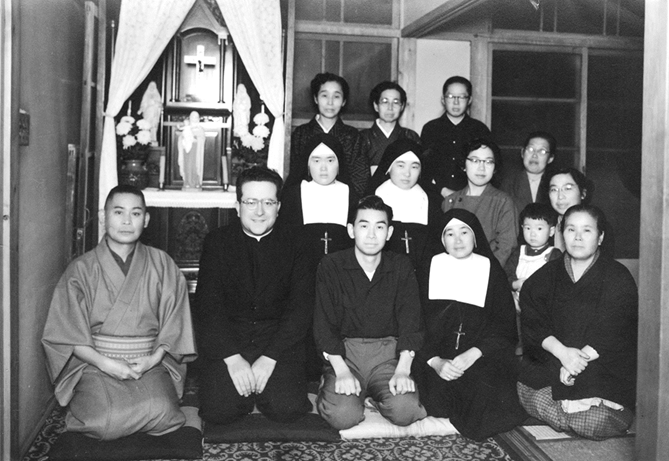
Lucca (AsiaNews) – With the promulgation of the motu proprio Cum missionalium opera, Pius XI officially established the Pontifical Institute for Foreign Missions (PIME) on 23 May 1926 through the union of the Lombard Seminary for Foreign Missions and the Pontifical Seminary of Sts Peter and Paul for Foreign Missions. This year, the Archdiocese of Lucca, which is in Tuscany (Italy), a place from which so many missionaries departed, also celebrates the 300th anniversary of its foundation.
This dual anniversary provided the opportunity to organise an international conference, which the Tuscan Archdiocese, together with PIME, hosted today. The conference specifically commemorated two PIME missionaries – Father Allegrino Allegrini (1926-2006) and Father Fedele Giannini (1927-2002), both of whom were active in their apostolate in Japan for many years.
Titled One Hundred Years of PIME and Missionaries from Lucca in Japan in the 20th Century, the conference brought together missionaries, historians, scholars, and representatives of other religions from Japan to discuss the legacy of these two important figures and, above all, the significance of the presence of this small Christian community in the Japanese context.
A message from Cardinal Luis Antonio Tagle, Pro-Prefect of the Dicastery for Evangelisation, along with Archbishop Fortunatus Nwachukwu, Secretary of the Section of First Evangelisation of the Dicastery, to this important gathering underscored the special significance of this missionary testimony.
Cardinal Tagle noted that the first PIME missionaries arrived in Yokohama from China, where they had been expelled. In this context, the youthful Frs Allegrini and Giannini arrived in Japan as their first destination in 1950 and 1954, respectively.
“The PIME missionaries were sent to China, full of zeal to preach the Gospel in that land," the cardinal writes. “However, God guided them to the port of Yokohama, in the Land of the Rising Sun. They did not land there by chance, but were sent by God.
"The history of the PIME mission in Japan clearly demonstrates that the mission is not accomplished by human efforts, but is, first and foremost, an initiative of God. However, this invitation from God always requires our response. And the missionary disciple, who responds to God's call, in turn becomes an invitation to others, a true witness."
The two clergymen “were sent to the rural areas in Saga and the mountain valleys of Yamanashi Prefecture, which at the time were among the poorest and most backward areas of Japan," reads the message from the pro-prefect of the Dicastery for Evangelisation. “Lodging in dilapidated structures rattled by the wind and rain, they had to endure hunger just like the local population. They had to learn the Japanese language on their own.
Yet, “Despite these circumstances, in just ten years they managed to build seven churches in towns in Saga Prefecture and four in Yamanashi. They also built kindergartens and orphanages alongside the churches, providing great comfort to Japanese children and young mothers in a country still devastated in the postwar period.
“This reminds us of the words with which our Lord sent His disciples: ‘He instructed them to take nothing for the journey but a walking stick—no food, no sack, no money in their belts. They were, however, to wear sandals but not a second tunic.’”
Tagle goes on to mention the special contributions by Frs Allegrini and Giannini. “Father Allegrino studied the Japanese language and Chinese characters in depth, conducting comparative research of classical Japanese and Western literature. This paved the way for an intellectual dialogue that explored how the Christian faith, expressed through Western philosophy and cultural heritage, could be welcomed and translated into East Asia.
“Father Fedele Giannini's love for Japan is well known. He deeply loved Japan and its people. Touched by the story of the ‘Kakure Kirishitan’, the hidden Christians who kept their faith in secret for over two centuries during the persecutions that began in the 17th century in Japan, he devoted his energies to making it known.”
The pro-prefect and the secretary of the Dicastery for Evangelisation finally mentioned the contributions that the PIME missionaries made in the following decades in Japan, which continue to this day.
“They spread a message of peace in a country ravaged by war, actively participating in disarmament and the peace and anti-nuclear movements. They met with leaders of Japan's traditional religions to build an alliance for peace, placing themselves at the forefront of interreligious dialogue.
“Today, they run soup kitchens to address the problem of child poverty hidden behind the façade of a prosperous Japanese society, and they offer a community to isolated and marginalised senior citizens to prevent them from dying alone. Pope Francis's appointment in 2023 of Mgr Andrea Lembo, a PIME member, as auxiliary bishop of Tokyo can also be considered the fruit of the tireless and dedicated work of PIME missionaries.”
The conference held today is part of the Thesaurum Fidei. Missionary Martyrs and Hidden Christians in Japan, which the Archdiocese of Lucca has been promoting since 2022, the year in which the latter commemorated the 400th anniversary of the martyrdom of one of its missionaries in Japan, Blessed Angelo Orsucci, a Dominican friar, killed in Nagasaki on 10 September 1622.
Coordinated by Archbishop Paolo Giulietti and Professor Olimpia Niglio, of the University of Pavia, Thesaurum Fidei has undertaken numerous important initiatives in recent years to rediscover the legacy of the hidden Christians, in cooperation with leading Japanese scholars and academic institutions.
One of the highlights that is worth mentioning is an international symposium held in Osaka as part of Expo 2025, with the aim of exposing the international community to the themes of the cultural encounter between Japan and Europe from the 16th century to the present.
Following the conference, the Thesaurum Fidei programme will dedicate two more events to PIME missionaries in Japan in the coming months.
From October 2026 to January 2027, the PIME’s Museum of Peoples and Cultures (Museo Popoli e Culture) in Milan will host the exhibition One Hundred Years of PIME and Missionaries from Lucca in Japan in the 20th Century, curated by PIME's Cultural Heritage Office.
This exhibition will allow visitors not only to appreciate some important art collections from Japan, but also to explore documents and photographic repertories created by missionaries in the Far East.
From 28 December 2026 to 31 January 2027, the Church of San Cristoforo in Lucca will host an exhibition of archival documents and oriental art objects collected from families from the Brancoli community, where Father Allegrino Allegrini periodically spent his short holidays.
This exhibition, curated by Olimpia Niglio and Tommaso Maria Rossi, will open up further perspectives for study and insight into the Lucca missions in East Asia.

.png)
13/10/2022 17:01
20/11/2007










