








Pope: The liturgy unites our many faces in the same faith
At the general audience, Leo XIV urged the faithful to become witnesses of his love on the Solemnity of Corpus Christi. Traditional processions are a “courageous testimony of faith" and a reminder that God is among his people. The pontiff also called on the faithful to pray for the Middle East. In his catechesis on the “Sacrosanctum Concilium”, he said that, “the rite interrupts our frenetic activities, leading us back to what is essential.”
Vatican City (AsiaNews) – Pope Leo XIV dedicated today's catechesis during the Wednesday general audience in St. Peter's Square to rite, sign, and symbol.
After greeting thousands of faithful from the popemobile, he continued his reflections on the documents of the Second Vatican Council, focusing on the constitution Sacrosanctum Concilium.
“Through the sacred rite we are thus formed in listening to the Word of God, in giving thanks and in adoration, in fraternal sharing and in ecclesial communion. We discover that we are an assembly with many faces, united by the same faith,” he said.
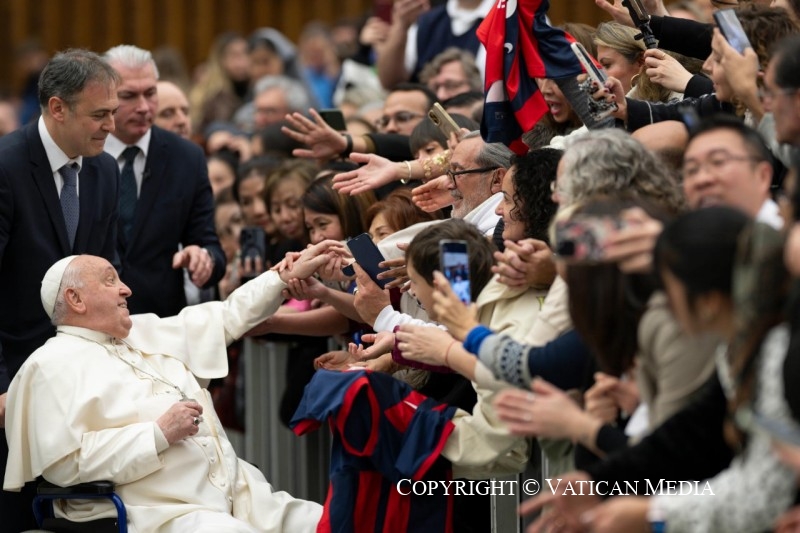
Indeed, many faces filled a festive and crowded St Peter's Square, whom Leo XIV addressed directly, as he usually does, at the end of the audience.
Among others, he greeted the participants in the conference on the revision of the Declaration of Taipei by the World Medical Association, which laid down the ethical principles for biobanks.
Meanwhile, as preparations get underway “for the Solemnity of the Most Holy Body and Blood of Christ, let us be strengthened by this divine gift and become witnesses of his love for all we meet. God bless you!” Leo said.
“Beginning with the Solemnity of Corpus Christi (tomorrow) and in the days that follow, you will pay special worship to Christ present in the Eucharist,” the pontiff said in his greetings to Polish pilgrims. The tradition of participating in Eucharistic processions is alive and well, "especially by families, children, and young people,”.
“Let it be a courageous witness of faith and remind everyone that God is present among his people and accompanies them in their daily lives. I bless you all!" the pope exclaimed.
Leo also greeted several religious groups present in St Peter's Square: the Daughters of the Sacred Heart of Jesus, members of the Montfortian Family, and the Sisters of Our Lady of the Cenacle, encouraging them "to be a sign of hope for those who thirst for God, for his truth, and for his peace."
"I wish to offer a special word to the priests and religious of the Middle East," Leo added from the parvis. "I accompany your ministry and the expectations of your respective countries with my prayers and my blessing."
In his catechesis on the constitution Sacrosanctum Concilium, Leo focused on the “truth” highlighted by the Second Vatican Council.
“The rites of the Christian liturgy are not a mere external covering of the sacramental mystery, a collection of arbitrary ceremonies, but are the ecclesial mediation through which the divine gift reaches us,” he explained. For this reason, “The Council invites us to understand the Mysterium fidei which is realized in the liturgy through rites and prayers”.
“The rite gives shape to liturgical action and, through it, to our lives, generating a spiritual sensibility in us that makes us capable of savouring the presence of God through Jesus Christ,” the pope added.
“Naturally, this happens if we do not remain strangers or silent spectators with regard to the liturgy, but rather participate in it fully – body, mind and heart”.
In particular, the rite consists of a well-defined "sequence" of prayers and gestures, which can sometimes clash with "spontaneity”, but is not meant to “constrain freedom within rigid frameworks.”
“On the contrary, with the solemn simplicity of its rhythms, the rite interrupts our frenetic activities, leading us back to what is essential. We thus discover another dimension of action that is not guided by calculations of productivity, and another experience of time and space.”
For Leo, the logic that supports the rite is in fact a logic of giving freely.
Speaking about “sign” and “symbol,” words often used interchangeably, he noted that, “In reality, a sign is symbolic when it is able to refer not only to an idea, but to an entire system of meanings and values”.
The same goes for the sprinkling with holy water, which evokes the baptism.
“[A]ll, symbols have a unique performative and transformative dimension, both in relation to the material elements of which they are composed and to those who come into contact with them, engendering a sense of belonging, touching the heart and mind, and giving rise to authentic ecclesial relationships,” the pontiff explained.
“We need to allow ourselves to be educated by the rites of the liturgy, caring for the beauty of our celebrations with a delicate touch and without arbitrariness, and committing ourselves to an authentic mystagogy,” Leo said.
“The experience of a living and devout liturgy, accompanied by appropriate mystagogical catechesis, is the best resource for reawakening in everyone that openness to the encounter with God”.

.png)
20/05/2026 16:47










