








Prabowo government's difficulties worsen after former minister convicted
Former Education Minister Nadiem Makarim has been sentenced to ten years for corruption. Meanwhile, five people have died during military training imposed on new rural cooperative managers. The way the government is managing the economy is increasingly criticised, especially regarding the opaqueness surrounding the Danantara sovereign wealth fund, which is expanding its reach.
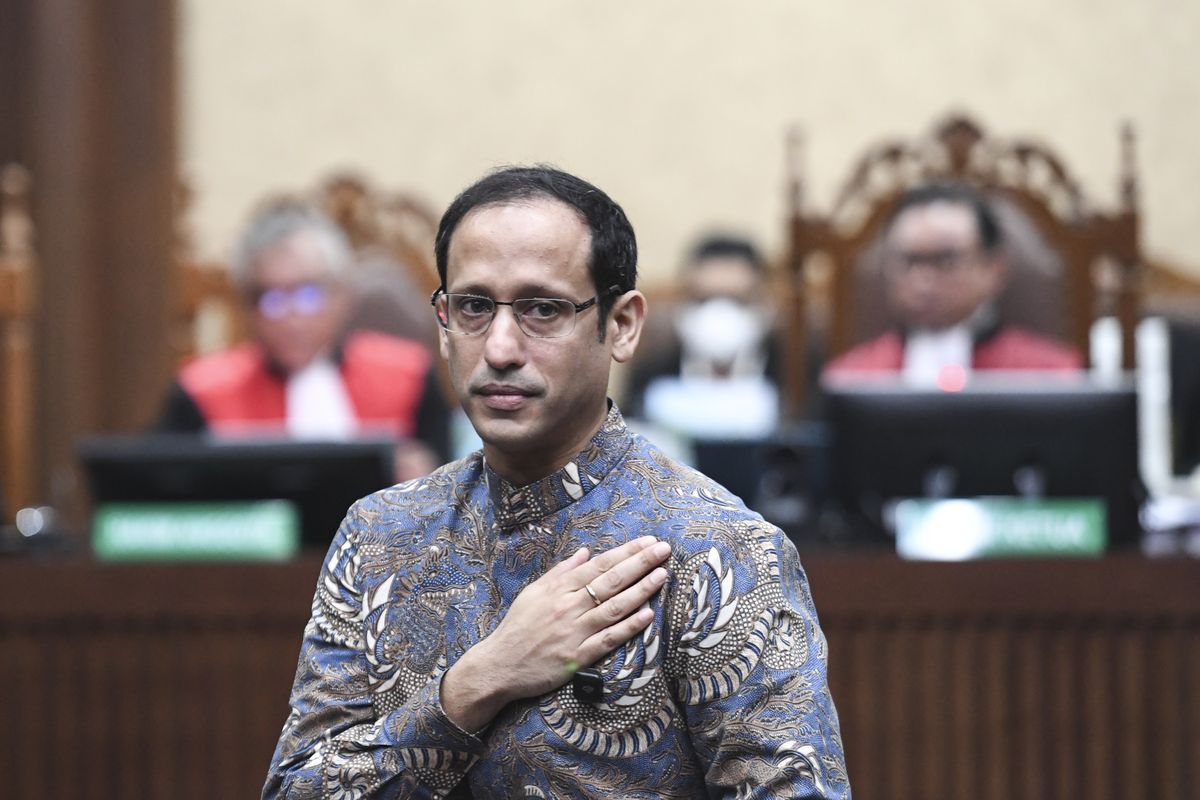
Jakarta (AsiaNews) – A ten-year prison sentence imposed on a former minister is further complicating the life of the Indonesian government, led by President Prabowo Subianto, already facing controversy resulting from recent economic reforms and protests over the military's growing involvement in civilian activities.
Former Education Minister Nadiem Makarim, one of Indonesia's most popular figures in recent years, was tried and convicted on corruption charges, which risks further fuelling the debate over government transparency.
The Jakarta Central Corruption Court found Makarim guilty in connection with the purchase of Chromebook laptops and Chrome Device Management licences during his tenure as Minister of Education, Culture, Research, and Technology.
In addition to the prison sentence, the judges also imposed a fine of one billion Indonesian rupiah (just under US$ 56,000) and ordered the restitution of 809 billion rupiah (US$ 45 million) to the state. If he fails to pay the full sum, his assets may be confiscated, and if they do not cover the fines, he will face an additional five years in prison.
The panel of judges concluded that the crime was committed "in a planned, structured, and systematic manner," causing losses to public coffers, and ran afoul of the government's commitment to fighting corruption.
The judges stressed that the defendant's solid financial situation ruled out any financial justification.
The decision, however, was not unanimous: one of the judges expressed a dissenting opinion, arguing that Makarim should have been acquitted.
The sentence is still significantly lower than that requested by the prosecution, which had asked for eighteen years in prison and restitution of some 5.6 trillion rupiah (US5 million).
The case has generated widespread interest in the country.
Makarim, 42, is not a traditional politician. The founder of Gojek, a digital platform that revolutionised the country's transportation and services sectors, he joined former President Joko Widodo's government with the aim of promoting technological innovation and modernising the education system.
His image as a successful entrepreneur, with a degree from Harvard University and already financially wealthy before entering politics, made it unthinkable for many Indonesians to believe that he was involved in corruption.
New economic reforms
The court decision comes as President Prabowo is still trying to implement a profound transformation of the state apparatus.
In recent days, he confirmed his intention to drastically reduce the number of state-owned enterprises, from the current number of over a thousand to about 250 within the next two years.
According to the government, more than half of state-controlled companies are operating at a loss, accumulating deficits of approximately 20 trillion rupiah. By eliminating duplication and inefficiencies, estimated savings of approximately 50 trillion rupiah per year could be made.
The Danantara sovereign wealth fund, charged with coordinating the reform, said that the plan will not lead to layoffs: all employees will be moved to new companies resulting from the merger of existing ones.
The government cited the creation of Bank Mandiri in 1998 from the merger of four state-owned banks after the Asian financial crisis as a model of success.
However, Danantara is taking on increasingly broad responsibilities but does not yet have proper oversight and transparency mechanisms.
It has failed so far to release financial statements, and several economists fear that the growing concentration of economic power in the hands of the state could lead the country back to Suharto's "New Order" era, when politics, the military, and business were closely intertwined, contributing to a crisis exacerbated by the 1997-98 Asian financial meltdown.
These reforms are part of Prabowo's broader economic strategy.
In recent months, the president also decided to centralise exports of coal, palm oil, and other raw materials through a state-owned company, a move that has generated uncertainty among investors and businesses.
Malaise over military interference
At the same time, the increasing use of the military in managing civilian initiatives is meeting with criticism.
The Indonesia’s National Commission on Human Rights and other organisations have called for the immediate suspension of mandatory military training for future leaders of the village cooperative programme, one of many projects promoted by Prabowo, which (like the free school lunch initiative) is proving largely unsuccessful.
Five participants died in the first ten days of the course. The Ministry of Defence attributed the deaths to various pre-existing conditions and announced a review of health procedures, while confirming that the programme will continue.
The human rights commission, however, argues that the training for cooperative leaders should focus on managerial, administrative, and financial skills, not military training.
The Civil Society Coalition for Security Sector Reform, a coalition of various humanitarian groups, has also denounced what it sees as the growing militarisation of public policies.

.png)










