








Radio Free Asia broadcasts again in Mandarin, Tibetan, and Uyghur
Long a thorn in Beijing's side, the broadcaster halted operations in October following cuts imposed by the Trump administration. CEO Bay Fang announced the news on social media, praising RFA's “critical work”. One of its first reports concerned labour exploitation of the children of prisoners in Xinjiang.
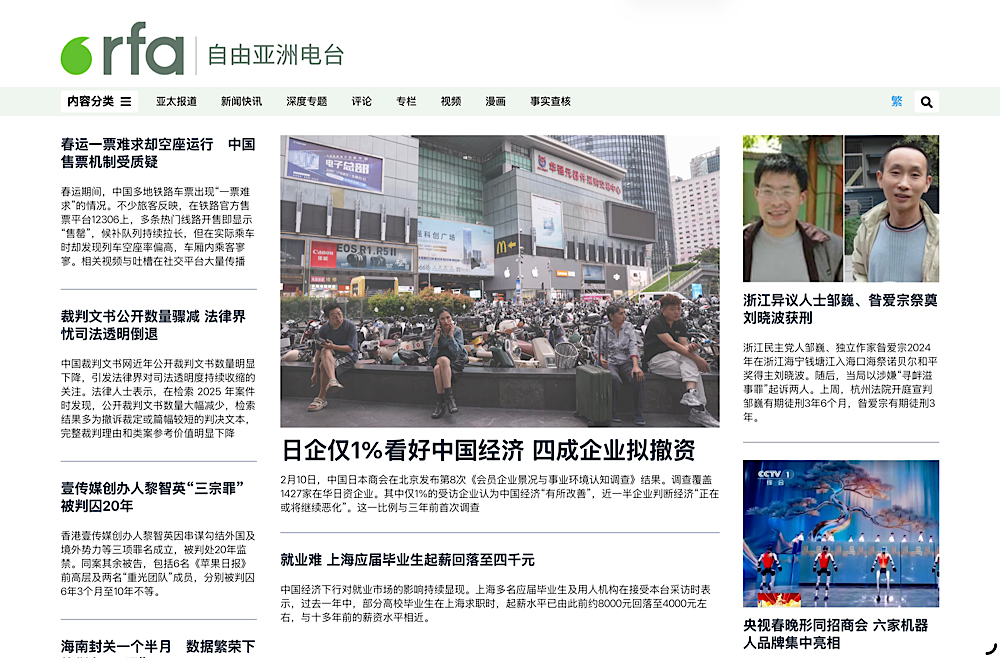
Beijing (AsiaNews) – Radio Free Asia (RFA) has recently resumed broadcasts in China after being off the air following US President Donald Trump's cuts, which had silenced one of the most authoritative voices denouncing Beijing's abuses and human rights violations.
Absent since October 2025, news and programmes in Mandarin, Tibetan, and Uyghur have given a new lease of life to an essential news organisation in a media landscape characterised by cuts and censorship.
On Wednesday, RFA President and CEO Bay Fang announced on LinkedIn that services had been restored, despite the government funding freeze imposed last year.
“This critical work, which we’ve been able to resume due to private contracting with transmission services, is already making waves,” Fang said. “RFA’s Uyghur service aired a report over the weekend about how children of detainees in Xinjiang are being forced into manual labour at a young age instead of going to school.”
The broadcaster’s work over the years had been crucial in exposing Beijing's abuses and violations against the Muslim minority in Xinjiang, including reports on internment camps, which uncovered a systematic pattern of abuses and violations despite China's denials.
Fang added that the Korean and Burmese services resumed broadcasting last December.
“RFA’s incredible journalists and technicians, as well as our legal and HR teams, have made this all possible. I cannot be more proud of everyone behind this effort to get back on our feet as we enter a critical phase for our organization’s present and future,” she said.
A spokesperson for the Chinese Embassy in Washington declined to comment on what he called a matter of US domestic policy, while accusing the outlet of harbouring an anti-Chinese bias.
“Radio Free Asia has long spread falsehoods and smeared China, and they have a poor record when it comes to reporting on China-related issues,” Chinese embassy spokesperson Liu Pengyu said. “We hope more media outlets in the U.S. can make objective and fair-minded reports on China and China-U.S. relations.”
China’s state media had praised last year's cuts. Long a thorn in Beijing's side regarding rights and freedoms, RFA halted all news production in October after Washington cut off its funding. By that time, it had already laid off or furloughed over 90 per cent of its staff.
Freezing nearly all public funding to independent media was one of the first controversial steps taken in early 2025 by the new administration, emblematic of Trump’s attitude towards rights and freedom of information.
The Cantonese-language service ceased operations last July after 27 years and is not among those that resumed broadcasting.
For years, RFA and its sister stations, including the Voice of America (VOA), have been funded with appropriations approved by the United States Congress and overseen by the United States Agency for Global Media (USAGM).
In 2025, Kari Lake, a former television host nominated by President Donald Trump as USAGM's interim CEO, suspended funding, alleging waste of public funds and bias against the new president.
The move, which led to mass layoffs, was criticised by many as a loss of US competitive advantage to China and other US rivals.

.png)
17/03/2025 14:33










