








Resilience and hope: Message from the Myanmar bishops' ad Limina visit
In Rome, the Bishops’ Conference met the Pope and the heads of the Roman Curia’s dicasteries in recent days for the event, which takes place every five years and involves dioceses from around the world. The presentation of new translations of liturgical texts into local languages and a review of Caritas’s response to the earthquake were among the most significant moments. Pope Leo XIV’s words of encouragement: “Myanmar is not forgotten”.
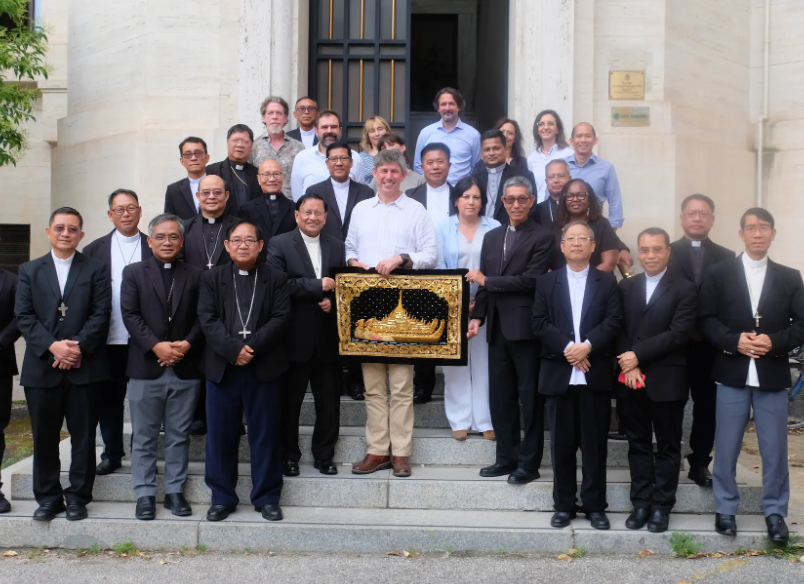
Vatican City (AsiaNews) - The Catholic Bishops’ Conference of Myanmar (CBCM) has recently undertaken its ad Limina Apostolorum visit to Rome, meeting Pope Leo XIV and the heads of the Roman Curia’s departments, bringing a message of suffering, resilience and an urgent appeal to the world not to abandon a country now in its fifth year of armed conflict.
The bishops arrived in Rome on 1 June, beginning their visit with a morning Mass in the historic Basilica of St John Lateran. Before the official programme began, the delegation also visited the historical museum of the Barnabite Order — the missionary congregation that first evangelised the Mandalay region in Myanmar — and met with Catholics originally from Myanmar living in Rome for an afternoon of shared prayer and fellowship.
Liturgy and charity beyond all wounds
Among the more low-key yet significant moments of the visit was the delegation’s stop at the Dicastery for Divine Worship and the Discipline of the Sacraments. The Diocese of Hakha reported that the words of consecration used during Mass had been formally translated into five local languages — Hakha, Falam, Mindat, Nharein and Zotung — and submitted to the Dicastery along with audio recordings and written texts following the diocesan bishop’s approval. These translations are now officially recognised by the Vatican, a significant milestone for the liturgical life of Catholic communities belonging to Myanmar’s ethnic minorities.
Among the most moving meetings of the week was the one at Caritas Internationalis, where officials warmly welcomed the bishops and listened to accounts of the scale of suffering in Myanmar. During last year’s earthquake, Caritas Myanmar supported over 399,600 people in 631 communities spread across 29 affected municipalities, providing food, shelter, safe water, livelihoods and psychosocial support through a network extending to all 17 dioceses.
Caritas leaders said they were deeply moved to hear of the interfaith solidarity that emerged from the rubble, with Catholic, Buddhist, Muslim and Hindu communities welcoming and supporting one another amidst the devastation. Bishop Raymond Sumlut Gam, who also serves as president of Caritas Myanmar, made a simple yet urgent appeal to the world: “Do not forget us. Do not forget our crisis. Our voice is very small. We need others to help us make it heard.”
Leo XIV: “Myanmar is not forgotten”
The highlight of the visit was the meeting with Pope Leo XIV on 6 June. The audience lasted almost two hours and addressed the topics of the formation of seminarians, the ongoing formation of priests, and the Church’s response to the humanitarian and political crisis in Myanmar.
According to Cardinal Charles Bo, Archbishop of Yangon, Pope Leo XIV assured the delegation that Myanmar “is not forgotten, but is always in his prayers”, and pledged to continue urging the world not to abandon the country – echoing the repeated appeals of his predecessor Pope Francis, who often said: “Do not forget Myanmar”.
“We were very happy to meet the Pope and we will return home feeling renewed and strengthened,” Cardinal Bo told Vatican News. “Despite the difficult situation, the Church in Myanmar is growing and becoming much stronger.”
The delegation also met Cardinal Pietro Parolin, the Vatican Secretary of State, presenting him with a traditional Kachin shoulder bag as a gift from Myanmar.
Myanmar has been ravaged by armed conflict since the military coup in February 2021, which has caused thousands of deaths and displaced over 3.6 million people. In March 2025, a devastating earthquake struck the country, exacerbating an already dire humanitarian crisis and increasing the suffering of communities already pushed beyond their limits.
Through the meetings held in Rome this week, the bishops presented this reality directly and without political calculation, asking only that the world listen and remember.

.png)
11/08/2017 20:05










