








Roses for 'Mother Suu': Burmese do not forget their detained leader
Aung San Suu Kyi, imprisoned since 2021, turned 81. According to the military, she has been under house arrest at an undisclosed location in Naypyitaw since late April, but no images have yet been released to prove this. Despite restrictions, she is being celebrated with prayers and flowers across the country and in the diaspora. Her son, Kim Aris, accuses the regime of “hostage diplomacy”.
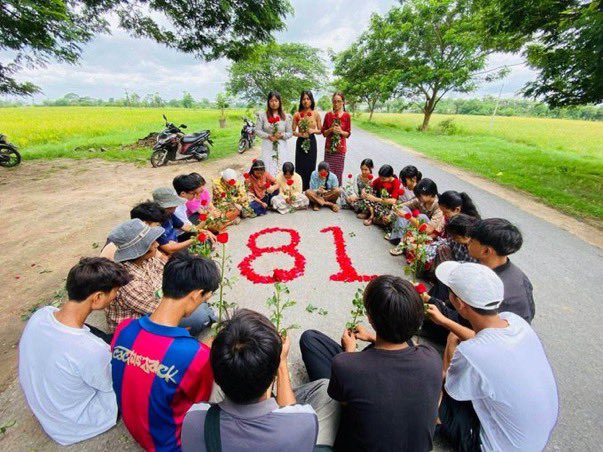
Yangon (AsiaNews) – Myanmar's detained leader Aung San Suu Kyi turned 81 on 19 June, and for the sixth year in a row she spent her birthday in the hands of the military. Across Myanmar and in many countries abroad, her people and the friends of the country answered the day not with anger but with roses, candles and prayer.
The rose has become the quiet symbol of this movement. In towns and cities, supporters pinned roses to their shirts, laid flowers at small shrines and handed single roses to people in the street. Inside Myanmar, the "Rose Campaign" was organised by local strike committees, who asked people in areas under military control to take part carefully and to keep their safety in mind.
The risks were real. Police had warned that anyone marking the birthday could be arrested. In Monywa, in Sagaing Region, the public strike committee held the campaign even though soldiers inspected the streets and restricted the sale of roses. Afterward, troops reportedly blocked parts of the city and carried out searches into the night.
In Wetlet, more than 200 people from 30 villages joined a marathon in her honour. In Yinmabin, residents from nine villages marched nine miles carrying roses and calling for her health, the fall of the dictatorship and the success of the revolution. In Pathein Gyi, members of a local defence group prayed simply that "Mother Suu" would soon be free. Public celebrations were also reported in the main cities of Yangon and Mandalay, and resistance fighters joined in. One fighter said the regime's refusal to release the 81-year-old leader only shows how much it still fears her.
Worldwide prayers and an interfaith spirit
Beyond the country's borders, the day took on a strong spiritual character. In Japan, the Burmese community gathered on 14 June at the Gotemba Peace Pagoda in Shizuoka Prefecture for a multifaith prayer service. A Buddhist abbot led prayers in his tradition, while Karen Christian and Muslim members offered prayers for her health, each according to their own faith. Those present also prayed for her release from what they called arbitrary detention.
In Vancouver, the Burmese Canadian Society held a prayer gathering before the birthday, with poetry readings, the release of balloons and a fundraising sale of Myanmar food. In Thailand, Myanmar migrants and exile groups organised a coordinated day of action.
Dr Sasa, a well-known pro-democracy leader and founder of the Institute for Peace and Federal Democracy, invited people of every religion and belief to mark the birthday with prayer and fasting. For many, the day was less a celebration than an act of faith and remembrance.
Embassies join the tribute
In Yangon, foreign embassies and diplomatic missions joined the campaign. The European Union, the United Kingdom, Germany, Norway and Switzerland shared images of roses on their social media pages, and some changed their profile pictures to rose designs. The Embassy of Canada called for her immediate and unconditional release, for proper medical care, for the freeing of all remaining political prisoners and for an end to the violence. Several governments repeated their demand for political reform and for the release of all who are held for their beliefs.
A son's question: is she still alive?
The most personal voice was that of her son, Kim Aris. He has not been able to confirm that his mother is even alive, and has built a global "Proof of Life" campaign around that single question. To mark the birthday, he launched the "81 for 81" challenge, asking supporters to run 81 kilometres, cycle 81 miles or walk 81,000 steps. He himself skateboarded 81 kilometres across London's Hyde Park, finishing on 17 June. In a video message for the day, he said his mother's “spirit cannot be caged”. Earlier, during a visit to Australia, he accused the regime of "hostage diplomacy" and of using his mother as a tool of psychological pressure.
The worry is not without reason. The regime says it moved the Nobel Peace Prize laureate from prison in Naypyitaw on 31 May to an undisclosed place, reportedly under house arrest, but it has kept her completely cut off from the outside world. Her lawyers have not spoken to her since 2022. She has been held since the coup of 1 February 2021, which removed her elected National League for Democracy government, and she was convicted in closed military courts on charges that her supporters and many observers see as invented to keep her out of political life. Earlier this month, the last remains of her party's headquarters were dismantled.
Rights groups press her case
Human rights groups used the day to push for action. The ASEAN Parliamentarians for Human Rights, a body of 134 current and former lawmakers from ten countries, signed an open letter urging ASEAN to demand the release of Aung San Suu Kyi and all political prisoners. The Assistance Association for Political Prisoners, which counts more than 22,000 people still held for political reasons, made the same appeal and backed the Proof of Life campaign.
The contrast of the moment was hard to miss. As supporters offered roses for the woman who led Myanmar's nonviolent struggle, the general who overthrew her, Min Aung Hlaing, was being welcomed in Beijing and, two weeks earlier, in New Delhi, gathering the international recognition while she is denied even the right to be seen alive. For the people who marked her 81st birthday, the rose was both a gift and a question: Where is Mother Suu, and is she still with us?

.png)
05/05/2026 14:14
17/03/2021 13:08
03/02/2021 16:50










