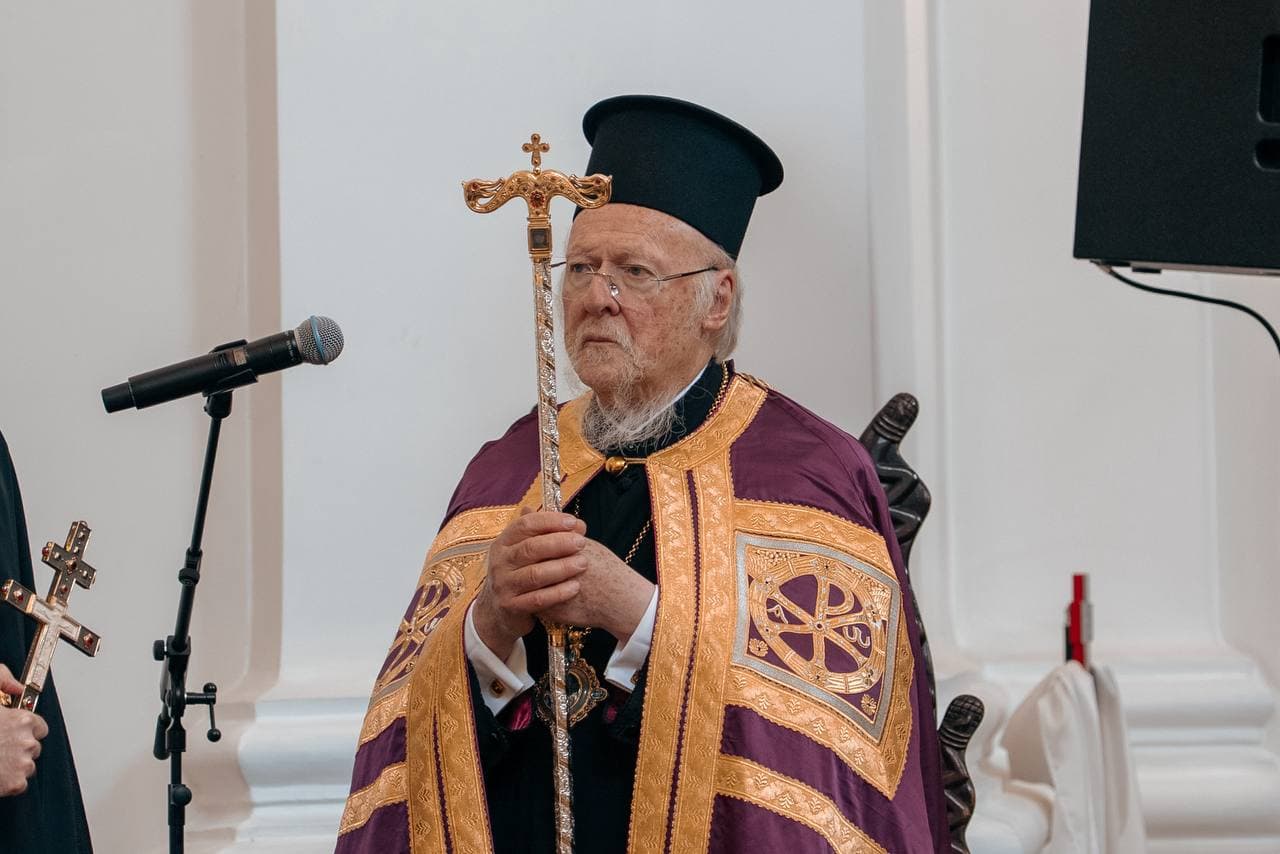
Vilnius (AsiaNews) - In recent days, the Ecumenical Patriarch of Constantinople, Bartholomew (Archontonis), visited Lithuania, whilst the Patriarch of Moscow, Kirill (Gundjaev), visited neighbouring Kaliningrad, a Russian enclave on the Polish shores of the Baltic Sea, and in Estonia a law threatening the structures of the Russian Orthodox Church has come into force.
The visit to Vilnius by the highest-ranking hierarch of global Orthodoxy completed the canonical process of restoring the territory of Lithuania – part of the ancient Metropolis of Kiev, annexed by the Patriarchate of Moscow at the end of the 17th century – to its jurisdiction.
In 2018, Constantinople granted autocephaly to the Ukrainian Orthodox Church (PZU), which Moscow describes as “schismatic”, and in 2022 declared the de facto apostasy of the Russian Orthodox Church, resulting in a complete breakdown of relations between the Greeks and the Russians.
Over the years, Constantinople has taken under its protection a number of clergymen “defrocked” by the Russian Orthodox Church for their pacifist stance, including a group of Lithuanian clergy led by Archpriests Vladimir Seljavko and Vitalij Motskus.
Three years ago, Bartholomew announced the establishment of his exarchate in Lithuania, which included, in addition to the Lithuanian pacifist clergy, the priests Georgij Roj and Aleksandr Kukhta, who had fled from Belarus, and later the renowned theologian and deacon Andrej Kuraev, who had left Moscow.
The duties of exarch were carried out by the Estonian hieromonk Justin (Kiviloo) and subsequently by Father Motskus. On Holy Trinity Sunday this year, Bartholomew consecrated Archimandrite Panaretos (Psaravtis), who had led the Slavic-Turkish community in Istanbul, as Bishop of Tamis and Exarch of Lithuania, installing him in Vilnius on All Saints’ Day.
The religious service was attended by numerous Ukrainian and Belarusian refugees, to whom the Patriarch addressed a special message, emphasising Vilnius’s hospitality and calling on Christians to remain faithful to the truth, even if this fidelity were to disrupt their traditional way of life.
Denis Kučinskij, personal representative of the head of the Belarusian transitional cabinet, attended the service and presented the Patriarch with a message from Svetlana Tikhanovskaya.
In the message, the politician recalled Belarus’s historic closeness to the Patriarchate of Constantinople, a declaration of intent stating that the Belarusian Orthodox Church, following the country’s liberation, would follow the path of independence from Moscow, following the example of the Ukrainian Orthodox Church.
It was in Vilnius, in March 2023, that Bartholomew, as head of global Orthodoxy, held the Moscow Patriarchate responsible for war crimes, including the “shocking abduction of Ukrainian children”.
In the same city, for the first time in history, he declared the Patriarchate of Constantinople’s readiness to lead the spiritual rebirth of Russia following the fall of the current regime and the ecclesiastical establishment that had become an integral part of it.
Due to military actions and the intensification of repression in Belarus and Russia, the Orthodox community in Lithuania has more than doubled, exceeding 100,000 people. The Lithuanian Exarchate of the Patriarchate of Constantinople already comprises ten parishes and has good prospects for growth with the appointment of its own bishop.
The rivalry between Moscow and Constantinople was further highlighted by Kirill’s visit to the neighbouring region of Kaliningrad, formerly East Prussia, the only Russian enclave in Western Europe. The Patriarch of Moscow has been officially banned from entering Lithuania since the summer of 2022, and now the planes of the two rival Orthodox leaders were separated only by the infamous Suwałki Gap.
The visit by the head of the Russian Orthodox Church was scheduled to coincide with the tenth anniversary of the establishment of the Kaliningrad Metropolis of the Russian Orthodox Church, and addressing the local clergy, the Patriarch emphasised, above all, his ‘patriotic’ mission: ‘You are a border detachment, and you have a special responsibility: to serve the Church, to serve your Fatherland’.
Meanwhile, in another Baltic country, Estonia, the State Constitutional Court has upheld the law on churches and parishes, adopted by parliament last autumn. President Alar Karis had refused to sign it, appealing to the court and citing the “unclear wording” of the new version.
The Court ruled that the protection of the Estonian state and its security take precedence over the undisturbed activities of foreign religious organisations, particularly those based in a state that has committed an armed aggression. The Orthodox Church’s political-religious war transcends all borders and extends into future centuries.