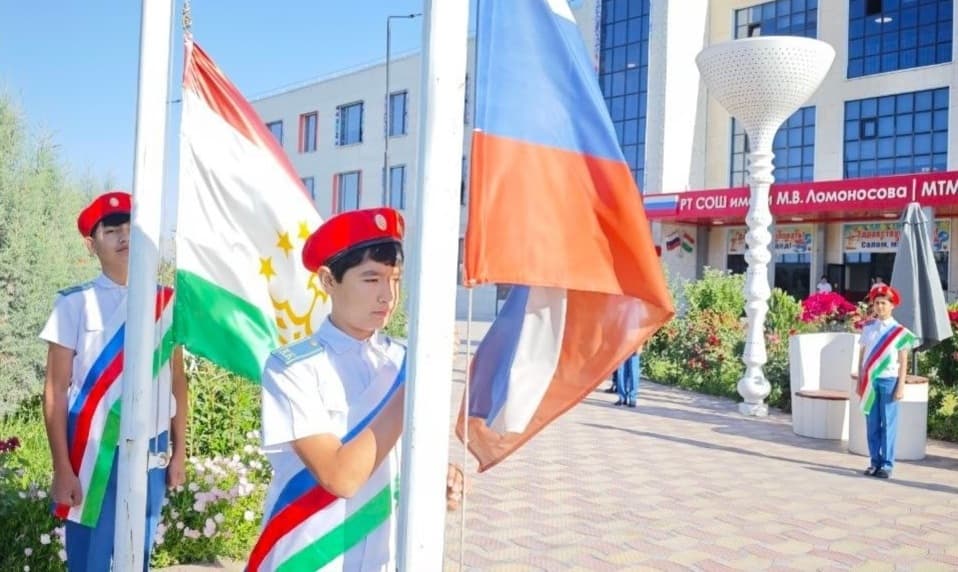
Moscow (AsiaNews) – Russia is investing substantial sums in the construction of schools across Central Asia, seeking to strengthen the use of the Russian language, given that the region’s younger generations are increasingly exposed to Western and Chinese influence.
When a new Russian-language school opened its doors in the town of Bokhtar, in southern Tajikistan, in 2022, thousands of local residents rushed to enrol their children. The school, named after the 18th-century Russian scientist Mikhail Lomonosov, is one of five Russian-funded schools to have opened in recent years in this impoverished Central Asian country, as part of a $150 million Russian state project. The modern three-storey building is under 24/7 surveillance, and tall flagpoles flying Russian and Tajik flags dot the surrounding grounds.
Mukhtor’s eldest daughter, interviewed by Asia Plus, is among the more than a thousand pupils enrolled at the school in Bokhtar. The 40-year-old construction worker hopes to be able to send his son to school as well, and says he “has no interest in politics; all that matters to me is my children’s future”, says Mukhtor, who asked that his surname not be published, “this school opens the door to universities in Russia and, perhaps, to better jobs there”. In total, around 6,000 pupils are enrolled at the five Russian-language schools opened in Tajikistan in 2022, which adhere to Russian educational standards, with teaching conducted mainly in Russian. The curriculum, as well as school ceremonies and symbols, are rooted in Russian culture.
“Moscow is building new Russian schools in Central Asia because it is focusing on the next generation. The aim is to secure long-term influence,” says an anonymous political scientist from Tajikistan, an authoritarian country where the government does not tolerate dissent.
Unlike older generations, young people in Central Asia do not feel nostalgic for the Soviet era; according to the expert, students are increasingly exposed to Western and Chinese influences.
Among the most significant projects is the $200 million construction of a campus for the Kyrgyz-Russian Slavic University in Bishkek. Partially funded by Moscow, this university already plays an important role in Kyrgyzstan’s higher education system, and Russia has also committed to building several new Russian-language secondary schools across Kyrgyzstan.
During his visit to Astana on 28 May, Russian President Vladimir Putin noted that around 60,000 Kazakh students are studying at Russian universities, emphasising that eight major Russian universities have branch campuses in Kazakhstan.
In Uzbekistan, Russian-language teaching remains popular in higher education and technical fields, despite the government’s efforts to make Uzbek the main language of instruction. There are Russian universities in the country, and bilateral agreements facilitate student exchanges and vocational training.
In Turkmenistan, where foreign educational initiatives are strictly regulated, Russian-language education remains under state supervision. Students travel to Russia to study under intergovernmental agreements, and educational ties persist despite wider restrictions on public life.
Across Central Asia, Moscow has also expanded its training initiatives – both elite and informal – aimed at young professionals, analysts and future policymakers. One example is the ‘School for Central Asia’ initiative, organised by the Aleksandr Gorchakov Public Diplomacy Fund, a Russian think tank that brings together young professionals from Russia and Central Asian countries for lectures and debates on regional issues.
Language policy in the region, home to significant ethnic Russian minorities, has periodically sparked controversy and strong reactions from Russian politicians. When Kyrgyzstan – the only country where Russian still has official language status – discussed the possibility of changing the names of districts in Bishkek (Oktyabrsky, Leninsky, Sverdlovsky and Pervomaisky), several Russian lawmakers and commentators accused the Kyrgyz of seeking to erase their shared history and of discriminating against Russian speakers.