








Sebastia: the archaeological laboratory of Israel's annexation of the West Bank
The entire area of the ancient city of Samaria north of Nablus has been expropriated and separated from the nearby Palestinian village in the name of promoting only the Jewish period of its history. Meanwhile, the Knesset is discussing the establishment of an authority to extend control over archaeological assets even in areas assigned to the Palestinian Authority.
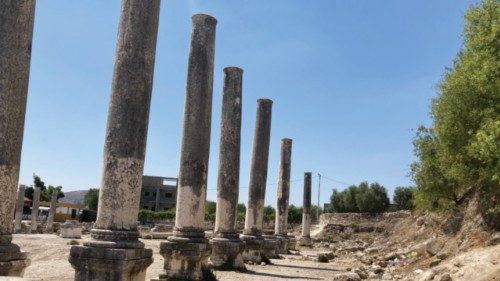
Ramallah (AsiaNews) - On the hills north of Nablus, where the occupied West Bank is a succession of olive trees, terraces and ancient ruins as far as the eye can see, Sebastia, the ancient biblical Samaria, is experiencing days of tension.
Roman columns emerge from the tall grass, the Byzantine basilica lies partly hidden by weeds, the Crusader basilica (which according to tradition housed the body of John the Baptist) stands out imposingly against the blue sky, while even older remains - linked to Samaria of the Northern Kingdom and then to the Herodian/Hellenistic period - remain buried under the vegetation. It is a landscape steeped in history, but also full of unknowns.
In the small town, a few dozen metres from the archaeological site, the atmosphere is one of alarm. Last November, the mayor, Mahmud Azem, received official notification from the Israeli authorities that the entire archaeological area on the hill would be expropriated. In total, about 180 hectares of land, mostly privately owned by Palestinians. For the approximately 3,500 residents, many of whom live off tourism and olive groves, the announcement came as a shock.
Rumours had been circulating for years about an Israeli “development” project for the site. But now the details are clear: a visitor centre, a large car park, a new access road that will completely bypass the village, and a fence that will separate the archaeological area from the Palestinian urban fabric. The archaeological area has always been considered Area C, under Israeli military control. The new project, in fact, aims to cut off the Palestinian village of Sebastia from the archaeological area that has guaranteed its identity and livelihood for centuries.
‘It is an attack on Palestinian landowners, on olive trees, on our heritage,’ says Azem. ‘Sebastia has entered a dark tunnel.’ . According to human rights organisations, this is the largest confiscation of land for archaeological purposes ever to have taken place in the West Bank since 1967.
For the Israeli government, however, Sebastia is much more than a tourist site to be promoted. Ancient Samaria was the capital of the northern kingdom of Israel between the 9th and 8th centuries BC, a key centre in biblical history. It is here that, according to tradition, King Omri and his son Ahab ruled before the Assyrian conquest in 722 BC. This past gives the place enormous symbolic significance for contemporary Jewish nationalism, which sees biblical Samaria as historical proof of the ancestral link between the Jewish people and the land.
It is no coincidence that the Sebastia project is promoted by members of Otzma Yehudit (Jewish Power), an ultra-nationalist far-right party that is part of the Israeli coalition government. Heritage Minister Amichai Eliyahu lives in a West Bank settlement and is an outspoken supporter of the annexation of the entire territory. ‘Sebastia is one of the most important sites of our national heritage,’ he has said on more than one occasion. ‘We want to bring it back to life and strengthen the bond between the people, their history and their country.’
But for many activists and civil society representatives, both Israeli and Palestinian, archaeology is only the language chosen for a broader political strategy. Israeli NGOs such as Emek Shaveh and Peace Now speak openly of ‘disguised annexation’. The expropriation of Sebastia, they argue, sets a dangerous precedent: the use of heritage protection to extend Israeli civil control over lands that, according to the Oslo Accords, should be under Palestinian administration.
This interpretation is supported by recent legislative developments in Jerusalem. At the end of 2025, the Knesset, the Israeli parliament, discussed a bill that would extend the Jewish state's jurisdiction over West Bank antiquities, creating a body parallel to the Israel Antiquities Authority, with powers also in Areas A and B. Sebastia has become something of a testing ground for this policy: an archaeological site transformed into a national park – the future Shomron Park – and effectively integrated into the infrastructure of the settlements.
The paradox is that Sebastia is a place of unique historical stratification. After the Israelite period, it was destroyed and rebuilt several times: by Alexander the Great, by Herod the Great, who renamed it Sebaste in honour of Augustus, and then under Byzantine, Islamic, Crusader and Ottoman rule.
'Over the centuries, there has been continuous cohabitation, a continuous cultural and religious exchange. I would say an osmosis, with the presence of different cults,‘ recalls Wala'a Ghazal, who looks after the small museum built near the mosque thanks to the efforts of the great Franciscan archaeologist Michele Piccirillo. ’Reducing Sebastia to just a centre of biblical Judaism is a falsification."
International law prohibits an occupying power from interfering with archaeological sites in the occupied territory. Sebastia has been included in the provisional list of UNESCO World Heritage Sites for the State of Palestine since 2012. The Palestinian Authority has requested the intervention of the United Nations Educational, Scientific and Cultural Organisation in this regard, while several Arab and European countries have expressed concern about what they see as the transformation of cultural heritage into an instrument of sovereignty.
Meanwhile, on the ground, the consequences are concrete. A local resident who lives and works next to the remains of the Roman forum points to the line where the fence will be erected. His house, restaurant and souvenir shop, which today stand on the edge of a wide dirt road used as a car park by the few agencies that bring tourists and pilgrims here, will remain on the “wrong” side.
“This plan will destroy Sebastia's economy,” he says. “They will take everything away from us”.
In short, Sebastia is becoming one of the symbols of a larger battle: that between memory and power, between archaeology and politics, in a land where the past never ceases to be used to redraw the present.

.png)
21/07/2020 13:25










