








Tears and fears among Christians in southern Lebanon
Despite growing fears, people are refusing to leave their homes as requested by the State of Israel. The Bishop of Batroun criticises (without naming it) Hezbollah for deliberately ‘drawing’ Israeli fire onto homes and fields now at risk of invasion. Criticism is also levelled at the Beirut government for an overly servile and passive stance. An activist tells AsiaNews: “If we leave, the South is lost”.
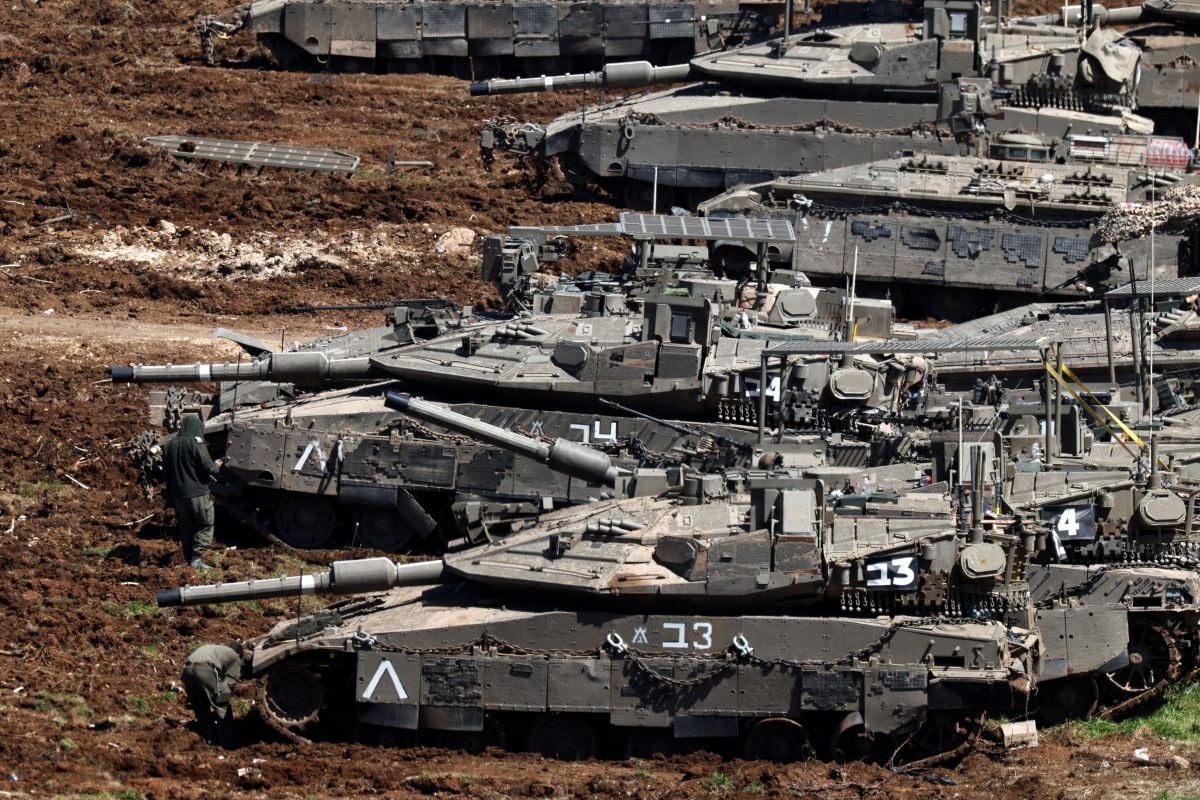
Beirut (AsiaNews) - Analysing the twelve days of war already passed between Israel and Hezbollah, General Khalil Gemayel, a retired Lebanese army officer, explains to AsiaNews: “Even though, on the surface, we have so far witnessed a series of raids, this is the first phase of an invasion. In military doctrine, when the populations of entire villages are asked to evacuate an area, it means that a large-scale [ground] military operation is planned”.
However, the senior officer continues, “despite their fear, many inhabitants of Christian border villages are refusing to leave their homes” as requested by the Israeli army, convinced that leaving could mean “never returning to their lands”.
A press conference was held recently at the Catholic Information Centre (CIC) attended by Fouad Abounader, former head of the Lebanese Forces, some twenty administrators and mayors from the affected villages, and the Maronite Bishop of Batroun, Monsignor Mounir Khairallah.
The prelate, who is also president of the Episcopal Commission for Information of the APECL (Assembly of Catholic Patriarchs and Bishops in Lebanon), explained that these evacuation requests were indirectly caused by the war between Hezbollah and Israeli forces. Although he did not directly name the pro-Iranian party, whose military and security activities have been declared illegal, Bishop Khairallah criticised the Shiite fighters for indiscriminately using houses and fields, thereby drawing retaliatory strikes onto Christian villages.
Ambiguous situation
It was precisely this “ambiguous situation” that cost the life of the priest of Qley’a, Fr Pierre el-Rahi, and the brother of the parish priest of Alma el-Chaab, Sami Ghafari, the bishop pointed out. He went on to say that he fears their persecution will lead to “the flight of all Christians” from the twelve villages on the border with southern Lebanon, having already caused the forced displacement of the population of the two villages of Kaouzah and Alma el-Chaab.
Populated mainly by Maronite Christians, these villages – whose total population is estimated at 75,000 during the summer months – have withstood all the wars fought in these regions. “And this has been the case since 1948,” assured Hanna Amil, deputy mayor of Rmeich, during the press conference held at the CCI.
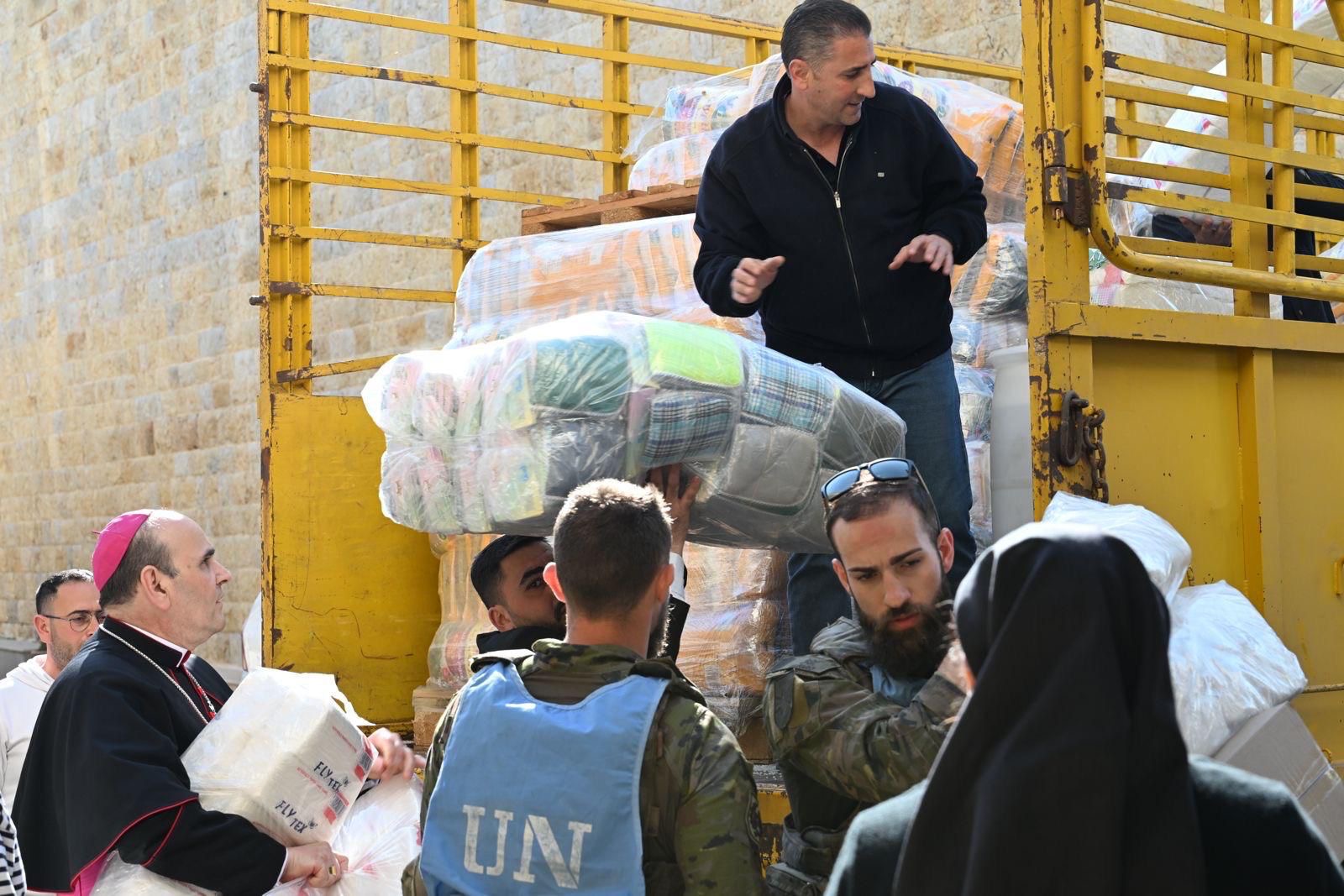
“We are leaving our homes, entrusting them to Providence and the intercession of the Virgin Mary and the saints, who will watch over them as we await our safe return,” added the head of the municipality of Alma el-Chaab, Chadi Sayah. He had to leave, along with his fellow citizens, in a convoy escorted by the UNIFIL mission.
Three dead in Aïn Ebel
With a heavy heart, Fouad Abounader tells us over the phone that three men from Aïn Ebel, including a close relative of the former Maronite Patriarch Antoine Khoreiche, were killed yesterday in a drone strike whilst they were installing a satellite dish on the roof of their house.
“We had to urgently contact the emergency services to recover them. We found them lying in a pool of blood. The news has shocked the village and sown doubts and fears in the hearts of all those who were counting on a status of relative neutrality, particularly with regard to Hezbollah, so as not to have to abandon their villages,” Abounader continued. Speaking is a former warlord who has turned to humanitarian and social work through an NGO, Nawraj, whose main aim is to stem the rural exodus from outlying Christian villages.
During the press conference at the CCI, another of the administrators of the southern villages spoke, emphasising that “the Israelis themselves seem not to know what they actually want”. Indeed, although their Defence Minister, Israel Katz, announced yesterday that the government had asked the army to “expand its deployment within Lebanese territory”, no date appears to have been set yet. At the same time, the senior Israeli official warned against the inaction of the Lebanese authorities, stating that, should this continue, his country “intends to take over” parts of Lebanese territory.
French President Emmanuel Macron and many others like him in Israel advise against this deployment and the possible creation of a buffer zone. From a military perspective, it will prolong the war and offer Hezbollah further opportunities to strike the army facing them, explain military experts, recalling how Israel has already had this unpleasant experience before withdrawing from this border strip in 2000.
Fears of military intervention
According to reports in the Israeli press, it appears that the military intervention feared by the Lebanese civilian population is not imminent, and many are hoping this remains the case. Supporting this view is the launch of around a hundred rockets by Hezbollah, coordinated with an Iranian missile strike. These launches overwhelmed the Iron Dome system’s capacity, allowing the Iranian rockets to strike the north of Israel in an apparently ‘successful’ operation, in response to which the Israeli army has vowed revenge.
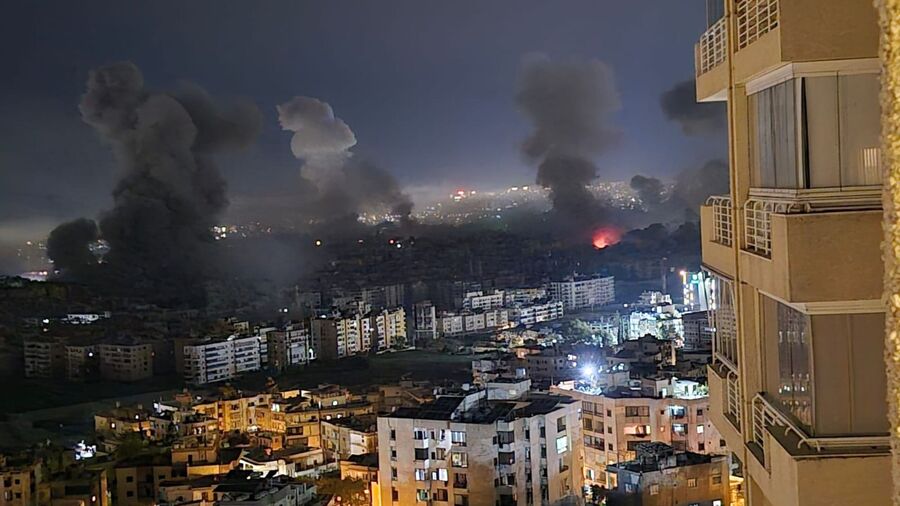
For many observers, this explains the escalation of events during the night of 11–12 March and yesterday, with the expansion of the scope of air raids and drone attacks in Beirut. Yesterday, a drone launched onto the campus of the Lebanese University, near Leylaki, a neighbourhood in the southern suburbs, killed the dean of the Faculty of Information, Hussein Bazzi, and his assistant. On the same day, a drone caused 12 deaths on a sandy beach in Beirut, Ramlet el-Beida, where families fleeing the suburbs had sought refuge.
Furthermore, an attack on Aramoun decimated a family of five. In addition, two buildings in the predominantly Muslim neighbourhoods of Beirut, Bachoura and Zokak el-Blatt, were bombed, one of which housed the vaults of Hezbollah’s bank, al-Qard al-Hassan, in its basement. “What can you expect? It’s war; there are no neutral zones,” a church source who asked to remain anonymous told AsiaNews. For Bishop Elie Haddad, the Greek Catholic Bishop of Tyre, interviewed by Télé-Lumière, “at this moment we must be more like serpents than doves”.
Anger and bitterness
Added to the suffering of having to abandon their homes is the bitterness and anger in the hearts of the inhabitants towards the “passivity” of the Lebanese state. “At Fr Raï’s funeral, the army deployed in Kley’a. Why shouldn’t they do so every day?”, asks the head of the municipality, Hanna Daher, who also wonders why the military withdrew from certain positions towards which the Israeli army was advancing.
Fouad Abounader, for his part, calls for a gendarmerie station in every village and a secure supply route. He also points to the early withdrawal of the UN mission (UNIFIL) at the end of 2026 to support his demands. For an administrator in Rmeich, the hour is fateful: “If we leave, if the South is lost, it will be the whole of Lebanon,” he tells us, “that is lost!” In reality, such tones seem all too gloomy for the Apostolic Nuncio, Monsignor Paolo Borgia, who today, together with Fouad Abounader, is touring southern Lebanon. The prelate will visit six towns, including Marjeyoun, Kley’a once again, as well as Deir Mimas, Ebl el Saki, Kawkaba and Rachaya el-Foukhar, to assess the situation and the condition of the population.

.png)










