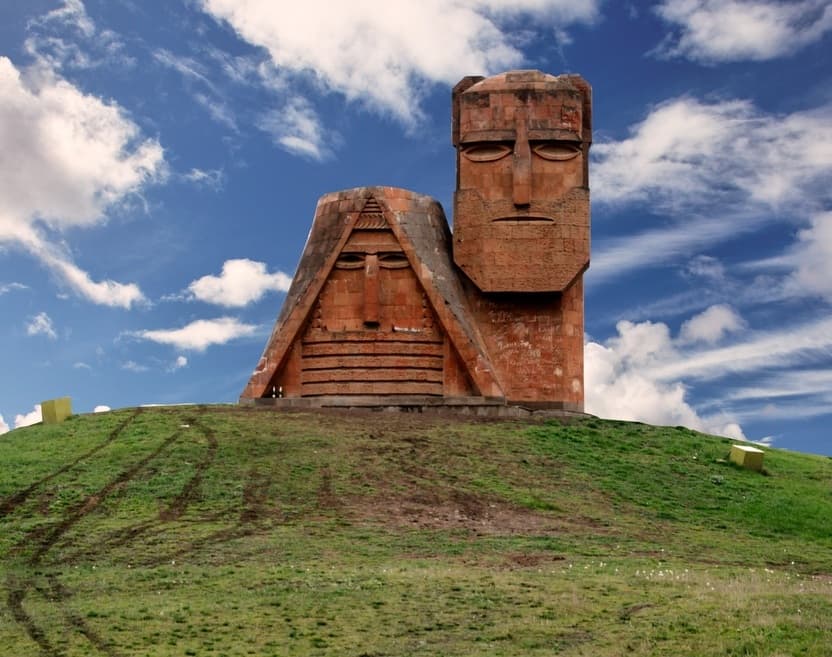
Yerevan (AsiaNews) - The guardian of the cultural heritage of Artsakh—the Armenian name for Nagorno-Karabakh—Ovik Avanesov, vice president of the historical-cultural nonprofit Azgain, has sounded the alarm over the possible total destruction of the monument “We—Our Mountains,” known as Tatik-Papik, one of the monuments symbolizing Armenian identity and historical memory.
He notes that since November 2024, photographs and videos of acts of vandalism have been circulating on social media, showing both the front and back of the monument defaced with offensive and “Armenophobic” graffiti. Similar incidents have also been reported at the Surb Akob Church and the Cathedral of the Protection of the Mother of God in Stepanakert, whose destruction was preceded by propaganda publications containing content offensive to Armenians, and there are now fears that Tatik-Papik may face the same fate.
The monument was created in 1967 by sculptor Sarkis Bagdasaryan and architect Yuri Akopyan. Carved from red tuff and standing approximately 9 meters tall, the complex rises atop a hill, symbolizing the unbreakable blood bond between the land and the people of Artsakh.
The sculpture depicts an elderly couple from Artsakh in traditional dress, standing shoulder to shoulder in a proud and indomitable pose. It has no pedestal; it appears to rise directly from the earth, embodying the deep roots of the people and their unbreakable bond with their homeland.
Regarding the “war of memory” between Armenians and Azerbaijanis, Moscow’s Foreign Ministry spokesperson, Maria Zakharova, also spoke out in recent days, noting that “Russia has raised the issue many times regarding the preservation of Armenian monuments in Nagorno-Karabakh; we believe that such things should not happen anywhere.”
The Russians are dismayed by the fact that there has been no official reaction from the Yerevan government, and are seeking to coordinate with the Baku government to prevent such incidents.
Zakharova notes that the 2020–2022 trilateral agreements between Russia, Armenia, and Azerbaijan also included a humanitarian path to reconciliation, which was intended to address issues of restitution and prisoner exchange, as well as the “respectful and conservative treatment” of monuments, historic architectural buildings, and memorial complexes.
In fact, Armenian Prime Minister Nikol Pashinyan spoke out on April 23 regarding the destruction of the Stepanakert Cathedral, stating that “a cautious approach to the matter is needed,” and that the incident “will be subject to international assessment at the governmental level.”
Meanwhile, Azerbaijani vandals continue undisturbed to ruin, deface, and destroy churches, Armenian khachkars, and other objects of historical and cultural value on Artsakh’s territory, with the aim of completely erasing the Armenian heritage—and without any significant reaction from the international community.
The positions of the Pashinyan government, which is striving in every way to conclude peace negotiations with Baku and maintain the international balance between the United States, Russia, and other states in the region, do not favor the defense of Armenian monuments in Nagorno-Karabakh, and this issue is being used by political opposition groups and the Armenian Apostolic Church to stir up public opinion against the ruling majority.