








The Easter Icons of Russian Victory
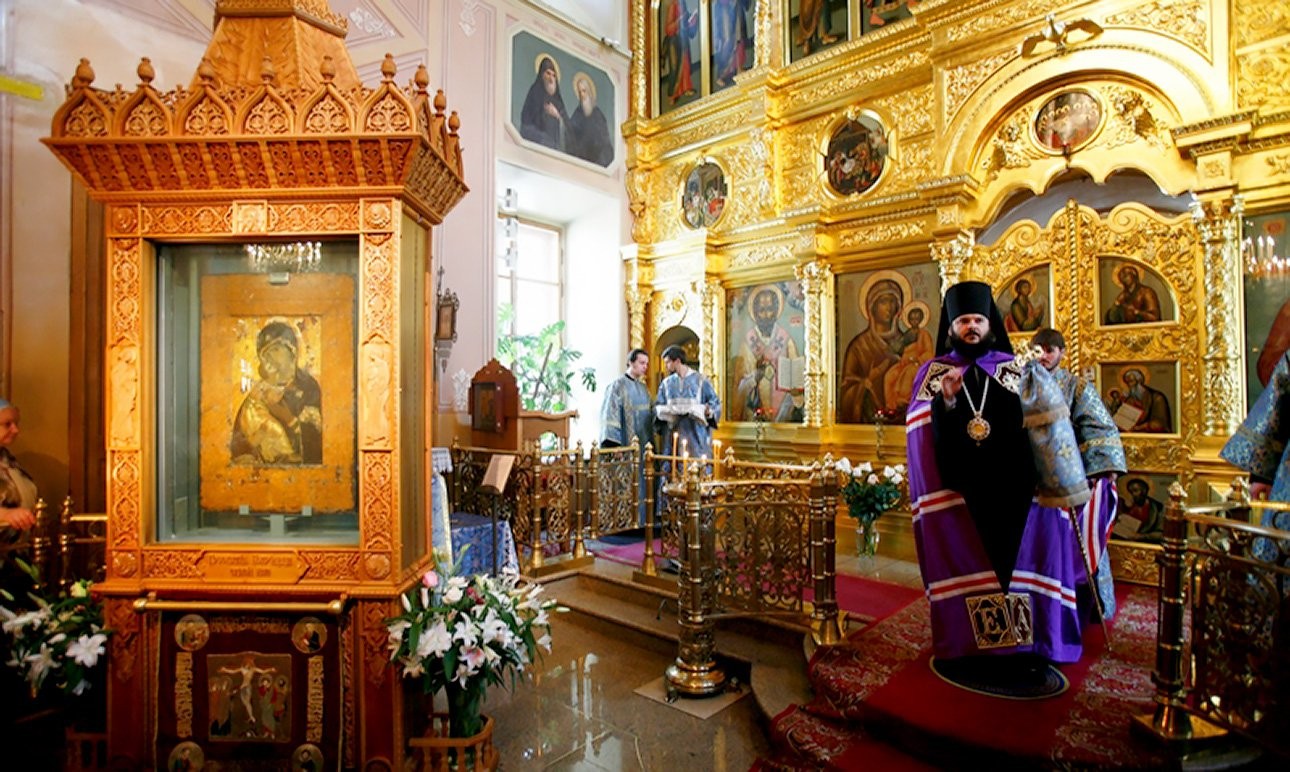
On extraordinary display in the Cathedral of the Holy Saviour, the icons of the Mother of God of Vladimir, also known as the ‘Madonna of Tenderness’ (Umilenije), and the one known as Donskaya are both symbols of Russian victories. They hark back to the great confrontation between East and West that gave rise to Rus’, and has continued to underpin the various ideologies in power in Russia to this day.
In one of his Easter homilies, Patriarch Kirill (Gundjaev) of Moscow called upon all Orthodox Christians in Kyiv and Ukraine from the Cathedral of the Dormition in the Kremlin to “pray for the preservation of the spiritual unity of the peoples of Rus’”, namely the Russians, Ukrainians and Belarusians.
He reinforced this appeal by stating that “we must not succumb to the devilish games that run counter to historical truth”, because the Church “never follows the orders of politicians”, even though in fact the affirmation of the “unity of the peoples of Russia” is precisely the task that President Vladimir Putin has assigned to Russians for the year 2026 as a political, social, moral and religious commitment.
The Patriarch has appeared somewhat unsteady in his solemn declarations from the altar in recent days, particularly when, during the Holy Thursday liturgy, he preached on Christmas, only to correct himself following a reminder from an altar server.
He then sought to restore his magisterial authority by focusing on Kyiv, the “mother of Russian cities” (a title later transferred to Moscow with the Tatar Yoke) and on “Saint Sophia of Kyiv”, the cathedral disputed between the various jurisdictions of the Orthodox Church, before moving on to the other cathedral of Saint Vladimir in Kyiv “temporarily occupied by the schismatics”, that is, by the Ukrainian Autocephalous Orthodox Church (OCU), before finally reaching the Dormition Cathedral in the Kremlin, built by the Italian engineer-architect Aristotele Fioravanti around 1470 with craftsmen from the Sforza Castle in Milan.
This procession through the historic cathedrals of Holy Rus’ serves as proof of the sanctity of the Russian war in Ukraine, dedicated to crushing the ‘diabolical schemes’ of those who refuse to acknowledge Moscow’s superiority over Kyiv, and over the rest of the world.
To make this proclamation of the true Russian faith even more evident and solemn, this year the Patriarch has also secured the support of the Virgin Mary, removing two of the oldest and most famous Marian icons from museums, as he had already done last year with Andrei Rublev’s icon of the Holy Trinity, to sanctify the union of the peoples; the three pilgrims of the Oaks of Mamre, who symbolise the Trinity, are in fact the eternal image of Russia, Ukraine and Belarus.
The Trinity has been returned to the place where it was originally painted, the Lavra of St Sergius of Radonezh, 70 kilometres from Moscow, in what is also known as the ‘Russian Vatican’.
Now, however, the icons of the Mother of God of Vladimir, also known as the ‘Madonna of Tenderness’ (Umilenije), and the one known as Donskaja have been retrieved; the latter was entrusted by the Don Cossacks to Prince Dmitry Donskoy of Moscow to celebrate the first victory over the Tatars at the Battle of Kulikovo in 1380, in the territory of the present-day Russian-occupied Donetsk Republic.
All experts criticise these operations to ‘return’ ancient icons to the Church, which put their preservation at risk; if nothing else, the two Marian icons did not have far to travel, moving from the Tretyakov Gallery to the Cathedral of the Holy Saviour in Moscow, separated only by the bridge over the Moskva River.
Both are symbols of Russian victories: the Donskaya icon symbolises Moscow’s rebirth after two centuries of Mongol rule, whilst the Vladimirskaya icon dates back to the early history of Kievan Rus’, prophesying the future rise of Moscow.
Legend has it, in fact, that the Prince of Kiev, Andrei Bogolyubsky, in the second half of the 12th century, roamed the countryside of Rus’ in search of a way to resist the assaults of the Asian and Caucasian peoples invading Russian lands, until he arrived at a remote monastery where, beside the altar, stood the holy Umilenije, a term denoting the tenderness with which the Mother caresses the face of the Infant Jesus in her arms—an icon which, according to tradition, was painted directly by Saint Luke the Evangelist, physician and painter.
The Virgin Mary then rose from her seat and walked ahead of the prince, showing him the way to Vladimir, the city dedicated to Prince Vladimir Monomakh, so named because he claimed descent from the Byzantine Monomakh emperors, one of whose daughters he had married (among the many wives he had taken).
Vladimir thus became the new capital of Rus’, and the icon was raised above the city’s Golden Gates, built to imitate the Holy Gates of Kiev. Kiev itself had in fact been destroyed by Andrei Bogolyubsky to ‘save it from the Bogomils’, the Asian enemies who sought to conquer it, anticipating by a millennium Vladimir Putin’s ‘special military operation’ blessed by Patriarch Kirill, who too was christened Vladimir at birth.
A relative of Andrei, Prince Yuri Dolgoruky, had travelled further east in those same years to develop trade along the route ‘from the Varangians to the Greeks’, establishing several post stations on the banks of rivers, including the most strategic one on the Moskva River, which gave its name to the capital that succeeded Kiev.
The fall of Kiev and the transfer of power to Vladimir thus shaped the fortunes of Moscow, which subsequently flourished thanks to agreements with the Tatars organised by the other victorious prince, Alexander Nevsky, in the mid-13th century, who managed to secure tax exemptions even for the Orthodox Church.
It is no coincidence that Patriarch Kirill also retrieved from the Hermitage Museum the silver reliquary in which the remains of the holy prince had been placed, the victor of the ‘Battle on the Ice’ on Lake Peipus against the Teutonic Knights who intended to impose Catholicism on the lands of Rus’ in 1240.
Ancient histories are now the main basis for Moscow’s claims over Kyiv and all the other peoples to be ‘reunited’ within the Russian world, as the modern histories of Tsarist Russia and the Soviet Union are too open to contradictory interpretations.
Not that those of Kievan Rus’ are any more straightforward, being marked by internecine wars between the princes who were heirs to Vladimir the Great, who had baptised the people of Kiev for reasons that were, in turn, hardly spiritual at all, with the aim of imposing Russian dominance over the trade routes to Constantinople.
Referring to the sacred icons of Byzantine origin thus brings us back to the great clash between East and West that gave rise to Rus’, and has continued to underpin the various ideologies in power in Russia right up to the present day.
The ancient Marian icons had not, however, been held in high regard throughout Russian history, which had primarily extolled those of the great Russian iconography of the 15th–16th centuries by great masters such as Andrei Rublev, his teacher Theophanes the Greek—to whom the Donskaya is attributed—and their great pupil Dionysius.
It was only in the mid-19th century that reliance began to be placed on restoration work and scientific studies, which were able to distinguish the icons of Kievan Rus’, mostly originating from Greece, from those that were strictly Russian, which subsequently became intermingled with Western Latin devotional art from the 17th century onwards.
The Bolshevik Revolution had scattered many important works, preserving the principal ones in the perpetually closed halls of the Tretyakov Gallery, where they were shown only to important guests from abroad.
Talk of a more open exhibition of sacred icons only began towards the end of the 1980s, in preparation for the celebrations of the Millennium of the Baptism of Rus’ in 1988, in which one of the most active organisers was the young Metropolitan Kirill, now Patriarch of Moscow.
However, access was only truly granted after the end of the USSR, and huge queues began to form in the Gallery’s halls, not only of tourists and visitors, but above all of the faithful who had returned to Orthodoxy, who would stop to prostrate themselves and pray before the Vladimir Mother of God, perhaps trying to touch her to magically obtain some form of intercession.
It was therefore decided to move the Icon of Tenderness to a chapel of St Nicholas, rebuilt specifically for this purpose in the museum courtyard, and to admire it, it has hitherto been necessary to enter without head coverings and in appropriate attire, making the sign of the cross with three fingers in accordance with the canons of the Russian liturgy.
Now, however, one can only contemplate the Donskaya and the Vladimirskaya in the cathedral in the shadow of the Kremlin, where foreigners and tourists are not permitted to enter, and perhaps not even Russians declared to be ‘foreign agents’.
The Easter prayer before the Victory Icons thus calls today for a new miracle from the Mother of God, one that might show the way to free oneself from the mud of the Donbass plains, where the Russian army has been bogged down for more than four years now, and restore Moscow to its lost grandeur.
Let us hope that the icons dating back to the first millennium do not crumble amidst all these pilgrimages between museums and cathedrals, leading to the disintegration of the entire Russian empire of the past and present.
RED LANTERNS IS THE ASIANEWS NEWSLETTER DEDICATED TO CHINA. WOULD YOU LIKE TO RECEIVE IT EVERY THURSDAY? TO SUBSCRIBE, CLICK HERE.

.png)
07/02/2019 17:28
12/02/2016 15:14










