








The Symbols of Armenian Easter
Like all Eastern Churches, Christians in Armenia are preparing to celebrate the resurrection of Jesus on Sunday 12th, reviving ancient customs such as holding eggs in their hands as they make their way to the Easter Vigil. Among the deeply meaningful rites is the Andastan, with the blessing of the four cardinal points to symbolise the rebuilding of a new world founded on faith and unity.
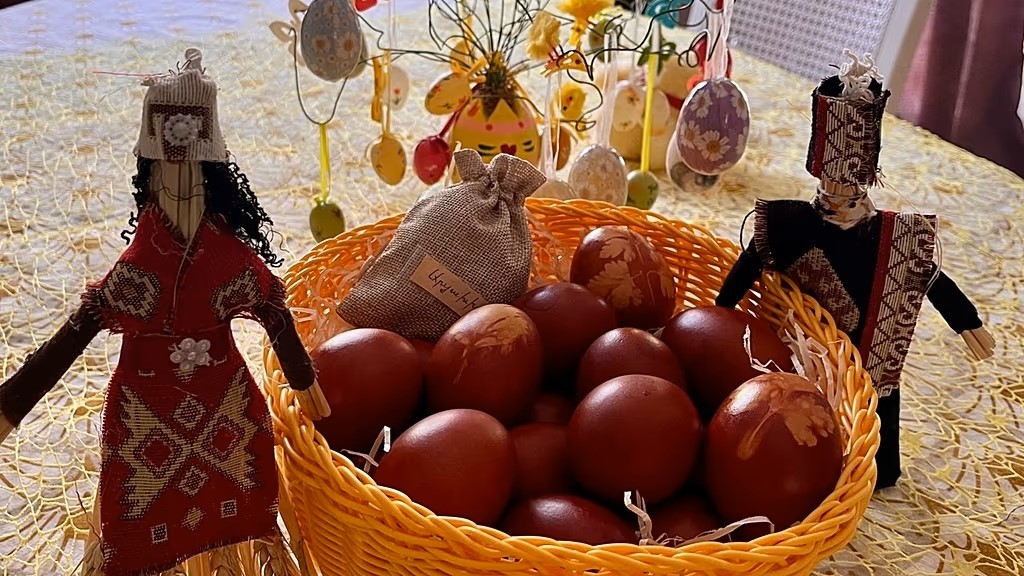
Yerevan (AsiaNews) - Like the Orthodox Churches, this year the Armenian Apostolic Church also celebrates Easter (in Armenian Zatik) on 12 April according to its own specific calendar, with particular popular enthusiasm expressed through symbols such as coloured eggs.
The egg is in fact considered the most obvious symbol of the resurrection and the beginning of new life, and the colour red recalls the blood of Christ in his sacrifice on the cross, shed for the salvation of all mankind.
Easter eggs are found throughout the Christian world in various forms, but the Armenians draw upon the profound teachings of their masters, such as Saint Grigor Tatevatsi, a 14th-century theologian and philosopher, musician, artist and educator, who, together with his disciple Ovanes Vorotnetsi, a church hierarch and a leading figure in Armenian political life.
The saint explained that “only at Easter do we paint eggs, for the egg is a symbol of peace and, as the ancient sages say, the outer shell is like the sky, the membrane like the air, the white like water and the yolk like the earth. Holding the red egg in our hands, we proclaim our salvation”.
With eggs in hand, people go to the Čragalujts, the Easter Vigil, awaiting the announcement of the Resurrection, which brings the fast to an end, and the faithful greet one another with the words “Christ is risen from the dead”, to which they reply in Armenian “Blessed be the Resurrection of Christ”, instead of the Orthodox “He is truly risen”.
Easter is followed by the fifty days leading up to Pentecost, a period known in Armenian as Khinank or Khunuk, from the numerical term ‘fifty’. The Armenians have a simple and touching tradition in their Easter preparations, which reaches its peak at Pentecost: the sprouting of grains. A few days before Zatik, wheat or lentils are placed in a small dish or earthenware bowl, watered and exposed to the light.
When the green shoots appear, the house is filled with a sense of spring, as if the earth itself were awakening right on the windowsill. These shoots are placed on the Easter table as a symbol of renewal, life and blessing. Western Armenians often decorate the plants with a red ribbon ‘to ensure a peaceful and happy year’ and, in some families, the sprouts are then planted in the garden, in the belief that they bring good luck to the home.
Immediately after Barekendan, the last sumptuous feast before the forty days of Lenten abstinence, two dolls appear in Armenian homes: Utis Tat (Grandmother Utis) and Aklatiz (Grandfather Pas).
Utis is plump, with rosy cheeks and a ladle in her hand: the mistress of the fragrant kitchen, the guardian of the flavours and joys of Barekendan. Aklatiz, thin, austere and holding a staff, reminds us that the time of abundance is over and that the path of purification has begun.
During Lent, the two seem to quarrel with one another: Utis guards the memory of sumptuous dishes, whilst Aklatiz keeps the house in silence, discipline and prayer. At Easter, their little dispute comes to an end: the dolls are put away as a sign that man has passed from abundance to abstinence and is now entering into the radiant joy of the Resurrection. Thus, two simple figurines become the symbol of a great inner journey: from winter to spring, from the carnal to the spiritual, from Lent to Easter.
Armenian Easter also features a rite that resembles an ancient legend: Andastan, the blessing of the four cardinal points. Only the Armenian Apostolic Church preserves this tradition, where every movement of the priest seems to rebuild the world anew.
The procession moves in a circle, inside or around the church, echoing the rhythm of the universe. The East is blessed as spirituality, the West as statehood, the South as fertility and the North as people and settlements.
Thus is born the ideal model of the homeland, founded on faith, well-being and unity. The faithful merely watch, yet the blessing touches everyone: the ritual seems to unite the nation. It is said that the roots of Andastan date back centuries, to pre-Christian times, when the circle was considered a symbol of protection and renewal. On Easter morning, this circle of light once again delineates the boundaries of the world, which the Armenians entrust to God.

.png)
07/02/2019 17:28
11/08/2017 20:05










