








Vicar of Arabia talks about the nuns in Yemen and the joy of Easter with those who suffer
Bishop Martinelli talks about the festivities in the conflict-stricken Gulf, starting with the testimony of the Missionaries of Charity. As a result of fear, some migrants have left the Emirates temporarily, while marriage and baptism courses are on hold. School and catechism classes have been "online for over a month." Church closures generated “significant media coverage”. A "people of peoples" from over a hundred countries bear witness to the faith.

Milan (AsiaNews) – The "most concrete example” of the mission in a war-torn area is that of "the Sisters of Mother Teresa of Calcutta" and “the priest who lives with them. I am impressed by their happiness, their joy of being in Yemen, able to stand beside the suffering people. They cannot solve the problems of their lives in conditions of extreme poverty, but they can offer concrete companionship to those in need,” said Bishop Paolo Martinelli, Apostolic Vicar of Southern Arabia (United Arab Emirates, Oman, and Yemen), who spoke to AsiaNews about Easter in one of the regions affected by the war launched by Israel and the United States against Iran, which has held the Gulf countries hostage for over a month.
In Aden, as in Dubai and Abu Dhabi, "this," the prelate adds, "seems to me the most important thing: to be there, to be a presence, a companion to men and women in their concrete situations, and to show how Christ [...] never stops walking with us." This also means keeping alive symbolic places like the Abrahamic Family House in the United Arab Emirates (UAE), which, despite being closed due to the war, has not interrupted "the path of interreligious dialogue," noting that "the use of violence in the name of God" is actually "an abuse of religion."
The full interview with Bishop Martinelli follows:
How did the Catholics in the vicariate experience Holy Week and Easter Sunday? Were there greater concerns about the war, or did the desire to celebrate and experience the feast prevail?
Before Holy Week, the only recommendation was to avoid large gatherings of the faithful, a requirement we diligently adhered to. We cancelled some activities and moved catechism online. Unfortunately, the situation got worse right at the start of Holy Week, especially in the Emirate of Dubai.
For this reason, at the beginning of the Triduum, civil authorities announced the closure of all places of worship in the Emirate of Dubai, [including] two of the largest parishes, which serve hundreds of thousands of faithful. Some celebrations were broadcast online. Many decided to travel to churches in other emirates to follow the Easter celebrations in person.
The management of the celebrations and the flow of faithful in the various parishes was very efficient thanks to the work of the priests, the staff involved in the various services, and all those who took part, followed instructions, and accepted to make some small sacrifices.
Have the forced closures led to greater attention towards Christians?
In recent days, we have had significant media coverage in the local and national press, like never before. The closure of the two churches in Dubai drew media attention, and several journalists came to learn about the life of our communities during this Easter season.
The Abrahamic Family House remains closed; however, through official channels, I was able to send a message of good wishes to the faithful who typically attend it, expressing the hope of being able to celebrate together again soon.
Civil authorities usually do not participate in our celebrations. Christmas is the time when we usually receive official greetings from them, but in recent days I had the pleasure of receiving some messages of good wishes.
Your Excellency, can you tell us about a particularly significant moment during the Easter season?
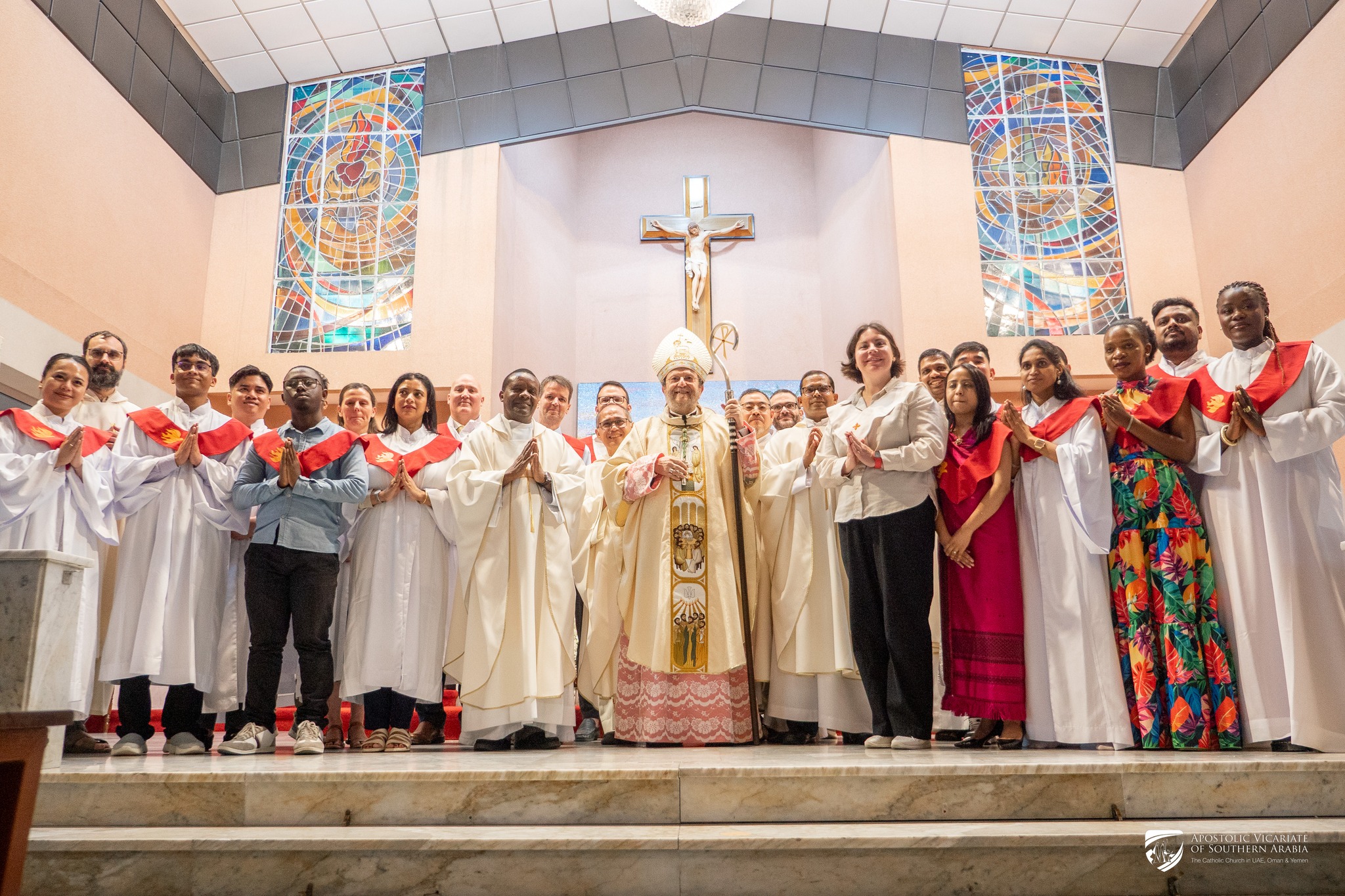
I would like to mention two significant events: the first is the Chrism Mass with all our clergy; we are all missionaries here. I was moved to see all the priests gathered in church to renew their priestly pledges next to the bishop. In my homily, I explicitly thanked them for staying [to continue] the vicariate's mission, joyfully facing the hardship of this wartime situation.
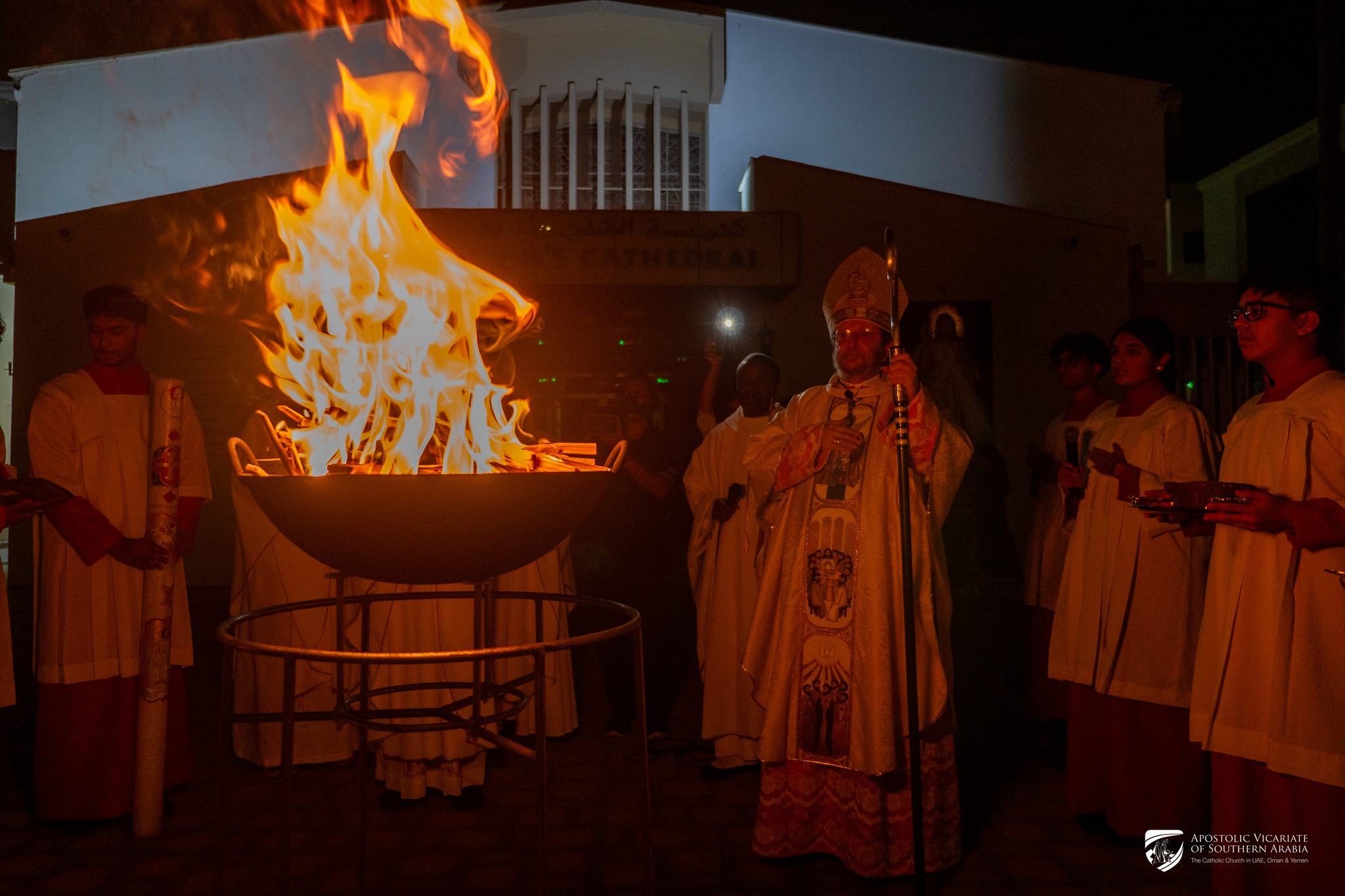
I was struck by the large turnout of the faithful at the Easter Vigil, despite the limited space (all celebrations in the cathedral were moved indoors for security reasons). This is truly a holy and faithful people. I thanked the Lord for this "people of peoples" from over a hundred different countries, who truly form, as Pope Francis said, a "joyful polyphony of faith." At such a time, the faithful seek closeness to the Lord, especially through the sacraments and the Mass.
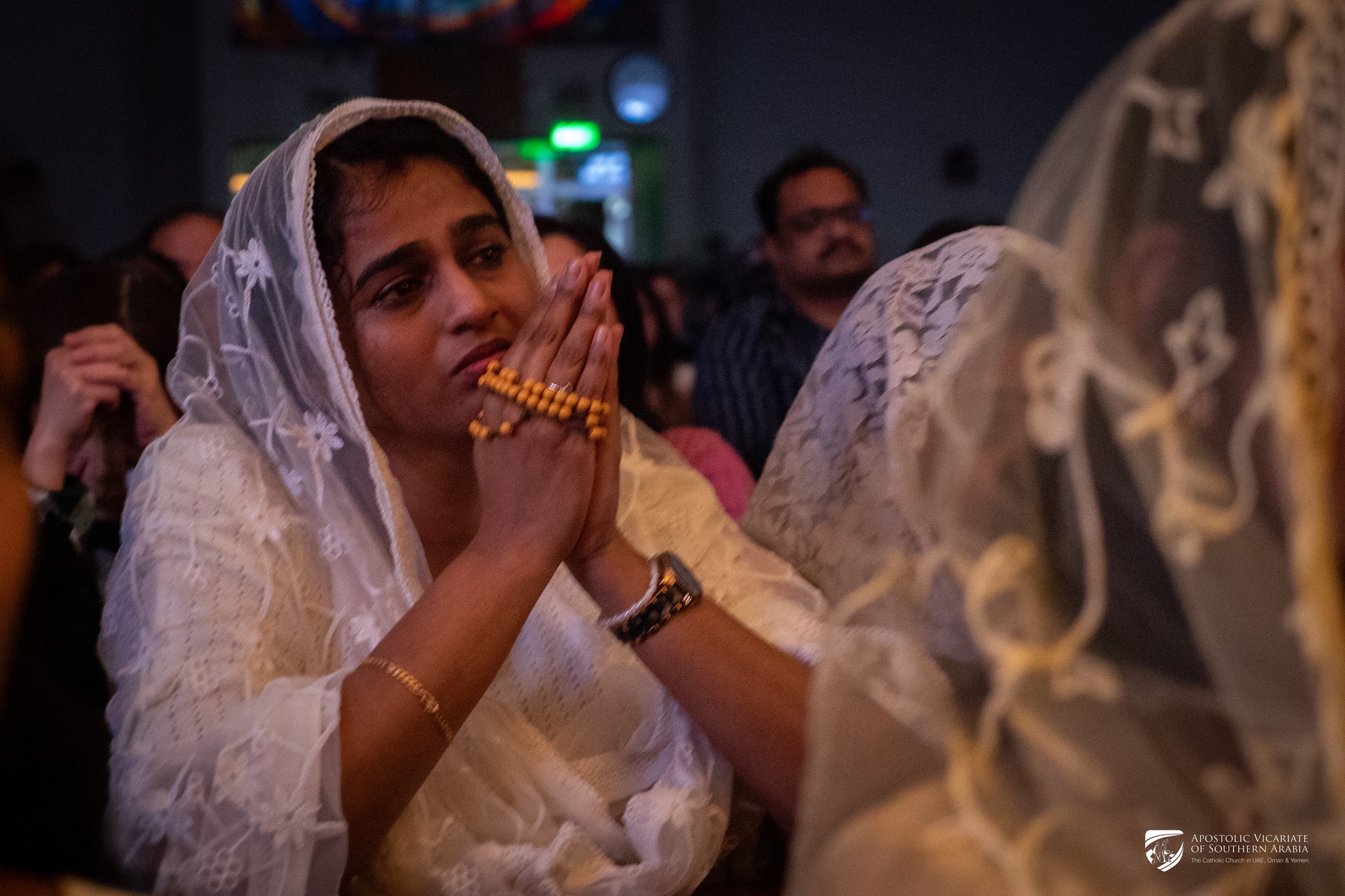
Holy Week, in particular, saw a large influx of people to confession. Then there were fears and worries about work, children, and the future. We try to help each other, to share, but above all, it is crucial to strengthen our sense of belonging to the Church, to the people of God. The most dangerous thing is loneliness.
In this sense, at Easter, it is important to emphasise that Baptism, which unites us to the death and resurrection of Christ, has made us one body; no one can ever separate us from the love of Christ.
More than a month has passed since the start of the war that has engulfed the peoples of the Gulf. From the first days, we have stressed the possible consequences from a religious and confessional perspective, starting with the Abrahamic House. What is the situation today?
On the one hand, life has continued as usual. Especially in the United Arab Emirates, the defence system has been very effective, while in Oman, attacks have been very limited. On the other hand, it is undeniable that there are fears related to the future, especially regarding employment, since it is hard to see a way out at present.
When it comes to interfaith dialogue, the issue is very complex. The players in this conflict, unfortunately, coat the war with a religious narrative that opposes any form of dialogue. This is profoundly flawed and ambiguous.
As Pope Leo put it, it is absurd to justify violence in the name of God. Moreover, the document on Human Fraternity, signed in Abu Dhabi by Pope Francis and the Grand Imam of Al Azhar [Ahmed al-Tayeb], describes the use of violence in the name of God as an abuse of religion.
The Abrahamic Family House is still closed, but the path of interreligious dialogue continues. Two examples illustrate this. Shortly before the end of Ramadan, the local authority in Abu Dhabi convened all religious leaders to break the fast together. This is an annual event. Last year, it was held at the Abrahamic Family House; this year, it was held in a municipal building.
Furthermore, just before Easter, the Minister of Tolerance and Coexistence, Sheikh Nahyan bin Mubarak Al Nahyan, convened all religious leaders for a forum on the relationship between religions and the promotion of the family as the foundation of society, which I also addressed.
In the coming days, sponsored by the same ministry, a meeting will be held on religions and social cohesion. Thank God, this journey continues, and it is extremely important that it not stop.
The vicariate's Catholic community is overwhelmingly made up of migrants, among the first to suffer the consequences of the conflict. What are their concerns, and what are they asking you?
I have heard of some disruptions related to the celebration of the sacraments; some have left the country, at least temporarily. Some marriage preparation courses and adult Christian initiation courses have been put on hold. However, we trust that these are only temporary problems, which will gradually resolve themselves.
The fact that both school and catechism have been online for over a month remains a burden for young people living in the Emirates. We held an online meeting with over a thousand teenagers and discussed their fears, what it means to experience this hardship as Christians, how to remain anchored in Christian hope, and how to pray during this time. It was a very intense moment and one of great spiritual sincerity.
Are their fears short-term, political and security-related, or long-term, enough to call into question their future and their continued presence in their countries of emigration?
War is always a shock. It challenges our certainties and raises new questions about the present and the future. In the Emirates, despite the large number of attacks by Iran, daily life continues, albeit more subdued.
People see that the security systems work well, but they don't easily get used to the alarms and the noise of missiles and drones. Certainly, there are sectors that are suffering. Many are fearful about the future, but for now, hope for a return to normal life seems to prevail. The country appears very united and cohesive.
Your Excellency, how much does the conflict impact daily life?
Again, it depends greatly on the location and type of work. In Oman, the situation is much quieter; people work regularly. Attacks have been sporadic. Church life is essentially unchanged. In the United Arab Emirates, the tourism and fishing sectors are affected by the conflict, while other sectors have managed to reorganise themselves through remote work.
From the start, I invited all the faithful to be united in prayer for peace and in solidarity with those in need. People are trying to help each other to overcome the present moment, in the hope that we can move towards a resolution of the conflict. Our laity are playing a key role in all of this.
As a pastor and community leader, what are your greatest concerns?
Ours is a unique Church, in many ways, within the Catholic Church. All the faithful are migrants and are here to work. There are no "local" Christians. The fears are typical of the world of migrants, of those with a strong sense of the transitory nature of things and circumstances. The war has profoundly heightened this condition and perception.
My greatest concern as a pastor is to offer everyone the companionship of faith, ensuring that no one is alone or isolated. But our Church does not have the means to respond to the great economic problems people face.
Our mission is to build the Church as a Christian community that accompanies the lives of the faithful, celebrates the faith, prays, prepares them in a mature and responsible faith, increases charity towards one another and towards those in need, and promotes Christian witness in all areas, to contribute to the good of all.
Do you have a model that inspires you in your mission?
Perhaps the most concrete example is the Sisters of Mother Teresa of Calcutta in Yemen. On the morning of 4 April, we had an online meeting with all the nuns (who number 10) and with the priest who lives with them. I am impressed by their happiness, their joy of being in Yemen, able to stand beside the suffering people.
They cannot solve the problems of their lives in conditions of extreme poverty, but they can offer concrete companionship to those in need and bring together the few Catholics for celebrations in the chapels of their homes, and thus humbly be the Church that lives in Yemen. This seems to me the most important thing: to be there, to be a presence, a companion to men and women in their concrete situations, and to show how Christ is present and never stops walking with us.
His death and resurrection have already embraced all possible evil, past, present, and future. He is here with us, even when the alarm goes off, even when you hear the sound of missiles and drones. The Lord in his Easter has united himself with us forever, and with him we can always begin anew with indomitable hope.
(Pictures from the website of the Apostolic Vicariate of Southern Arabia)
GATEWAY TO THE EAST IS THE ASIANEWS NEWSLETTER DEDICATED TO THE MIDDLE EAST. WOULD YOU LIKE TO RECEIVE IT EVERY TUESDAY? TO SUBSCRIBE, CLICK HERE.

.png)
12/02/2016 15:14
19/03/2025 14:39
15/09/2024 12:55
11/08/2017 20:05










