








Vicar of Istanbul: an ecumenical Easter of ‘peace and hope’ for the Middle East
Bishop Palinuro tells AsiaNews about the Holy Week celebrations, just a few months after the Pope’s visit. The repercussions of the Gulf War are hitting the most vulnerable: the poor, migrants and refugees. Ankara “has not responded” to Tehran’s “provocations” and remains a “moderating presence” in regional conflicts. Pope Leo XIV’s apostolic journey continues to “yield positive results”.
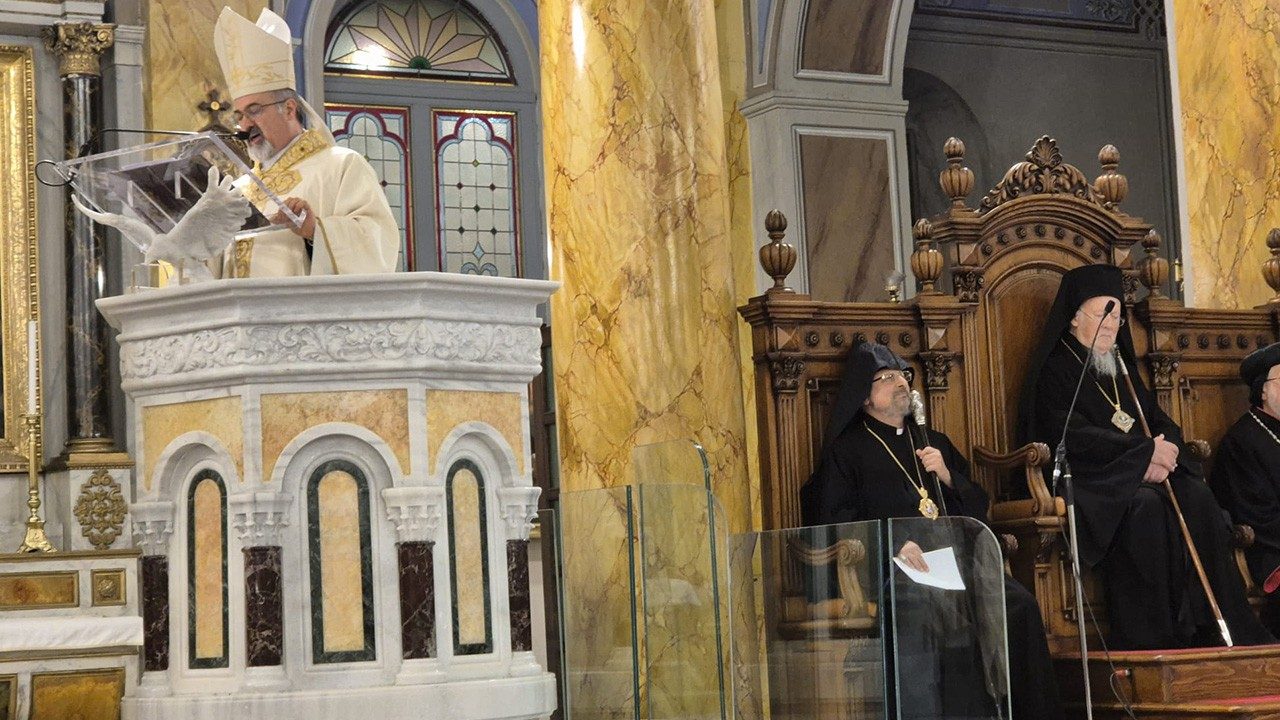
Milan (AsiaNews) - “Even in a context such as ours, with an Islamic majority, Easter is observed with particular fervour and is prepared for by the various communities with great zeal and much hope. What characterises it is an attitude of openness towards the future, of anticipation for a turning point in relations in the Middle East in particular.” This is what the Apostolic Vicar of Istanbul, Bishop Massimiliano Palinuro, told AsiaNews, as he prepares for the Holy Week services, beginning with the Chrism Mass celebrated yesterday evening. “Here in Istanbul it is particularly complex because it involves the participation of bishops from the Eastern Churches, representatives of the [Ecumenical] Patriarchate of Constantinople, and the Apostolic Nuncio [Bishop Marek Solczyński]. This too – the prelate confides – is a sign of hope: this communion in prayer” between Catholics and other Christian denominations who “celebrate together; these are truly signs of communion and fraternity that give hope”.
Turkey has so far been only marginally affected – at least militarily – by the war launched by the United States and Israel against Iran, having intercepted on a couple of occasions some missiles heading towards its territory. However, the political and energy consequences are being felt, and it is in this context that Ankara’s decision to accelerate plans for “peaceful nuclear energy” to meet energy needs fits. Describing the services and the special intentions of the faithful, the Vicar of Istanbul speaks of “an atmosphere of prayer to obtain from the Lord the gift of peace. “What we are experiencing at this time,” he continues, “is the inability of human means to achieve peace […] and this increases our trust and hope in the Lord’s help.”
“This is the most significant attitude,” explains Bishop Palinuro, noting that where “human means are failing” and revealing “their inadequacy”, the Christian community responds “with prayer to invoke the gift of justice” which is under threat in the Middle East and throughout the world. “We are celebrating Easter,” he continues, “amidst concerns over the prospect of a conflict that seems to have no end, risking to spread and involve other countries.” “This war, globally and here in Turkey in particular, has already claimed many victims among the most vulnerable sections of the population. Refugees, economic migrants, and the poor of every kind,” he notes, “are even more stifled by the inflation and social injustice that the war causes.”
An indirect involvement in the Gulf crisis, which is also reflected within Istanbul’s Catholic community: “Many members of our communities,” says the vicar, “come from countries directly involved in the conflict: Iran, Iraq, Lebanon in particular, and Syria.
“These brothers and sisters of ours, who have already lost their homeland for various reasons—due to other wars, other forms of persecution—are now being further stripped of their roots and their future by this conflict.” The Easter message, he continues, affirms once again that “evil cannot prevail; death and injustice cannot have the final say. “This Easter, then, becomes for us a proclamation of hope, and the people living in this state of despondency, and at times even despair, see in Easter,” he emphasises, “the only light that illuminates the darkness.”
Among Turkish Catholics, the memory of Pope Leo’s apostolic journey between late November and early December last year is still vivid. “Our community,” explains Monsignor Palinuro, “remains small, but vibrant and open to the future, full of hope and the leaven that makes the dough rise, the salt that gives flavour. We are committed to building relationships of peace with other Christian communities. We are committed to maintaining sincere collaborative relationships with the authorities and the government” and to demonstrating “inclusivity” within the Turkish religious and cultural landscape.
The distinctive feature, the vicar continues, is “the ability to foster dialogue among the different peoples and nations that make it up, in defiance of all forms of nationalism and identity-based tendencies”, as a true “presence of peace and a sign of possible inclusivity”. “Here, the Church truly shows itself to be like a single people of God,” he adds, “made up of many nations from many places, speaking different languages and belonging to different cultures. And this sign becomes particularly significant whilst opposing nationalisms, and identity-based, racial or religious pride” are tearing apart “the unity of the human family”.
Continuing his reflection on international conflicts, the prelate sees Turkey as “a moderating presence” and one of the few nations that plays “a key role” in maintaining “a profile of great balance”. “By its very nature,” he emphasises, “it lives between different worlds and is inevitably compelled to engage in dialogue and create channels of communication”. Great leaders seem to have “lost the sense of the common good” and “rather than wisdom, they appear driven by blind calculation, anger and passions”, observes the prelate. Hence Turkey’s “extremely positive” role in terms of “moderation, pacification and dialogue, both in terms of intergovernmental meetings and from a diplomatic perspective”. Ankara has so far “not responded” to Iran’s “numerous provocations”, the bombings and attacks in border areas, and “this is a positive sign”. A testament to common sense for other nations, he notes, which “are plunging into the vortex of retaliation”.
The war in the Gulf and tensions in the Middle East also have consequences for relations between governments and peoples. “It is clear,” observes Monsignor Palinuro, “that the warmongering attitude of the current government of the State of Israel has provoked, at an international level—and here in Turkey in particular—a resurgence of the never-dormant anti-Semitism, with all its devastating consequences.” The government of Prime Minister Benjamin Netanyahu is creating “new pretexts to fuel this rhetoric. “To defuse this anti-Semitism,” he adds, “it is necessary for [Israel] to change course and for the Palestinian people to be granted those essential rights that lead to peaceful coexistence.” “There is no other way, no other hope,” and what Turkey is clamouring for “is a change of course that appears necessary.”
Bishop Palinuro concludes by returning to the Pope’s visit, the memory of which “continues to have a positive impact” not only among Catholics encouraged “by his words and presence” but also among other Christian denominations, the Ecumenical Patriarchate, the government and the Muslim majority. The Pope’s visit, he emphasises, “has opened up new prospects for resolving the unresolved issue of the lack of legal recognition of the Catholic Church”. In this regard, “a dialogue forum has been established, a joint Turkish-Vatican commission to discuss possible solutions. It is expected that in the coming months – concludes the Apostolic Vicar of Istanbul – there will be a second meeting of this joint commission and that a solution may be reached to this problem, which creates considerable difficulties for the management of the Church’s structures and activities operating in Turkey”.
(Image taken from Vatican media)

.png)
12/02/2016 15:14










