








Cardinal Pizzaballa: “God is with those who die in war, not with those who abuse his name”
The Patriarch of Jerusalem’s address at a webinar organised by the Oasis Foundation. “We have seen in these decades of conflict what violence has produced: only further fear, resentment and hatred. We know that Leo XIV’s appeals will fall on deaf ears, but we must continue to speak the truth. Information is a weapon in this conflict. Gaza has been forgotten, yet the situation remains dire. In the West Bank, there are almost daily attacks by settlers on Palestinians'.
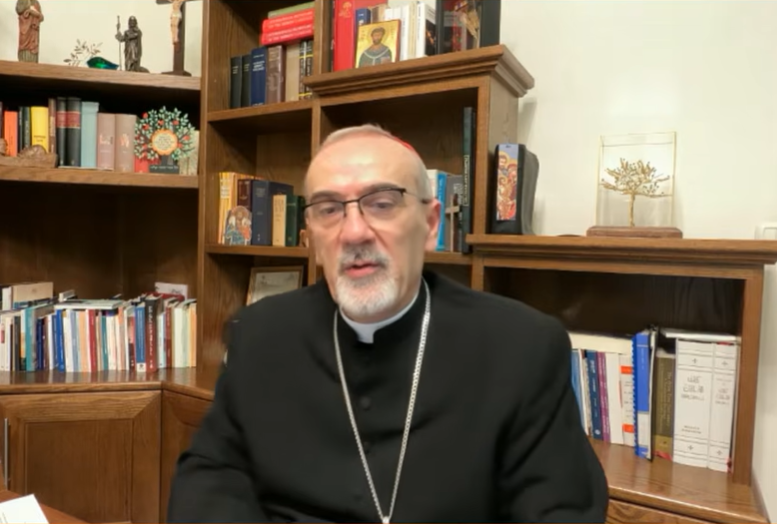
Milan (AsiaNews) - “The abuse and manipulation of God’s name to justify this and any other war is the gravest sin we can commit at this time. War is first and foremost political and has very material interests, like most wars. We must do everything we can to leave no room for this pseudo-religious language, which speaks not of God, but of ourselves”.
Cardinal Pierbattista Pizzaballa, Latin Patriarch of Jerusalem, said this last night whilst speaking from the Holy City at a webinar organised in Italy by the International Oasis Foundation on the conflict tearing the Middle East apart. Asked about the words of Secretary of War Pete Hegseth, who during a briefing went so far as to quote Psalm 144 to invoke a divine blessing on the ongoing attack, Cardinal Pizzaballa replied that “as believers we must do everything possible not to leave the discourse to them. We need to say that no, there are no new crusades. If God is present in this war, He is among those who are dying, who are suffering, who are in pain, who are oppressed in various ways, throughout the Middle East – I am not saying on one side or the other. This conflict has religious connotations, but they are manipulations: those who wish to bring religion into it exploit the name of God.”
Commenting further on the appeal launched once again yesterday by Pope Leo, the Patriarch of Jerusalem said: “We have seen in these decades of conflict what violence has produced, the human devastation in which we now find ourselves. What is built on violence perishes; it has no future, but it also creates a void around itself: fear, resentment, hatred—all that which, in Christian language, belongs to the world of death. It does not allow you to see anything beyond yourself.” “We know full well that the Pope’s appeal is very true, but also that it will fall on deaf ears,” added Cardinal Pizzaballa bitterly. “But what use is a Church if not to speak of a reality that does not yet exist? We must continue to say these things that may seem far-fetched, but in which we believe because they are true. We also need to come together, to know who we can count on and invest in for the future.”
During the link-up with the Oasis Foundation, the cardinal also had strong words on the role of the media in this war: “Communication,” he said, “is part of the conflict; it is a way of making it known but also of justifying it, of making it acceptable. And so the role of journalists is not merely to report the news, but to scrutinise it critically, to help the reader make sense of what we find, to provide as accurate an interpretation as possible, or at the very least to help them form a critical view and make their own judgement.”
In this regard, he highlighted the information blackout currently enveloping Gaza and the West Bank. “Gaza is no longer being discussed, but the situation remains dire from a humanitarian perspective,” explained Pizzaballa, who is in constant contact with the Holy Family parish.
There is no longer a problem of hunger, but there are still 2 million displaced people, deprived of everything; 80% of the Strip is still destroyed, and no reconstruction has begun; 36 hospitals are partially operational, but medicines are lacking, even basic antibiotics. People are literally living in the sewers; the images cannot convey the smells. It is impossible to understand how and when this dramatic situation will be resolved: the Board of Peace has not yet understood what it should do. And in any case, it is a sort of vicious circle: if Hamas does not hand over its weapons, Israel will not withdraw; Hamas will not hand over its weapons unless Israel withdraws. Everything remains at a standstill.”
“As for the West Bank,” he added, “the situation is deteriorating constantly: almost every day there are attacks by settlers on Palestinian villages. There are now almost a thousand checkpoints; Palestinians still struggle to move about, and permits have largely been cancelled.” Finally, the Patriarch also expressed concern about the consequences of two recent measures relating to the land registry and the non-recognition of Palestinian academic qualifications in Israel, recently adopted by the Israeli government: “Bear in mind that in many Palestinian areas, properties are not registered; they are still tied to the old administration prior to 1967, so it is all very complicated,” he commented. As for the other problem in our schools, we have 232 Christian teachers who come from Bethlehem, because we do not have any for Jerusalem. They will no longer be able to come. And this will not only cause financial hardship for their families, but also for the schools because they will not be able to find Christian teachers. And these,” he added, “are just two examples to illustrate how complicated the situation remains for all of us.”

.png)










