








Census is the new frontline in Manipur’s ethnic war
Thousands of people took to the streets to demand the postponement of the 2027 census until the National Register of Citizens is updated. For the majority Meitei, this is a tool against illegal immigration from Myanmar, while for the Kuki-Zo minority, it risks becoming a means of political and social exclusion. The ethnic conflict that broke out in 2023 remains unresolved, exacerbated by competition for land and cross-border routes.
INDIA
Census is the new frontline in Manipur’s ethnic war
Nirmala Carvalho
Thousands of people took to the streets to demand the postponement of the 2027 census until the National Register of Citizens is updated. For the majority Meitei, this is a tool against illegal immigration from Myanmar, while for the Kuki-Zo minority, it risks becoming a means of political and social exclusion. The ethnic conflict that broke out in 2023 remains unresolved, exacerbated by competition for land and cross-border routes.
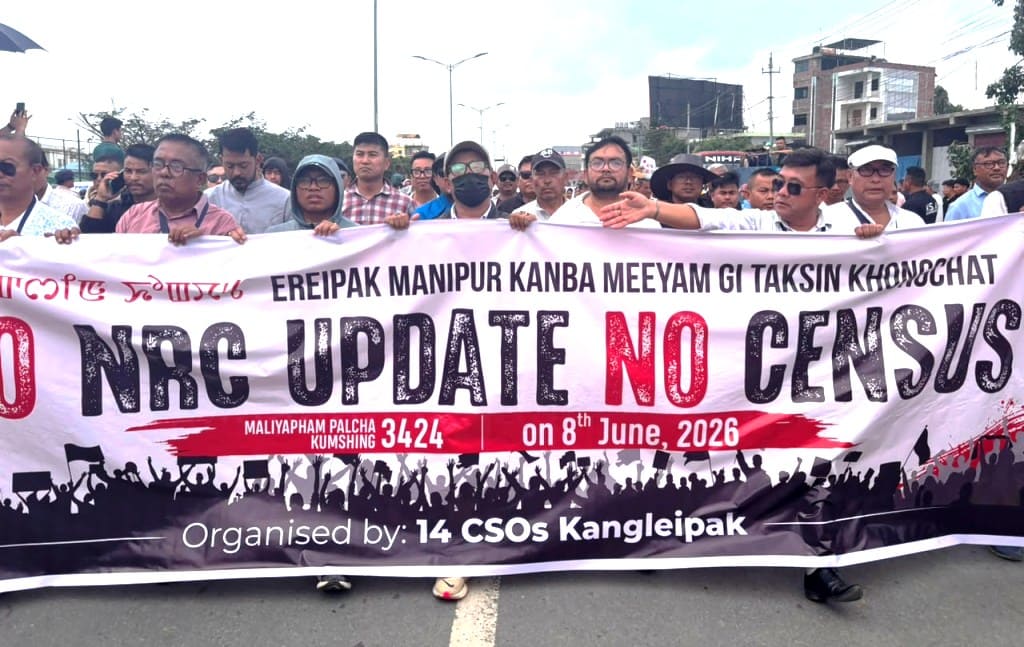
Imphal (AsiaNews) – Thousands of people took to the streets in Imphal yesterday to demand that the national census scheduled for 2027 not be conducted in Manipur before the National Register of Citizens (NRC) is updated.
The state government responded by reiterating a call for reconciliation with the Kuki-Zo community, still deeply affected by the ethnic violence of the past three years. Despite this, interethnic violence continues and is becoming increasingly complex.
The rally, organised by a group called CSOs Kangak, demanded, “NRC First, Census Later”. The protesters called on the central government in New Delhi to halt the publication of census data and to withhold the redrawing of constituencies until an NRC based on the 1951 census data is completed.
According to the organisers, the census risks altering the demographic balance of the state without first identifying those considered illegal immigrants.
This is a particularly sensitive issue in Manipur, where a portion of the majority Meitei population, which lives mostly in the Imphal Valley, has believed for years that immigration from Myanmar has changed the ethnic make-up of the hilly areas, home mostly to the Kuki-Zo (about 16-20 per cent of the population) and Naga (about 24% of the population) communities.
Myanmar is precisely one of the key issues in the crisis. The long border, crossed in recent years by tens of thousands of people fleeing the civil war that erupted after the 2021 coup, has become a major issue in Manipur.
In several parts of the state, the situation is out of control because ethnic armed groups have been fighting for decades, sometimes against the central government, for greater local autonomy.
The border between India and Myanmar is largely a legacy of British colonial rule. When the two countries gained independence in 1947 and 1948 respectively, it became an international border, dividing people from the same ethnic groups, stuck on either side of the border.
Manipur itself, for example, joined India in 1949, two years after the partition of India and Pakistan and the creation of the two states. Over the following decades, each ethnic community formed its own armed organisations (although they are called volunteers locally, and meant to protect villages), not unlike what happened in Myanmar.
Yesterday, the Kuki-Zo community forcefully rejected the protesters' request; for them, the NRC is a discriminatory instrument. For many members of the largely Christian minority, a procedure based on historical documents risks harming the very families who suffered the heaviest consequences of the violence that broke out three years ago.
The conflict has so far left more than 250 people dead, according to official figures, and forced more than 60,000 people to flee their homes, creating one of India's worst internal crises in recent years.
Thousands of displaced people are still living in temporary camps, often without identity papers, property deeds, or other documents necessary to prove their citizenship. This situation is increasingly common in other northeastern states of India.
In several states governed by the BJP, which also controls the central government, deportation campaigns have multiplied, targeting primarily Bangladeshi Muslim immigrants, accused of having entered illegally from Bangladesh even though they are resident Indian citizens.
The fear, in this case, is that the same situation will arise with the displaced Kuki, who, however, risk being expelled to Myanmar, a country embroiled in a brutal civil conflict since 2021. For Kuki-Zo leaders, requiring displaced persons to present today papers dating back to 1951 would represent an insurmountable obstacle.
If the Meitei majority's requests were granted, Indian citizens of Kuki ethnicity risk being excluded from the registry simply for not possessing the required documents, finding themselves involved in administrative disputes or even risking being classified as illegal immigrants. This situation would mirror what is already happening in neighbouring Assam.
Tensions over the issue have also grown since the meeting, held between 5 and 7 July in New Delhi, between a delegation from Manipur and the Registrar General and Census Commissioner of India, responsible for the national census.
Manipur's new chief minister, Yumnam Khemchand Singh, who belongs to the Meitei majority, has attempted to revive intercommunal dialogue. During a visit to Kangpokpi District, a Kuki-Zo stronghold, he invoked the principle of "forgive and forget" as the basis for building lasting peace.
The chief minister met with representatives of local Christian Churches, who handed him a memorandum calling for an investigation into the killing of three pastors during the violence and for an end to the economic blockade that continues to impact several parts of the state.
Addressing the protesters, Singh stated that the protracted conflict is particularly affecting the younger generations, who have grown up in a climate of division and mutual distrust. His words, however, are unlikely to be enough to bridge a rift that remains deep.
In November last year, some radical armed Kuki groups proposed to the Indian central government the creation of a Union Territory for the Kuki-Zo community, who, unlike the Meitei, is one of the tribal groups protected by the constitution. The new territory would also include Naga-majority districts.
At present, the conflict that erupted in May 2023 can no longer be interpreted simply as a clash between the Meitei majority and the Kuki-Zo minority. Since February of this year, violence has escalated between the Kuki and Naga communities as well; the two had already been at war since the 1990s, resulting in at least 1,500 deaths, according to some estimates.
The fighting contributed to shifting the demographic balance of several border areas, including Moreh, an important trading town on the border with Myanmar. Some Naga groups believe that they lost control of a strategic hub for cross-border trade, with its associated sources of income.
The Indian government, which from the late 1990s to 2015 signed several temporary peace treaties with various armed groups from various communities, has never found a real political solution to the tensions, much less the conflict that broke out in 2023.
Instead, it has simply continued to keep the armed groups from the various communities apart, separated by checkpoints and buffer zones manned by security forces. Some armed militias have de facto control over certain parts of the territory, after 6,000 weapons were taken from police arsenals in May 2023.
The conflict has thus become a complex competition for control of territory, resources, and the main trade routes to Myanmar, which also plays a key role in illegal trafficking, especially in timber, weapons, and drugs, of which the former Burma is the world's leading producer.
According to a 2025 study, drug trafficking in Manipur has seen a significant jump since 2020 (when the BJP came to power in the state), to the point of outpacing the state's legal economy. At the same time, those involved in the illegal trade, the report notes, are “high-profile politicians, top-rank army and insurgent groups”.

.png)
01/08/2018 15:23
24/03/2026 15:13
16/04/2025 17:19










