








China boosting Myanmar’s military regime, detains academic
Chinese President Xi Jinping welcomed his Myanmar counterpart, Min Aung Hlaing, to whom he has reiterated China’s support. The visit coincides with the recent arrest of a leading scholar of China-Myanmar relations and the release by an ethnic militia of 200 POWs captured during fighting along the border.
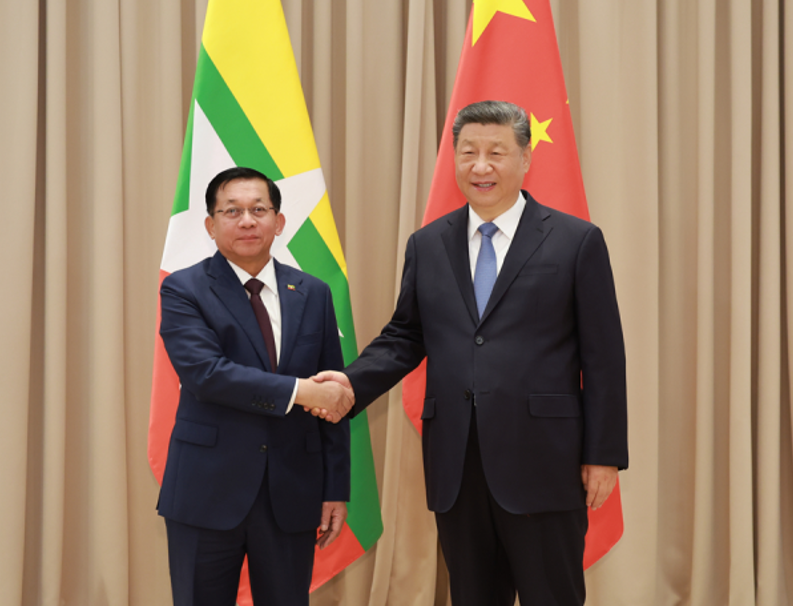
Beijing (AsiaNews) – Chinese President Xi Jinping received Myanmar’s President Min Aung Hlaing in Beijing yesterday, another show of China’s support for the government led by the former head of the Southeast Asian country’s military junta. This comes as Myanmar remains mired in civil war while China recently arrested a well-known Myanmar expert on Myanmar-China relations.
For Min Aung Hlaing, the visit represents another step towards the normalisation of the regime that took power in the February 2021 coup.
To this end, Chinese President Xi expressed his willingness to boost bilateral cooperation and promote the “pauk-phaw” (fraternal) friendship between the respective peoples.
According to China's Xinhua news agency, Beijing stands behind the development and security needs of the new Myanmar government to help it “find a correct path of development that suits its national conditions and wins popular support”.
At the end of the meeting, which lasted less than an hour, the delegations witnessed the signing of 18 memoranda on cross-border transportation in the Greater Mekong area, bilateral trade, disaster relief and cooperation in the health and communications sectors.
The visit, which will last five days, is the second time Xi and Min Aung Hlaing meet in less than a year.
For the Myanmar leader, this is the second trip abroad after India a few weeks ago since he formally took over the presidency as a civilian leader relinquishing his military positions in the wake of an election not recognised by the West and most of Myanmar’s Southeast Asian neighbours.
For Myanmar’s leaders, Chinese and Russian support thus represents an indispensable resource for their political survival.
According to a Yangon-based diplomat quoted by Nikkei Asia, the military regime "depends on Chinese support in the form of money, diplomatic backing and weapons”.
Still, behind the official statements it is also possible to see China’s concerns over Myanmar's stability.
Beijing has invested billions of dollars in strategic infrastructure (pipelines and pipelines) as part of its Belt and Road Initiative, which is designed to allow China to expand its trade by reducing travel times and avoid certain “bottlenecks”.
Xi wants to connect the southern province of Yunnan to the Indian Ocean through the China-Myanmar Economic Corridor, which crosses regions affected by fighting between Myanmar’s regular army and ethnic armed groups, who constitute the resistance to the regime.
Many observers believe that one of the main objectives of the visit is to reassure Chinese leaders about the ability of Myanmar’s government to ensure the security of the areas where infrastructure projects are being built.
In the past couple of years, China, although without directly intervening, has already exerted diplomatic pressure on ethnic militias to limit their offensives, contributing to the recent successes of the Myanmar’s military in recapturing territory, especially in the north.
In return, Min Aung Hlaing wants greater Chinese involvement to consolidate control over border regions and reopen trade.
The visit is taking place in a climate of rising tensions following the arrest in China of U Min Zin, a US citizen and a well-known Myanmar scholar, director of the Thailand-based Institute for Strategy and Policy-Myanmar (ISP-Myanmar).
Chinese authorities accuse him of espionage and threatening national security. U Min Zin went missing a few days ago when he arrived in Kunming, the capital of Yunnan, where he was supposed to attend a series of academic meetings.
The scholar is considered one of the foremost experts on Sino-Myanmar relations and the ISP-Myanmar has published numerous studies in recent years on China’s role in the conflict and the impact the civil war is having on trade along the border.
Richard Horsey, researcher at the International Crisis Group, a well-known Brussels-based think-tank, explained to Nikkei Asia that U Min Zin “has been a pioneer in promoting analysis of China-Myanmar relations, establishing one of the few dedicated China studies programs in Myanmar and encouraging greater dialogue and understanding between the policy communities in the two countries”.
For some analysts, his arrest is a signal of Beijing's growing sensitivity to any form of independent monitoring of its activities in Myanmar.
One of the latest ISP-Myanmar reports was an analysis of relations between China and the Myanmar National Democratic Alliance Army (MNDAA), one of the most prominent ethnic militias fighting the military junta, but subject, like several other groups, to Chinese influence.
Coincidentally, when Min Aung Hlaing arrived in China, the MNDAA handed over 200 prisoners of war to the Myanmar army.

.png)
04/05/2023 16:41
04/05/2021 16:15
01/08/2023 14:11
31/05/2021 11:25










