Bangkok (AsiaNews) - Having been the first to congratulate former General Min Aung Hlaing on his appointment as president of Myanmar – a role that perpetuates his control over the country more than five years after the military coup he led – the Thai authorities are continuing to consolidate relations with the Burmese regime.
So far, Thailand has shown itself to be the least hostile among the member states of the Association of Southeast Asian Nations (ASEAN) towards a counterpart accused of genocide and subject to international sanctions, without applying concrete pressure to bring about an end to repression and conflict. These are initiatives that ASEAN itself is formally calling for, moving beyond its traditional policy of ‘non-interference’ in the internal affairs of its member states.
Min Aung Hlaing’s transition from the leadership of the military junta to the presidency of Myanmar following last December’s sham elections took place, moreover, under the direction of the People’s Republic of China, which announced today that it will welcome Min to Beijing next week for a “state visit”.
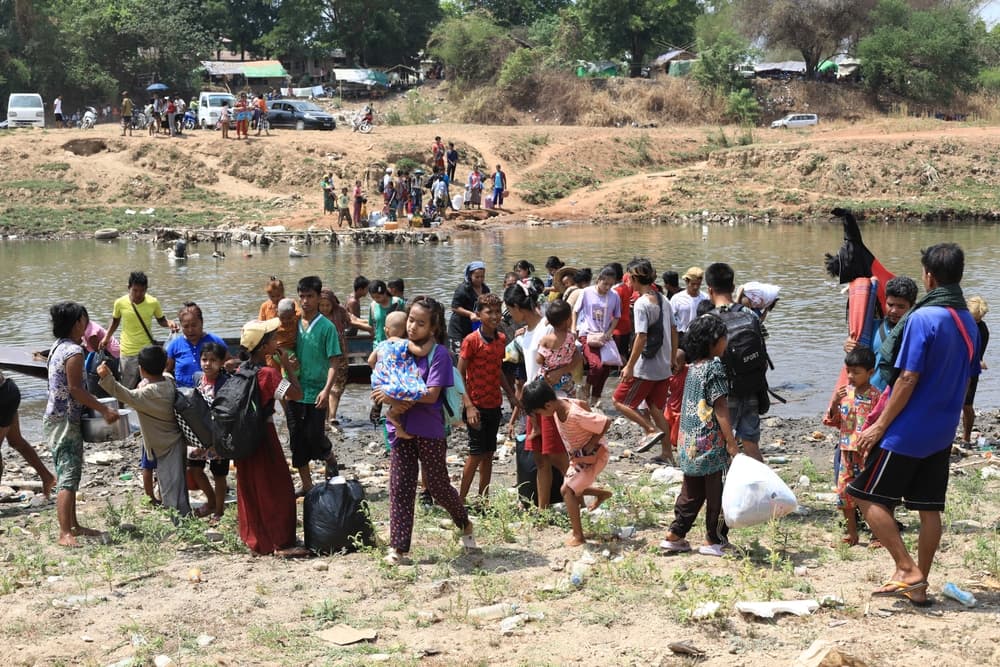
The result of all this is an ambiguous situation that inevitably affects Burmese people fleeing the fighting towards Thailand, among whom there have been thousands of cases of refoulement and frequent reports of abuse and mistreatment in the camps set up along the border. In Myanmar, mass crimes have displaced over three million people, with tens of thousands of refugees forced to flee to Thailand in search of protection. However, given the lack of a legal framework for their identification, it is likely that many are not counted and are not receiving any form of protection.
In November 2026, the United Nations Human Rights Council will review the human rights situation in Thailand from the end of 2021, as part of the Universal Periodic Review process, which covers all countries in turn.
In its report submitted five years ago to the Human Rights Council’s Working Group, Thailand had highlighted the government’s efforts, including a national screening mechanism to identify people in need of protection and ensure they are granted legal status and access to necessary public services. However, in 2023, Thailand reportedly granted protection to only seven individuals under this mechanism, which has been criticised for also including migrant workers.
Against this backdrop, several organisations are pressing Bangkok to take immediate and concrete measures to put an end to arbitrary arrests, detentions, torture and forced returns. As previously, Thailand has also received – without any tangible results – recommendations relating to refugees from the latest Review, including that concerning the ratification of the 1951 Convention relating to the Status of Refugees and the 1967 Protocol thereto.
On the contrary, documentation submitted by various organisations (including Fortify Rights) continues to report arbitrary arrests and detentions of refugees and systematic refoulement to Myanmar, including through cooperation with the Burmese military junta. In April 2024, the Thai authorities repatriated more than 650 refugees across the Moei River into an area of active conflict in Karen State. Between February 2024 and November 2025, the Thai authorities forcibly repatriated 3,500 Burmese nationals across the Ranong-Kawthaung border, some of whom were subsequently conscripted into the army at gunpoint.
In a similar context but involving different parties, on 27 February 2025 Thailand forcibly repatriated to China around forty Uighur refugees who had spent more than a decade in immigration detention centres. Meanwhile, yesterday, a Thai court found two other Uighur men guilty of the most serious terrorist attack in the country’s history, sentencing them to death. The two were found responsible for planning and detonating a powerful bomb on 17 August 2015 near the Erawan Shrine in central Bangkok, which killed 20 people and injured over 120. However, the verdict continues to raise doubts: irregularities in the police investigation and the trial, which lasted ten years, have left many questions unanswered regarding the full reliability of the conviction.