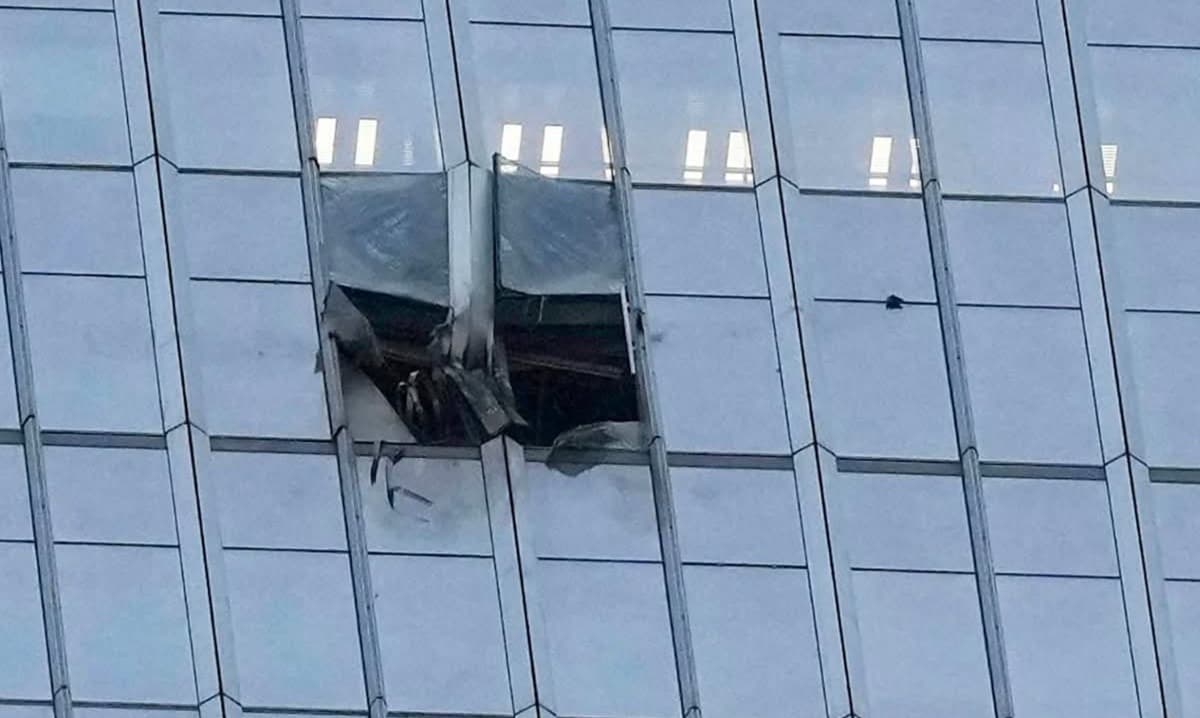
Beijing (AsiaNews) – Last Friday evening, a small, single-engine plane crashed into the CITIC Tower, Beijing's tallest skyscraper, at 5:55 pm (local time). Some of the building's windows shattered upon impact, sending shards and debris raining down from more than 500 metres on the street below.
Firefighters and ambulances quickly responded to the scene. Yet, shortly after, it was as if the accident had never happened. Within hours, posts, photographs, and videos of the crash had disappeared from Chinese social media.
Police officers on the scene prevented passersby from taking pictures at the scene and asked those who had already taken images to delete them. A delivery driver told Reuters that he had filmed the plane wedged into the side of the building, but then deleted the video for fear of repercussions.
A search for the building's name on Xiaohongshu, the local platform also known as RedNote, returned only content published the previous day, proving that more recent posts about the incident had been deleted by Chinese authorities.
State television CCTV, whose headquarters are located directly across the street from the crash site, also made no mention of the incident in its Friday evening news, a common practice in China: when accidents of this kind occur, information is immediately censored or barely mentioned in the hours that follow, especially after the information rapidly spreads.
Chinese authorities took nearly 24 hours to issue a deliberately vague official statement. “A single-engine, two-seat light sport aircraft collided with a high-rise building while flying near the East third ring road in Chaoyang,” reads a statement posted by Chaoyang District authorities on WeChat.
The pilot, the sole occupant of the aircraft, died on impact, while 13 people on the ground were injured, the official statement added. The circumstances of the accident, it continues, are "being investigated by the relevant authorities." The statement never mentions the name of the building, nor does it disclose the name of the pilot, nor their gender.
What went wrong?
The CITIC Tower, also known as China Zun after an ancient type of Chinese vase that inspired the building's profile, is a 108-story, 528-metre-tall skyscraper. Since 2018, it has been the tallest building in Beijing and among the top ten in the world.
It houses the headquarters of the CITIC Group, one of China's largest state-owned financial conglomerates, as well as the offices of technology giants and international financial institutions.
Several embassies, from the United Kingdom to Vietnam, are within a few minutes' walk. But the skyscraper is also just seven kilometres from Zhongnanhai, the heavily guarded complex where President Xi Jinping and the Chinese Communist Party's top brass live and work.
The airspace above Beijing is among the most tightly controlled in the world. Flying a light aircraft into the capital requires prior authorisation from both the Civil Aviation Administration of China and the People's Liberation Army Air Force.
A flight without these authorisations would be classified as a hei fei (literally black flight), i.e. illegal. Furthermore, new regulations went into effect on 1 May 2026, effectively banning all recreational flying and the use of civilian drones within the city's administrative boundaries.
A former pilot told the Financial Times that any aircraft entering the airspace within Beijing's Second Ring Road would immediately trigger an alert, potentially involving the Air Force.
The CITIC Tower is located just beyond the Third Ring Road, so the fact that a small propeller plane managed to reach it, apparently undetected or un-intercepted, raises a series of questions that have sparked online speculation due to Beijing's censorship.
Accident investigation
The aircraft involved in the accident was a Sunward Aurora SA60L, a Chinese-made two-seater light aircraft. It has a cruising speed of between 170 and 220 kilometres per hour and a maximum takeoff weight of approximately 340 kilograms.
The registration number, B-12PP, was visible on some of the wreckage captured in footage verified by several international media outlets, including the Financial Times and the Associated Press.
The aircraft belonged to Dongshi Shuangyue General Aviation, a flight school based at Shifosi Airport in Pinggu, a district about 60 kilometres east of Beijing as the crow flies.
Based on tracking data from Flightradar24, reported by the Chinese-language newsletter Shuiping Jiyuan, published on Substack, the aircraft made two flights on 26 June, the day of the accident.
The second flight record shows that the plane flew for several minutes over an area approximately seven kilometres from Shifosi Airport, then exited the assigned airspace, assumed a constant heading of 270 degrees (i.e. due west), and accelerated toward the centre of the capital. At normal cruising speed, it would have taken between 15 and 20 minutes to cover that distance. Contacted by the newsletter's author, the school reported that it had no information on the pilot's identity on the evening of the accident.
According to information released by Chinese dissident Li Ying (better known as Professor Li on X), the pilot, identified in the flight log as “Liu Junhua, commander”, had taken off at 5:30 pm for a solo training flight within authorised airspace.
Ten minutes later, instead of landing on Runway 18 as planned, the aircraft exited the assigned area and maintained a constant heading of 270 degrees.
Tracking systems reportedly followed the aircraft to the Fifth Ring Road, after which the signal disappeared. Subsequent attempts by the airport to contact control towers and the Air Force were met with no response.
The Liu Junhua case
The identity of the pilot is causing further confusion. Late Friday evening, a Financial Times journalist at Shifosi Airport reported seeing uniformed police officers supervising a group of men in black suits searching a black SUV parked inside the airport.
A search of the license plate of the vehicle, a Buick Enclave CXL, returned the name Liu Junhua. However, the Financial Times stated that it was unable to verify any connection between the vehicle, its owner, and the accident.
A woman named Liu Junhua held a senior position at a subsidiary of China CITIC Bank, the banking arm of the same group after which the skyscraper struck by the plane is named.
According to documents published on the CITIC Wealth Management website and cited by several Chinese-language sources, a woman named Liu Junhua was still listed as one of the five directors of the company's investment department on 22 June (four days before the accident). Documents dating back to 2023 also listed her as head of the investment management line.
The identities of the pilot and the banking executive may be the same, but it is also true that Liu Junhua is an extremely common name in China.
On Saturday afternoon (apparently in an attempt to stem speculation), CITIC Wealth Management issued a statement containing some statements attributed to Liu Junhua on economic and financial matters.
This indirectly contradicts the theory that she was the person who died in the crash. The statement, however, did not include any photographs or explicitly refer to the incident, sparking a new wave of suspicion on social media.
The question that has generated the most astonishment on Chinese social media remains unanswered: How did a small aircraft maintain an unauthorised route for at least 15 to 20 minutes and reach one of the most heavily guarded areas in China (apparently) without being intercepted?