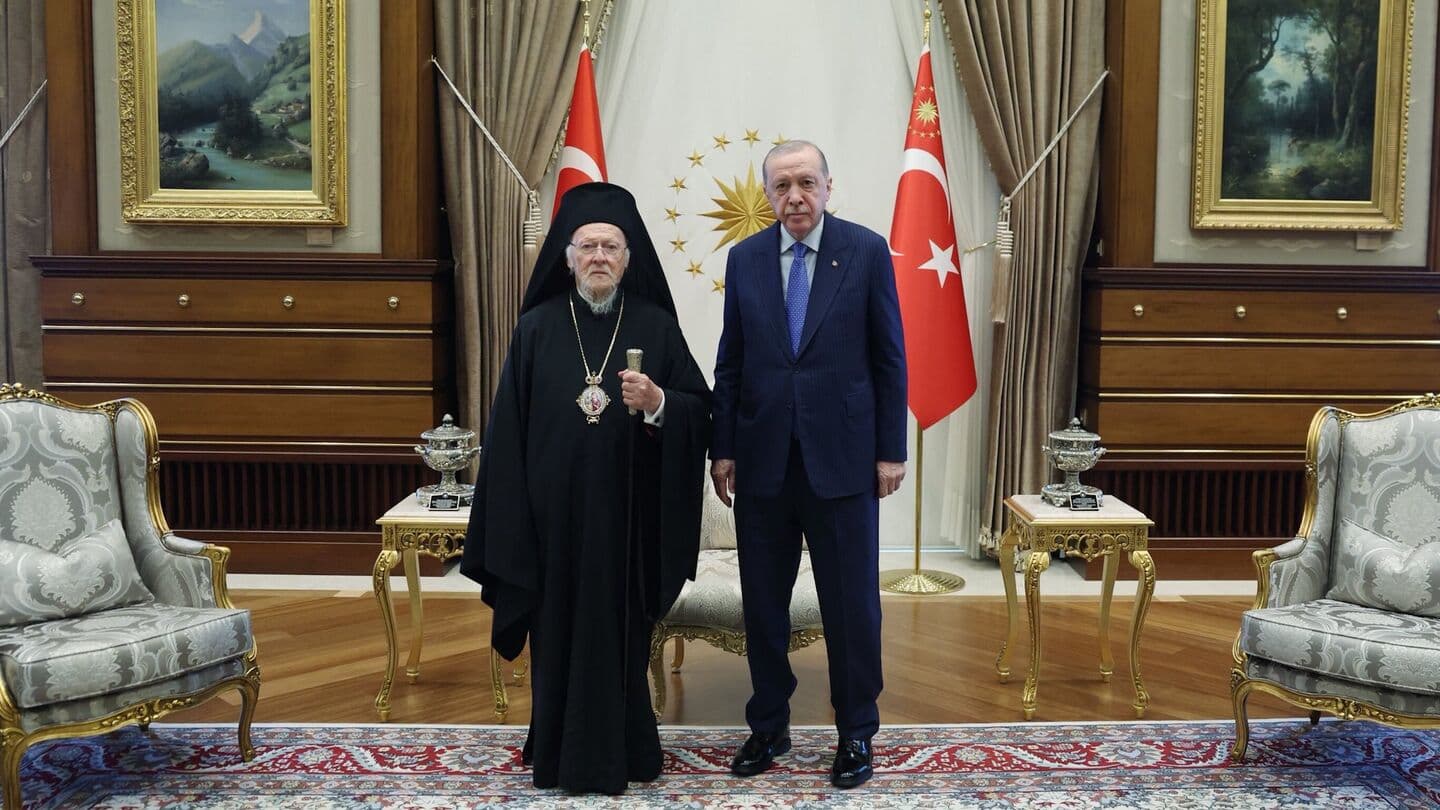
Istanbul (AsiaNews) – Ecumenical Patriarch Bartholomew I and Turkish President Recep Tayyip Erdoğan met yesterday (pictured) to discuss the reopening of the historic Halki seminary, one of Turkey's Christian heritage sites, ironing out the last details in order to achieve the long-standing goal of reopening the school by next September.
The rare face-to-face meeting rekindles hopes in Turkey’s Greek Orthodox community that the centuries-old theological institute, located on an island near Istanbul, will finally see the light.
This comes a few weeks before a NATO summit next month, which is also expected to include US President Donald Trump, who has previously called for the seminary's reopening during his last meeting with his Turkish counterpart.
The seminary’s history begins in 1772, when Halki monastery administrators received permission from the Ottoman sultan to open a school; however, the first classes were held only in 1844 due to a fire that broke at the facility in 1821.
After the original building was destroyed in the 1894 Istanbul earthquake, it was rebuilt with the permission of Sultan Abdulhamid II and reopened in 1896. It covers an area of 2,360 m2 and was designed in the shape of the Greek letter Π, Pi.
Following the Treaty of Lausanne, the seminary was required to operate within Turkey’s educational system; for this reason, it was closed in 1971 by a ruling of the Constitutional Court.
After that, only the Private Halki Greek High School for Boys continued to operate in the monastery, although reopening efforts resumed after the appointment of Bartholomew I as patriarch in 1991.
In an official statement, at the conclusion of the meeting at the presidential complex in Ankara, the Orthodox Patriarchate said that talks were held in a “cordial atmosphere," focused on solving the long-standing issues concerning the Greek Orthodox community in Istanbul.
Specifically, the discussion centred on concrete steps to reopen the historic seminary, a process now being negotiated between the Turkish Ministry of Education, the Council of Higher Education (YÖK), and the Patriarchate.
While the meeting marks a major diplomatic thaw in the country, scholars believe the sudden momentum behind the talks is linked to political pressure from Washington. However, no details or comments have emerged from circles close to the Turkish president, nor have there been any official statements.
The ecumenical patriarch had last met Erdoğan in November 2025, during Pope Leo XIV's apostolic visit to Turkey.
In recent weeks, the future of Halki was once again in the news in connection with talks between Turkish and US leaders over growing tensions between their two countries over minority rights and maritime borders in the Aegean Sea.
The seminary - located on the island of Heybeliada off the coast of Istanbul, the country's economic and commercial hub - served for decades as the Ecumenical Patriarchate's main theological school.
Generations of Orthodox clergy, including the ecumenical patriarch himself, trained there.
The school was closed in 1971, following a ruling by the Turkish Constitutional Court whereby private higher education institutions must be under government control.
The Patriarchate has long called for its reopening, arguing that the closure had effectively frozen the possibility of training future generations of priests.
Last week, Bartholomew commented on the status of the seminary's renovations, which are scheduled to be completed by September.
The Ecumenical Patriarch noted that he is awaiting authorisation from Turkish authorities to allow the school to resume regular operations.
“President Recep Tayyip Erdoğan instructed Education Minister Yusuf Tekin in 2024 to examine the possibility of reopening our school,” Bartholomew told Turkey’s Hurriyet daily.
The Christian leader said that Tekin visited the seminary in May two years ago, and since then, constructive talks have been held between the ministry, the Council for Higher Education, and the Ecumenical Patriarchate.
The meeting between Erdoğan and Bartholomew comes just weeks before the NATO summit on 7-8 July in Ankara, which is expected to be attended by US President Trump, who hosted Erdoğan at the White House last September.
Few topics were at the centre of the meeting, but one was the Halki Seminary. “We are ready to do whatever is incumbent upon us on the Heybeliada school,” Erdoğan told Trump at the time, adding that he would discuss the issue with Bartholomew after returning to Turkey.
The meeting between Bartholomew and Erdoğan comes amid growing tensions between Turkey and neighbouring Greece, both members of the Atlantic Alliance.
The conflict has been exacerbated by a recent Turkish bill that deems as Turkish territorial waters the sea within six nautical miles of the Aegean Sea, with the Turkish government opposing any extension or claim by Greece beyond the current limit.
Speaking last week, Bartholomew suggested that tensions between the two countries should not be projected onto minority communities in either country.
Turkey’s Greek Orthodox want to be treated as equal citizens and feel like an integral part of the country, "not as second-class citizens," the patriarch stated. “I believe the same wish is shared by members of the (Turkish) minority in Greece,” he added.
Turkey has long tied the reopening of Halki seminary to reciprocity with Greece, often linking the status of the Turkish Greek Orthodox community to the rights of the Turkish Muslim minority in the Greek region of Western Thrace.
Turkey has urged Greece to recognise the community's Turkish identity, allow the election of Muslim religious leaders (mufti), and address controversies over minority schools and religious foundations within the country.
Photo: Office of the Presidency of the Republic of Türkiye.