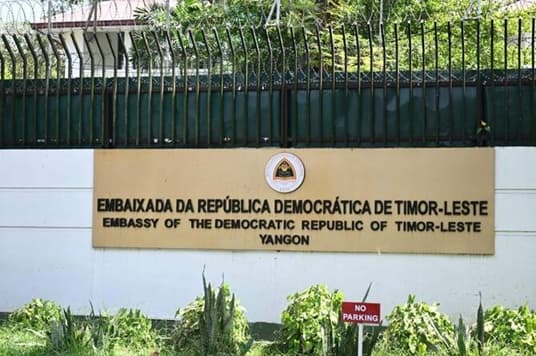
Bangkok (AsiaNews) - Internal divisions within the Association of Southeast Asian Nations (ASEAN) over the Burmese crisis are becoming increasingly evident. The expulsion of the East Timorese diplomatic mission from Yangon, ordered by the Burmese military authorities, marks a new breaking point within the regional bloc, already deeply divided on how to manage relations with the regime after the 2021 coup.
Naypyidaw's decision comes after East Timor filed a complaint against the Burmese army for war crimes. According to several regional analysts, this is the junta's strongest diplomatic retaliation against another ASEAN country and a sign of the bloc's growing fragmentation.
The Burmese Foreign Ministry has informed Elisio do Rosario de Sousa, chargé d'affaires of the East Timor embassy in Yangon, that he must leave the country by February 20. State media have called Dili's initiatives “totally unacceptable.”
At the root of the crisis is an initiative by the Chin Human Rights Organization (CHRO), which represents the largely Christian Chin ethnic minority. At the end of January, the organization's leaders traveled to Dili, where they met with various authorities, including President José Ramos-Horta, and filed a formal complaint with the Department of Justice.
The complaint accuses the Burmese army of war crimes and crimes against humanity perpetrated in the civil war that followed the 2021 coup. The allegations include gang rapes, the killing of ten civilians, including a journalist, the assassination of Christian religious leaders, and the bombing of a hospital and church buildings in Chin State.
The CHRO asked Timor-Leste to apply the principle of universal jurisdiction, which allows national courts to prosecute serious international crimes even if they were committed abroad. On February 2, the Timorese judicial authorities opened formal proceedings by appointing a prosecutor.
The Burmese military government reacted harshly, arguing that the decision sets a dangerous precedent in relations between the two countries. The CHRO explained that it chose Timor-Leste because of the independence of its judicial system and because the population is familiar with the suffering associated with occupation and violence.
A diplomatic clash of this kind between ASEAN members is rare. It is also the first time that the courts of one country in the bloc have taken legal action against another member state for human rights violations.
The matter is particularly sensitive because East Timor only became the 11th ASEAN member in October 2025. Myanmar had previously threatened to block its accession, contesting President Ramos-Horta's meetings with the Burmese National Unity Government (NUG), which the junta considers a terrorist organization.
East Timor then gave assurances that it would not allow NUG offices or anti-junta activities on its territory, but relations remained tense. The court case has taken the tension to a new level.
The Dili government condemned the expulsion of the diplomat and reiterated its support for “the return of democratic order in Myanmar,” expressing solidarity with the Burmese people and calling for respect for human rights.
The issue has arisen at a time when ASEAN is already struggling to maintain a common line on the Burmese crisis. The elections organized by the junta between December and January, deemed neither free nor fair by the opposition and international observers, have accentuated the differences.
Cambodia and Brunei have moved closer to the post-election Burmese government. Phnom Penh has maintained close contacts with Naypyidaw: former Prime Minister Hun Sen, for example, was the first foreign leader to visit the junta after the coup.
The Philippines and Indonesia, on the other hand, refuse to recognize the vote, arguing that the junta has not implemented the ASEAN Five-Point Consensus, the 2021 agreement calling for an end to violence, the establishment of inclusive dialogue, and humanitarian access. The Philippines has even proposed replacing the five-point consensus agreement, which it considers ineffective. Malaysia and Singapore have also expressed doubts about the legitimacy of the elections.
Recently, however, Thailand has stated that it hopes to bring Myanmar back into the organization. Bangkok “wants to be a bridge reconnecting Myanmar to ASEAN,” Thai Foreign Minister Sihasak Phuangketkeow said yesterday after meeting with his Burmese counterpart in southern Thailand.
These divergent positions show an increasingly fragmented ASEAN, where national interests prevail over the cohesion of the bloc.
The case in East Timor adds to international pressure on the junta, already on trial at the International Court of Justice on charges of genocide against the Rohingya, brought by Gambia.
The CHRO's strategy, on the other hand, calls for intervention by ASEAN national courts, challenging the traditional principle of non-interference in the internal affairs of member states.
This is a major dilemma for ASEAN: defending non-interference risks appearing indifferent to the human rights of the Burmese people, but supporting the judicial independence of East Timor could, on the contrary, weaken a principle that has held the bloc together for decades.
It will now be up to Malaysia, which holds the rotating presidency for 2026, to manage the crisis.