








Fr. Mencarini honored as Righteous: Liftetime spend in Italy and Hong Kong
The city of Milan has officially added to the list of the Righteous who stood against genocide the name of a PIME missionary who aided Jews during the Nazi persecution, before departing for the Chinese metropolis where he went on to serve the local community for 60 years, until his death in 2007. Father Gianni Criveller, editorial director of AsiaNews, commemorates him.
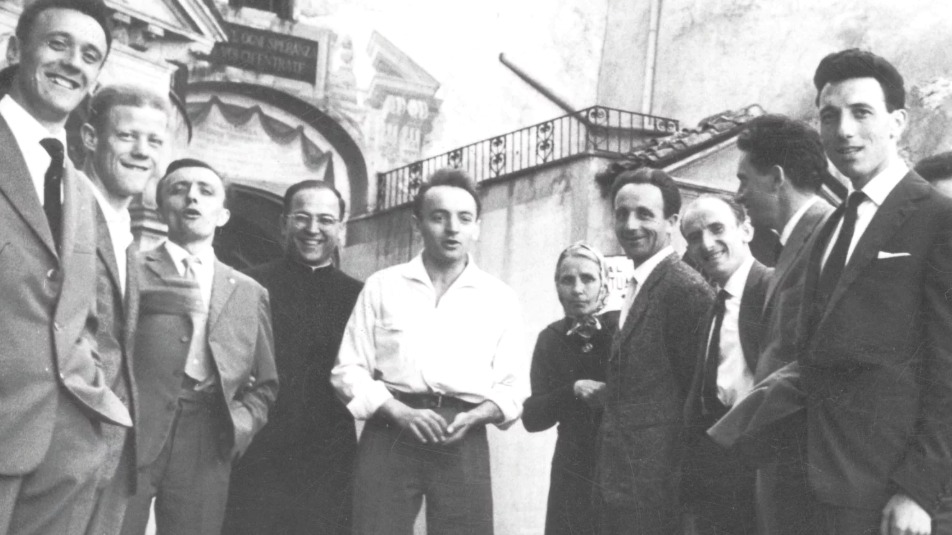
Milan (AsiaNews) - On March 11, in a ceremony held at Monte Stella - where for several years now, on the initiative of the Gariwo Foundation, a “Garden of the Righteous” has been established to honor those who, during the Holocaust of the Jews, but also during other more recent genocides, did not remain indifferent to the fate of the victims of hatred - Father Lido Mencarini, who was a PIME missionary in Hong Kong for many years and passed away in 2007. Before leaving for China, Father Lido had helped some Jews flee to Switzerland during World War II in Italy. Below we publish a memory of Mencarini written by our editorial director, Father Gianni Criveller, who also recalls the much good done by this missionary in Hong Kong.
I was in Hong Kong with Father Lido Mencarini, born in Lucca on November 30, 1916, when he died on May 2, 2007, at the age of 90.
A few months earlier, the PIME community had celebrated his 90th birthday with a dinner attended by Cardinal Joseph Zen, Bishop John Tong, and all the main diocesan authorities. It was a simple celebration, yet Father Mencarini appeared genuinely surprised. He did not expect anything, even though he had served the Diocese of Hong Kong, the largest Chinese diocese in the world in terms of number of Catholics, with loyalty and dedication for 60 years. His contribution to the city was fundamental in the difficult years following the Japanese occupation. Mencarini was diocesan procurator, responsible for the enormous commitment to school education (there were three hundred Catholic schools), vicar general of the diocese, and regional superior of PIME.
He was a tireless, humble, and generous worker. As one of the leaders of the Church in Hong Kong, he did everything he could to ensure that it responded to the enormous needs of millions of refugees. His health did not always support him: throughout 1956, he was ill with tuberculosis. After his recovery, he resumed working without reserve until the last days of his life.
We, his confreres, without exception, remember him with affection and respect, as a model to be imitated. He taught us to work in silence. He welcomed people with a big smile, putting them at ease, as if nothing else mattered at that moment. He was ready to offer his opinion and was open to listening to others. This humble openness allowed him to abide by the decisions of the community.
Father Lido was a deeply honest, sincere, discreet, and humble man. He experienced conflicts, never provoked by him, without becoming bitter or creating enemies. In the 1970s and 1980s, the PIME community was divided between the elderly and the young, between those who wanted to change everything and those who did not want to give up their traditional roles. Father Lido had a traditional approach, but he knew how to listen to young people and was respected by them. For this reason, it fell to him, for a long time, to lead an otherwise divided community with a spirit of unity.
He paid particular attention to the many confreres who had left the ministry: he prayed for each of them every day and remained close to them with his advice and encouragement. This was no small feat in an era of harsh mutual judgment. It was impossible to hear a word of criticism from his mouth toward a third person. He lived with joy, serenity, and peace, qualities that are rather rare.
In 1964, Mencarini was elected Superior General of PIME. He did not accept this responsibility, presumably because he did not consider himself qualified, but above all, I believe, because Hong Kong was at the top of his priorities. He kept the news of his election to himself, and many of us only learned of it after his death.
Father Mencarini observed the same discretion regarding his involvement in organizing a plan to save dozens of Jews and anti-fascist activists. It happened in Cantù during the Nazi occupation: Mencarini served there from 1941 to 1947 as a young parish assistant because, due to the war, he could not be sent on a mission.
No obituary written by PIME missionaries mentions this story. Simply because he never spoke about it to anyone in Hong Kong. I have a vivid personal memory: in 2007, the year of his death, I spent a lot of time with him at the PIME archives in Hong Kong, as I was writing the history of our presence in the city. He was a valuable source. One day he said to me, ‘Some people from Cantù have written to me about old stories from when I was there. But they're crazy!’ I remember his smile when he told me that. And honestly, I didn't even understand what he was talking about. As I said, Father Mencarini never spoke about it, nor did he ever want to.
This is what it was about: some former young people from the San Paolo oratory in Cantù recounted Mencarini's actions in favor of Jews, which no one in the city knew about. The Municipality of Cantù wanted to organize a special ceremony in honor of the reluctant Father Mencarini. But the missionary's death forced the organizers to suspend their trip to Hong Kong.
On that occasion, the mayor of Cantù, Tiziana Sala, publicly acknowledged that Mencarini was a hero who saved dozens of people from deportation and concentration camps, comparing him to Giorgio Perlasca from Como.
Many years later, it is impossible to know the full extent of Father Lido's work. The information that has been certified by research and testimonies and that led to his inclusion in the Garden of the Righteous in Milan is as follows.
Father Mencarini supported the Resistance and organized several trips to help foreign prisoners and Jews flee to Switzerland. A handwritten page from Mencarini's “Mass Register,” entitled “Clandestine Activities,” shows that from September 1943, he made several trips to help prisoners and Jews cross the Swiss border. He enlisted the help of the Italian Red Cross in Cantù and, in particular, its president, Tina Cattaneo. From December 29, 1943, for about a month, he hosted and hid two Jewish families named Gabbai, each consisting of three members: husband, wife, and son.
The role of Cantù and the Italian Red Cross as a transit point is attested to by the statements of some expatriate Jews, kept in the Cantonal Archives of Bellinzona. Furthermore, what Father Mencarini wrote about the events of the two Gabbai families is corroborated by five documents from the same Cantonal Archives of Bellinzona. Everything coincides: names, family composition, method of expatriation, carried out on the same day, January 28, 1944, and at the same border crossing at Laghetto, near Chiasso. It is therefore certain that Father Lido Mencarini played a decisive role in the salvation of those families. The Gabbai families came from Capannori, in the province of Lucca, the missionary's hometown. This element reinforces the hypothesis of his collaboration with the Delegation for the Assistance of Jewish Emigrants in Tuscany (DELASEM), or what remained of it after the arrests in the fall of 1943.
Finally, I would like to suggest a possible link with another well-known missionary from Lucca who was involved in organizing the rescue of Jewish families: Don Arturo Paoli (1912-2015), a few years older than Father Mencarini and both students of the diocesan seminary in Lucca. During the war years, Don Arturo Paoli was the main contact in Lucca for the Delegation for the Assistance of Jewish Emigrants in Tuscany, headed by Giorgio Nissim. For his commitment, Brother Paoli, author of numerous books on spirituality and Little Brother of the Gospel, who lived in Algeria and Latin America, was also awarded the title of Righteous Among the Nations (1999).
* editorial director of AsiaNews and the PIME Missionary Center in Milan

.png)










