








Francis, Leo, and Chinese Catholics a year later
An analysis from an observer familiar with the Church's journey in mainland China notes that Pope Leo’s remarks about China clearly show him as the shepherd with the “smell of the flock" hoped for by Pope Francis. For this reason, the faithful today hope to see a change that will give hope for the future, even to those who wish to live their faith in China.
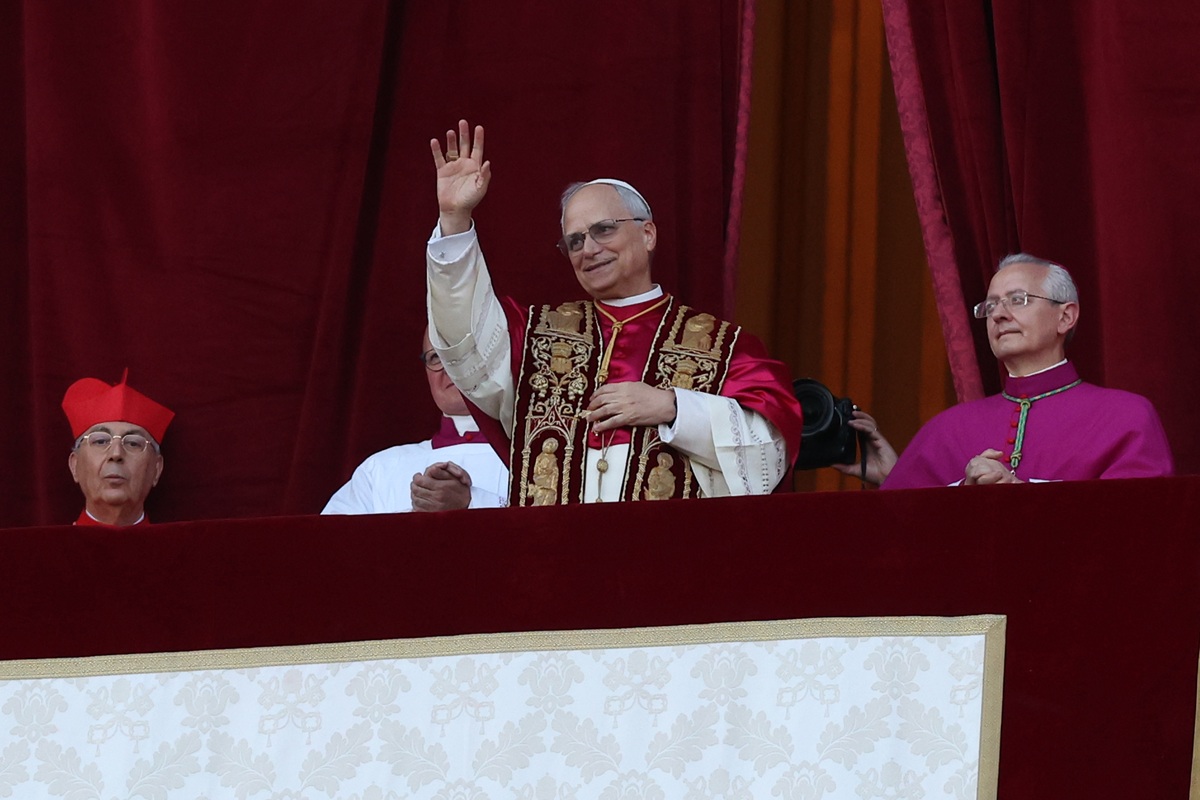
This year’s Easter celebrations brought back memories of the days a year ago that saw the final farewell to Pope Francis and the weeks leading up to Leo XIV’s election. After 12 months, how does the Church in China view the new pontificate? We publish the first of a two-part analysis written by a Chinese source for AsiaNews.
Milan (AsiaNews) – At the start of Lent, a rumour began circulating among the faithful in mainland China that Pope Leo XIV had expressed a "new position" on relations between China and the Vatican.
This news had no authoritative sources, and its authenticity appears questionable; therefore, it would not be worth commenting on. However, if I venture to do so, it is only to give voice to a sincere feeling widespread among Chinese Catholics towards the universal Church and the pope himself, as well as express their high expectations regarding relations between China and the Vatican.
I intend to approach this topic from two perspectives. In this first article, I will analyse some of Pope Leo XIV’s traits; in a second, I will focus on some new trends that have emerged in the Church in China over the past year.
The Legacy of the Augustinians
In mid-May 2025, a week after the pope's election, the author had the good fortune of attending a conference given by one of his students, John.
In John's eyes, Pope Leo is first and foremost a religious man deeply imbued with the Augustinian spirit, embodying the order's typical spirit of introspection, humility, and friendship. He is always kind to others, willing to listen, personifying the spirit of communion of "one heart and one soul in God."
John shared a very touching detail. Some 20 years ago, when he decided to leave the seminary and not continue a religious life, the future pontiff, then prior provincial, did not utter a single word of reproach, but instead worried about his future livelihood.
Learning that John was without local support and out of work, Father Prevost entrusted him with his car for temporary use, helping him start a new life. Today, that young man has become one of the main managers of a large Catholic publishing house.
The Election of Pope Leo XIV: The Last Surprise of Pope Francis, a book written by Elisabetta Piqué and Gerard O’Connell, recently published in New York, argues that, as the first Augustinian pope in history, his character is profoundly influenced by this tradition. He possesses an “inner strength” derived from prayers and Augustinian spirituality, and is extremely calm, inclined to listen, does not interrupt others easily, and speaks precisely and thoughtfully.
Many who knew him during his tenure at the Dicastery for Bishops say that Pope Leo XIV is extremely humble. Before the conclave, he had never considered being elected. He is currently in the early stages of developing his own style of governance.
Undoubtedly, he is above all a child of Augustinian spirituality. He views problems with the eyes of faith, unites people through friendship, governs through communion, demonstrating profound care for the entire human family.
Bringing the periphery's perspective to the centre
Elise Ann Allen, who writes for the Crux news website, was the first to conduct an exclusive interview with the pope. In her biography of the pope, she defines Leo XIV as a "missionary to the world”.
Unlike other popes, before his ministry, Leo visited the global Church extensively and worked for over ten years in poor regions of Peru, thus bringing the perspective of the "peripheries" to the centre of the Vatican system.
Furthermore, in managing Church crises, he displays a rule-abiding, transparent, decisive, and calm style, and a pragmatic, person-centred approach in emergency situations.
Piqué and O’Connell’s book also highlights his many “firsts”: the first pope born in the United States but who spent much of his adult life abroad, described as “the least American of Americans”; he holds citizenship of Peru, a country he served for over 20 years, acquiring in the process a “Latin American heart”.
This “Pope of Two Worlds” possesses a dual cultural understanding of North and South America that his predecessor, Francis, lacked.
Created a cardinal by Pope Francis, he is committed to continuing the process of synodality and addressing social issues such as poverty and migration; in this sense, Leo XIV is the “last surprise” Francis left to the world.
Personality in continuity
The pontiff is the guardian of the Church’s deposit of faith, but also the guide who sinks her roots in the present time. This does not mean that every pope cannot have his own style. In choosing a name, the current pope drew inspiration from Leo XIII and his encyclical Rerum Novarum, with the intention of acting in the age of the digital revolution.
As early as late January, well-informed journalists in Rome said that his first encyclical, tentatively titled Magnifica Humanitas, could be published after Easter, centred on the impact of artificial intelligence, technology, and posthumanism on human dignity, and focused on the unique value of each human being.
Leo XIV also follows Leo XIII in paying attention to Eastern Churches.
Piqué notes that, like Francis, Leo XIV detests doctrinal rigidity and cold bureaucracy, often displaying spontaneity; however, his style is more moderate and delicate.
Before entering the religious life, he studied mathematics; after ordination, he specialised in canon law, earning a doctorate.
His stable character leads him to behave in ways that remind us of the traditional image of a pope: donning the red mozzetta and gold cross at the beginning of his pontificate, moving to the Apostolic Palace, using Castel Gandolfo as a weekly retreat, and celebrating Holy Thursday in the Lateran Basilica.
"The smell of the flock"
According to O'Connell, Leo XIV pastorally follows Francis's pragmatic approach, while intellectually he inherits the depth of Benedict XVI and Leo XIII. He is described as a shepherd with "the smell of the sheep”, capable not only of listening but also of concretely addressing difficulties.
In his first public statement on China, he acknowledged his experience in dealing with Chinese people, government, and religious leaders, asserting that in the short term he will uphold the Holy See's current stance.
He acknowledges, however, the complexity of the situation and the need to better understand how the Church can fulfil its mission while respecting culture and political issues, taking into account the faithful who live under pressure or without full religious freedom.
His words on China clearly convey "the smell of the flock" since he understands the suffering of the faithful and the difficulties of the Church in a complex political context.
After Pope Francis passed away in 2025, Chinese Catholics spontaneously commemorated the late pontiff, but in some cases local authorities prevented them out of political fears. A year later, with new changes underway in Vatican diplomacy, they hope to see signs of hope for the future.
(1 - to be continued)

.png)
24/10/2025 12:59
10/05/2025 11:18
28/10/2009










