








Holy Sepulchre archaeologist: “Why there can be no Easter without the rites here”
The Franciscan Amedeo Ricco – one of the key figures in the excavations that have brought to light new evidence supporting the Gospel accounts – comments on the celebrations in Jerusalem following the ‘incident’ on Palm Sunday. ‘We are experiencing a quieter Easter, which takes us back to our roots. But the Sepulchre remains the living heart from which to proclaim that death does not have the final say.’
Milan (AsiaNews) - What happened on Palm Sunday in Jerusalem – when the Israeli authorities effectively prevented the Latin Patriarch of Jerusalem, Cardinal Pierbattista Pizzaballa, and the Custos of the Holy Land, Fr Francesco Ielpo, from entering the Church of the Holy Sepulchre to celebrate Mass – was an unprecedented incident in recent history. A move described as “serious and unjustified” in the joint statement issued the same day by the Latin Patriarchate and the Custody, because it directly affected the highest-ranking representatives of the Catholic presence in the Holy Places, precisely during the most significant days of the liturgical year.
At the press conference on 31 March, Brother Francesco Ielpo adopted a firm yet constructive tone: he reiterated that entry to the Holy Sepulchre is not a privilege, but a well-established historical right, linked to the Status Quo that has governed the life of Christian communities in the Holy Places for centuries. He also recalled how, despite wars and crises, the Franciscan presence at the Holy Sepulchre has never ceased in over seven centuries, and how the liturgy has never been interrupted, not even since the start of the current conflict. At the same time, he emphasised the importance of dialogue with the Israeli authorities, which in the hours that followed led to shared solutions that are currently enabling the Easter celebrations to take place — albeit in a reduced form.
The Custos’s words follow a line already set out by Cardinal Pizzaballa: prudence, a sense of responsibility and a willingness to engage, but also a clear defence of freedom of worship and the universal role of Jerusalem for billions of believers. This year’s Easter, marked by unprecedented restrictions but also by a determination to preserve what is essential, is situated within this balance of firmness and openness.
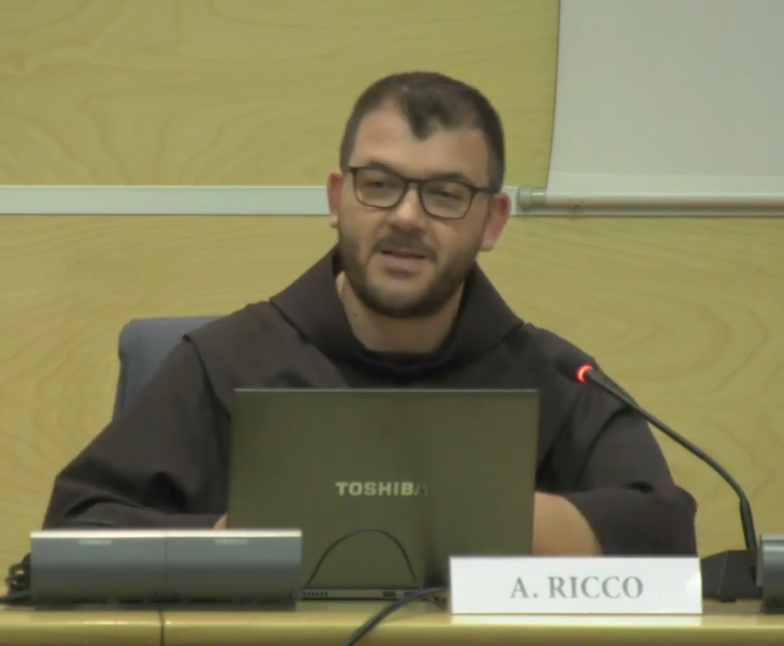
In this context, we have gathered the testimony of Friar Amedeo Ricco, a Friar Minor and archaeologist at the Studium Biblicum Franciscanum, who has lived in Jerusalem for over a decade. Following his biblical and archaeological training in the Holy Land and Rome, he was one of the key figures in the recent season of excavations and restoration work at the Holy Sepulchre (alongside the team from La Sapienza University in Rome led by Francesca Romana Stasolla), experiencing from the inside one of the most important research campaigns of recent decades. His perspective combines scientific expertise with a profound spiritual experience
Fra Amedeo, following the events of Palm Sunday, what is the atmosphere like in Jerusalem? And how will you be spending this Easter?
It is an atmosphere marked by fatigue and concern, but also by a concrete determination to move forward. What happened was serious, because it touched not only on a practical matter, but on a principle: the right of Christian communities to live and celebrate in the Holy Places according to the Status Quo. However, dialogue with the authorities has enabled us to find solutions for Easter. We are experiencing more intimate, almost ‘essential’ celebrations, but no less genuine for that. Joking with my fellow friars, I pointed out how this year’s Easter, with its restrictions, will in some ways be ‘pre-Constantinian’, in the sense that it will be experienced much as the Christian communities of the early centuries probably experienced it.
You have played a leading role in the archaeological excavations of recent years. What new discoveries have emerged?
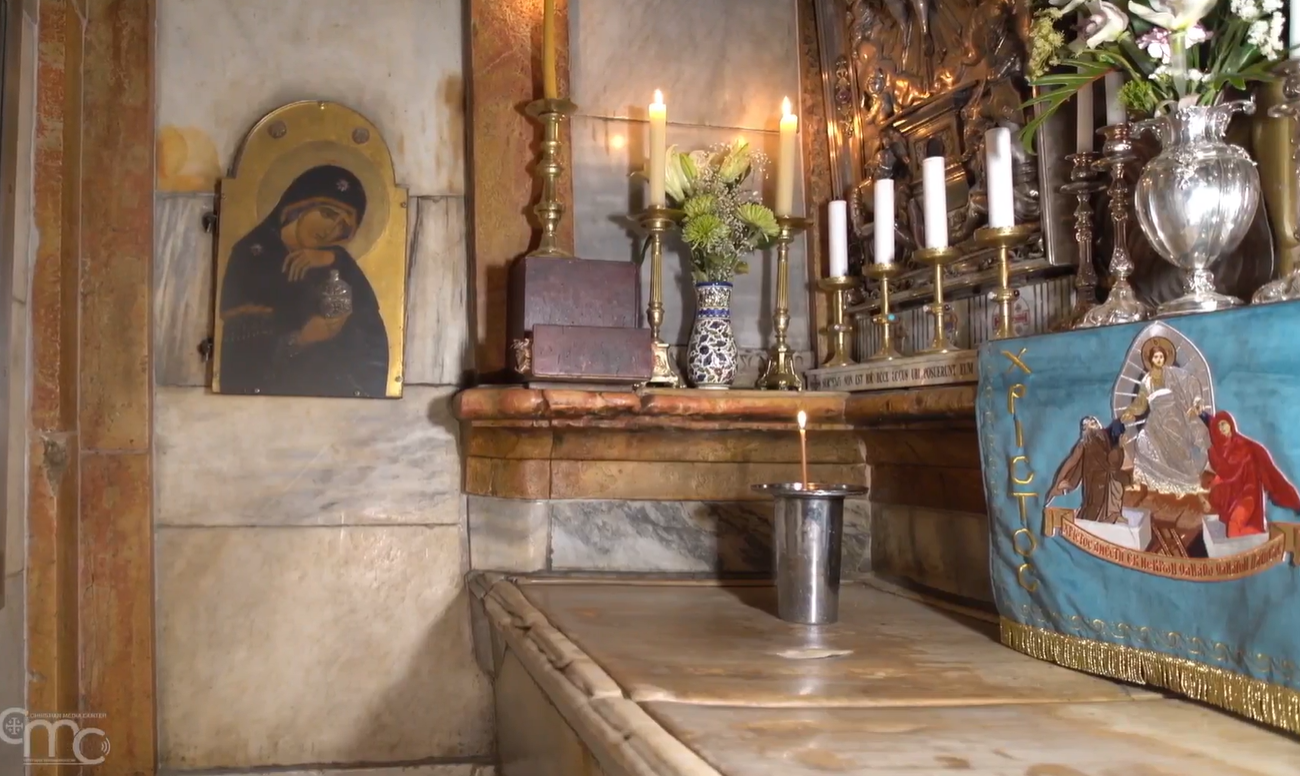
Over the last ten years we have witnessed a historic turning point. For the first time, during the restoration work, the opportunity arose to scientifically investigate the subsoil of the basilica. One of the most surprising discoveries concerns the aedicule of the Holy Sepulchre itself: beneath the modern structures, substantial portions of the tomb’s original rock have emerged. This has completely changed the scholars’ perspective. We have also documented ancient layers: quarries, agricultural walls, gardens and burials. Elements of the earliest early-Christian monumentalisation of the venerated tomb. Evidence that confirms the Gospel account.
What kind of experience is it, even on a human level, to work in a place like this?
It is an all-encompassing experience. From a scientific point of view, it is a pinnacle, but from a human and spiritual point of view, it is something that leaves a lasting mark. There are moments when you find yourself facing an untouched glimpse, predating every subsequent transformation, and you realise you are among the very few to have seen it like this, in person. Not in photos, not in books: there, with your own eyes. It is a grace, but also a responsibility. Because you know you are touching a place that belongs not only to history, but to the faith of billions of people.
The Holy Sepulchre, however, is first and foremost a spiritual place. What does it mean to experience it during Holy Week?
Here, the liturgy is not merely remembrance: it is direct experience. The words of the Gospel resonate in the very places where they occurred. This changes everything. It is not merely a ‘memory’, it is participation. On Good Friday, for example, the Scriptures are read before the rock of Calvary, right up to the hour of Christ’s death. And then there is the veneration of the Cross at the very site of the crucifixion. It is an intensity that is difficult to describe.
Another very distinctive feature is the celebration of the Easter Vigil. Why does it take place here on Saturday morning?
It is one of the most fascinating peculiarities of the Church of Jerusalem. The Easter Vigil, which in the rest of the world is celebrated on the night between Saturday and Sunday, takes place at the Holy Sepulchre on Saturday morning. This is due to the rules of the Status Quo, which allocate times and spaces to the various communities and do not permit a prolonged night-time celebration. But this apparent ‘anomaly’ holds a profound meaning: the Church of Jerusalem is the first in the world to proclaim the Resurrection. When the Exsultet, the great Easter proclamation, is sung here, the rest of the world is still in the silence of anticipation. It is as though from this place, the empty tomb, the proclamation first sets out, eventually reaching all the other Churches. Of course, it is striking to proclaim “this is the night” whilst outside it is already day, but this very fact shows that Easter transcends time and space. It is a universal proclamation that originates here and spreads everywhere.
Then there is a rite that, more than any other, characterises the Easter liturgy...
Yes, the Easter Sunday procession. It is something that exists only here. After the celebration, three circuits are made around the tomb, in remembrance of the three days of the Triduum. Along the way, the Gospels of the Resurrection are proclaimed towards the four cardinal points. It is an extraordinary gesture: space becomes proclamation. The Gospel starts from that precise point, the empty tomb, and symbolically opens out to the whole world. It is the concrete representation of the birth of Christianity.
This year, however, everything is more restricted…
Yes, and in a sense it takes us back to our origins. A ‘quieter’ Easter, almost domestic, as in the early centuries. For a long time, the Church lived without major public celebrations, preserving the faith in a more hidden but no less authentic way. Perhaps this situation invites us precisely to this: to rediscover what is essential. Easter does not depend on the grandeur of the rites, but on the depth with which it is lived.
What message do you feel called to share today?
That the Holy Sepulchre continues to be a living heart. Despite everything – conflicts, tensions, restrictions – it remains the place where it is proclaimed that death does not have the last word.
And this proclamation cannot be stopped. It may change form, become more discreet, more fragile, but it continues to reach the world. And it is perhaps precisely in the most difficult moments that it shows all its strength.
Photo: Christian Media Center

.png)
24/10/2019 17:56










