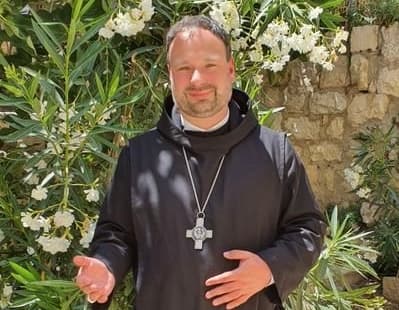
Jerusalem (AsiaNews) – The situation is "difficult”, the Christian community is “under pressure”, and the most disturbing aspect involves the current Israeli leadership, because for “the first time" it includes people "who hate Christians, who are notorious Christian haters”, this according to Abbot Nikodemus Schnabel, a German-born Benedictine monk who heads the Basilica of the Dormition on Mount Zion in Jerusalem.
Abbot Nikodemus Schnabel spoke[I] to AsiaNews, at a time of growing attacks by Jews against the Christian minority, including Israeli soldiers in southern Lebanon attacking Orthodox Christians and Israeli settlers attacking Christians, especially in Jerusalem.
In the past, the clergyman was himself attacked and spat upon by “Jewish extremists”. Now the “people who spat on me are part of the Israeli government, especially the minister for National Security.”
“In 2015, we had a horrible arson attack in Tabgha, and the lawyer who defended the arsonists was Itamar Ben-Gvir,” the abbot noted. “This man, who hates Christians, who hates really Christianity, is now in charge of my security, and this is really horrible;” the clergyman said.
“If you go to the West Bank,” he added, “the only, entirely Christian village, Taybeh, is really under threat,” amid “rising settler violence”.
The current problem, he explains, is not only linked to racism, but is the result of “Kahanist” ideology, linked to the extremist Jewish religious movement inspired by right-wing and religious Zionism. “Jewish extremism, this terrorist ideology,” is undergoing a revival, and admits no room or rights for other groups, including Christians.
In recent weeks, several incidents of sectarian intolerance, if not violence, have involved Jewish settlers, ultra-Orthodox Israelis, and army soldiers operating across the border in Lebanon.
On 19 April, in the village of Debel, southern Lebanon, scene for a while of military operations, a soldier desecrated a cross with Jesus by hitting it with a sledgehammer.
A few days later, on 28 April, perhaps the most disturbing incident occurred when a man linked to Jewish extremism, who was later arrested, attacked a French nun in Jerusalem, near the Cenacle.
The woman religious was struck from behind while walking in the Mount Zion area, then pushed to the ground and kicked. The scene, captured by security cameras, went viral. It clearly showed the unwarrantedness of the act.
Today, the attacker, 36-year-old Yonah Shreiber, was arrested and officially charged today. He allegedly attacked the nun after seeing her wearing clothing and objects reflecting her faith, in an attack motivated by "sectarian hatred”.
Recently, in another incident, a Jewish settler was videotaped spitting in front of the entrance to the Armenian Cathedral of St James, in Jerusalem, a not uncommon act against Christians in the Holy City. After committing the act, he defiantly turned to the cameras and used his middle finger to form the shape of a cross.
Finally, in the small Christian village of Debel, southern Lebanon, an Israeli soldier stuck a cigarette in the mouth of a statue of the Virgin Mary. The incident reportedly dates back several weeks, but emerged only recently.
The escalation of attacks is also confirmed by the numbers, which show a 63 per cent increase in hostile acts against Christians in Israel in 2025. The most frequent involve spitting (over 50 per cent), followed by insults, shouting, or threats (18 per cent), attacks on religious symbols (15 per cent), physical violence (5 per cent), and desecration of sacred places (3 per cent).
Born in December 1978 in Stuttgart, Germany, Father Nikodemus Schnabel has lived in the Holy Land for several years and is among the leading experts on the Eastern Church.
A former administrator of the Abbey of the Dormition and patriarchal vicar for migrants for the Latin Patriarchate of Jerusalem from 2021 to 2023, he was installed as abbot of the basilica on 28 May 2023.
The church is located in an area that, even in the past, has seen moments of tension and is no stranger to sectarian violence and attacks by Jewish extremist groups.
Abbot Nikodemus himself was spat on, and in a controversial incident, Israeli authorities asked him to remove his cross while he was near the Western Wall.
Some areas in the Holy City are more sensitive than others, the cleric explains, where episodes of violence and intolerance occur more frequently. They include the Via Dolorosa and Mount Zion, the site of the Last Supper, and the Basilica of the Dormition, which stands near the Tomb of David, with nationalist and radical groups claiming the area as exclusively their own.
These people say that “our church has to be destroyed. The crosses have to be removed. This is typically Kahanist ideology.” For them, “Jerusalem, is only for the Jews.”
Regarding the Abbey of the Dormition, “it's very presence in the skyline of Jerusalem” is seen as an issue. “If you look at Jerusalem, it's very difficult not to see our church.” For this reason, it “has to be destroyed.” They want “to wipe out the Christian presence of Jerusalem. And that's the thing.”
“If they shout at me, it's go home to Rome, go home to Italy, although I'm German. But you see, they hate me not because of my nationality. They hate me because I'm an abbot, because I'm Christian.”
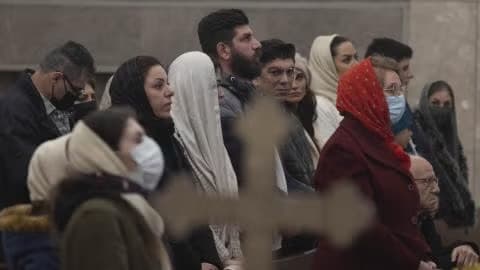
Many Christians have “the feeling that there's no place for us. We are not welcome. And this is really a big shift”. Those with homes in Cyprus or Greece, like the Christians of Nazareth or Haifa, are actually thinking about leaving.”
In the past, Israeli authorities used Christians to promote religious tourism “advertising, especially the Dormition Abbey to say, come visit the Holy Land”.
“In 2003, I entered monastic life,” the abbot explained. “They were proud that Israel was home to the holy places of Christianity, Islam, the Druze, the Bahá'í, the Jews. So, it was really like, look, we are an open place.”
Things have changed since then. “Now it's really clear Israel is for the Jews. And the minorities are maybe tolerated, but they should shut up.”
And social media are amplifying feelings of intolerance and hatred.
Christians “should not be visible. This is very often what I hear if there are attacks on me. And then you see the comments in social media and others. It's a reaction: ‘Why he has to walk so provocative through Jerusalem’.” For them, “It's a holy city for Jews. If I walk in civilian clothes, it's okay, but why should I provoke by being visible as a monk”, with a cross.
This attitude does not apply to everybody. “My Jewish Israeli friends [. . .] are very sad and unhappy and in fear with the development of their society.”
It is feared that, with the Gulf War putting a halt on pilgrimages, it will be even more obvious that Christians in the Holy Land are but a tiny minority, struggling to survive.
“I fear a Christian Disneyland. Of course, the professionals, like the German Benedictines, Italian Franciscans, French Dominicans will remain. We will remain here, but I really fear that the local indigenous Christians will disappear”.
“Christians have the feeling that there's no place for us,” and this attitude has grown and is linked to the regional wars, first in Gaza and now against Iran (and Lebanon).
“The focus of the world is now on the war and nobody cares what the settlers are doing,” the abbot explained. “Nobody cares. In the shadow of war, people have the courage to be more open with their hatred. Of course, I think war is always a way to dehumanise the enemy.”
“We have extreme right-wing politicians who are criminals,” the abbot laments, but “of course, I also see many wonderful people. I have to say again and again, wonderful civil society groups.”
This is really the case with “the Rossing Center (for Education and Dialogue),” which “really cares about the Christian presence. So, there's a lot of positive things to say, but I see a difference between civil society (groups), I feel them very supportive, and official Israel, who is not doing enough against the phenomenon of Jewish terrorism.”
[I] The interview was edited for clarity and length.