








Netanyahu approves 34 new West Bank settlements, an 80 per cent increase from 2022
The government gave its green light recently, without much fanfare, just as settler violence was escalating. Since the start of the current legislative session, 103 settlements were approved, on top of 127 already existing settlements. Settlement procedures have also changed, showing a desire to accelerate the process of seizing land. Polls show Likud decline, but the country's majority opposes the ceasefire with Iran.
Jerusalem (AsiaNews) – In the shadow of wars in the Middle East, from Iran to Lebanon, and amid the silence of the international community, Israel's far-right government is promoting a systematic policy of expropriation and occupation of Palestinian lands.
This involves dozens of new settlements in the West Bank and a rise of attacks by Jewish settlers in the Occupied Territories, which have not spared Christians, as the parish priest in Taybeh has repeatedly lamented.
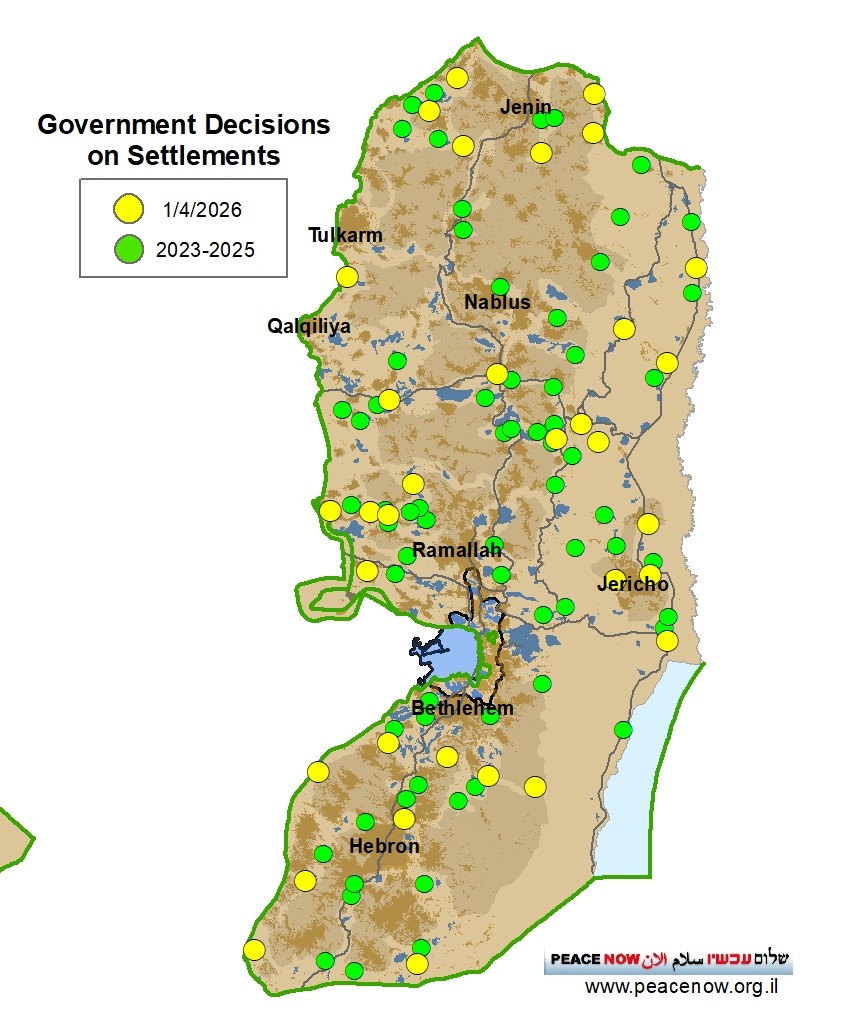
The latest green light was given on 1 April, but remained secret for several days, Peace Now reports. According to the Israeli peace movement, the government have approved at least 34 new settlements, most of them outposts in remote areas of the mountainous territory, bringing the total number of settlements approved since the current government took office from 69 to 103.
Furthermore, some sources indicate that the Israeli government has planned to build energy, water, and electricity infrastructure even before completing the process of seizing the land on which the new settlements will be built.
This procedure appears decidedly unusual compared to the past and demonstrates a significant shift in planning, experts note, aimed at accelerating the establishment of the settlements and ensuring their immediate survival in a disputed area.
According to activists, the government refrained from making the news public so as not to anger its US ally during the war against Iran, but now that a ceasefire has been reached, it has rushed to make it public.
This approach also contradicts the calls for caution from the Israeli Defense Forces (IDF) leadership, who have reportedly expressed firm opposition to the plan for new settlements on security grounds. Indeed, an expansion would entail greater security burdens, adding to those already present and active.
“The [Israeli] government has gone into a frenzy ahead of the elections, seeking to create as many facts on the ground as possible and leave Israel with scorched earth,” reads a statement issued by Peace Now.
“Today it is already clear to everyone – and the IDF emphasizes this again and again – that the establishment of settlements harms security, places an abnormal burden on the IDF, and undermines the possibility of resolving the conflict and achieving any future security and peace.”
The 34 approved settlements join the 68 settlements previously approved by the government, bringing the total number of new settlements recognised by the current government to 103.
This is an unprecedented number, as official statistics indicate. Before the current government (which includes pro-occupation and pro-settler leaders), 127 official settlements existed in the West Bank. The addition of another 103 settlements in recent years represents an increase of approximately 80 per cent.
A map of the new development plans published by i24news shows settlements around Jenin, south of Nablus, in the area between Bethlehem and Hebron, and in other areas without any prior Israeli presence.
These include both completely new settlements and existing illegal outposts that will be recognised as official settlements (like Yishuv Hada'at, north of Turmusaya).
According to Peace Now, this decision does not concern the establishment of settlements in Areas A and B, as some sources claim, but places in rather Area C, adjacent to Areas A and B.
Some of the settlements already existed as "neighbourhoods" of other settlements and have been granted independent settlement status; others were illegal outposts that began the process of legalisation as independent settlements; still others are new settlements.
In fact, some sources suggest, a new one will be built in almost every settlement bloc in the West Bank as part of this unprecedented decision, including points close to the Green Line and settlements that will create a separation between Beitunia and Modi'in Illit.
Six new settlements are planned for northern Samaria, considered among the most sensitive: Noa (the most significant), Emek Dotan, Aloné Shomron, Ta'anakh, Rom Gilboa, and Ma'ayanot.
The construction of the "walls" around Jericho is also being sped up with three new settlements to complete the encirclement of the Palestinian city on all sides: Tzuri, Elisha, and Dia. The latter is planned to "be built on the mountain ridge to the west, on state lands.
Dia’s location, at a point overlooking the entire area of the city, allows control— of the eastern border region,” this according to a government paper. “Furthermore, the new settlement is intended to create territorial continuity between Mevo'ot Yericho and Tamra to the north and Vered Yericho and Mitzpe Yericho to the south."
The Israeli far-right government's territorial expansion plan does not just concern the West Bank. Recently, speaking at the inauguration ceremony for the Maoz Tzur settlement, pro-settlement Finance Minister Bezalel Smotrich stated that the border expansion will also include Gaza, Lebanon, and Syria.
In his view, “there will be a political leg in Gaza that will expand our borders, there will be a conclusive political leg in Lebanon that will expand our borders to the Litani on defensible borders and there will be a conclusive political leg in Syria with the Hermon crown and the buffer zone at least. That's what they respect in our neighborhood and that's what is needed to secure our security.”
While the cabinet is accelerating its territorial expansion plan, Prime Minister Benyamin Netanyahu's Likud party is losing support among voters, a series of recent polls suggest.
At the same time, some reports show that Israelis are overwhelmingly in favour of the policy of permanent war, and are opposed to the ceasefire with Iran (and Lebanon), a sign of a growing obsession with security despite the consequences of the conflict.
In the first place, although Likud is losing ground, anti-Netanyahu Zionist parties would not win a majority in the 120-member Knesset if a vote were held now, Israeli Public Broadcasting Corporation (KAN), Channel 12, and Channel 13 report. Israel’s next elections are set for October.
The KAN poll gave the anti-Netanyahu Zionist parties 59 seats; Channel 12, 60; and Channel 13, 55. KAN gave the Likud 25 seats, down from 28 last week, while the far-right Otzma Yehudit party of National Security Minister Itamar Ben Gvir would take 10 seats, up from eight last week.
The Sephardic ultra-Orthodox Shas party held steady at nine seats, while the Ashkenazi ultra-Orthodox United Torah Judaism party is at seven, down from eight last week. Likud's last coalition partner, Finance Minister Bezalel Smotrich's Religious Zionism party, failed to clear the electoral threshold.
KAN’s poll gave 19 seats to the right-wing party of former Prime Minister Naftali Bennett, the same as last week. Another 14 seats, up from 13 last week, would go to the centrist Yashar party of former IDF chief Gadi Eisenkot.
The Democrats, a left-wing alliance led by former IDF Deputy Chief of General Staf Yair Golan, would win 11 seats, up from nine last week, while the Yisrael Beytenu party led by hawkish and longtime MK Avigdor Liberman would win nine (up from eight at the last count).
Completing the Zionist opposition parties, the centrist Yesh Atid party led by opposition leader Yair Lapid is at six seats, down from nine, while the other centrist party, Blue and White, led by Benny Gantz, failed to clear the threshold.
In total, KAN’s poll attributes 51 seats to Netanyahu's coalition and 59 seats to the Zionist opposition parties, meaning each bloc would have to rely on defectors from the other bloc or the support of Arab parties to reach the 61 seats needed for a majority government.
Majorities in all three polls disapproved of the ceasefire with Iran, with 56 per cent of respondents in the KAN poll, 53 per cent in the Channel 12 poll, and 51 per cent in the Channel 13 poll opposed to the two-week ceasefire.
Channel 12 also asked respondents whether Israel should continue attacking Hezbollah in Lebanon. A large majority, 79 per cent, support continuing the war.
(Photo credit: Peace Now)

.png)
06/02/2026 16:32
25/06/2008










