








New mausoleum limits land use in Kerala
After decades, the Catholic community in Vallakkunnu can now bury its own in a two-storey mausoleum with nearly 400 burial cells. For Bishop Kannookadan of Irinjalakuda, such an innovative and eco-friendly solution avoids communal tensions and conveys a message of faith.
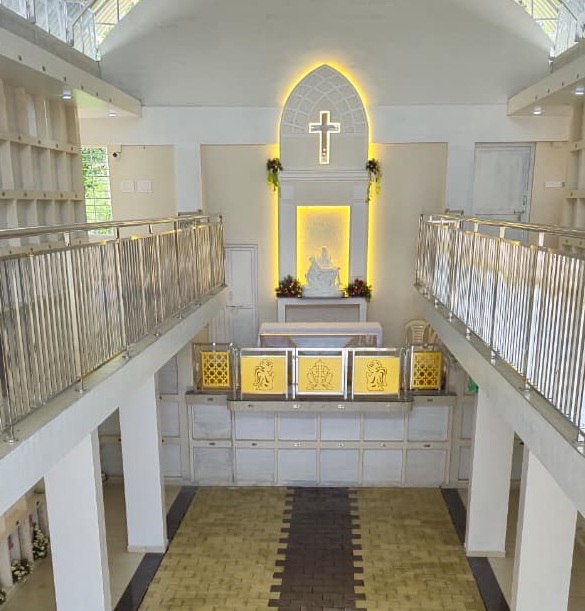
Kochi (AsiaNews) – The Parish of St Alphonsa in Vallakkunnu, Diocese of Irinjalakuda (Kerala), has inaugurated an innovative cell-based two-storey mausoleum, offering a sustainable solution to land scarcity and environmental concerns.
The structure, which covers some 6,000 square feet or 550 square metres, has 388 burial cells on two levels, and was completed at a cost of about 30 million Indian rupees (around US$ 315,000), entirely funded with contributions from parishioners, a testament to strong community participation.
From the outside, the building looks like a church, but inside it is a cemetery with order, decorum, and efficient use of space, with funerals and prayers possible in all weather, protecting attendees from rain and intense heat.
For decades, the Vallakkunnu community did not have its own cemetery and was forced to use that of a nearby parish. The idea of building a cell-based cemetery was first raised in 2018, but work began only a year and a half ago.
Following the inauguration, the mortal remains of about 30 recently deceased parishioners have already been placed in the new cells.
The project was also drafted with long-term sustainability in mind. After the natural process of decomposition, entombed remains will be moved to an ossuary located behind the cells, allowing the same cells to be reused by future generations.
“The dream of the parishioners of Vallakkunnu to have a cemetery has finally become a reality. After the dedication of St Alphonsa Church, the establishment of a cemetery became a long-cherished wish of the parish community,” said Father Tinto Kodiyan, the parish priest, speaking to AsiaNews.
“Efforts toward this goal had been continuing for the past 18 years,” added the clergyman who stressed that the result was possible thanks to the joint efforts of many. “The cemetery became a reality through the dedicated efforts of former parish priests, trustees, organisation leaders, members of the cemetery committee, and all the faithful of the parish.”
The blessing and inauguration ceremony were held in the presence of Bishop Pauly Kannookadan of Irinjalakuda, as well as priests, men and women religious, representatives of civil institutions, and numerous parishioners.
Bishop Kannookadan emphasised how the new cemetery responds to the concrete needs of the area. “Vallakkunnu is near the Irinjalakuda railway station. There is a parish there with more than 300 families,” he said.
“It is not very easy to get permission for a cemetery on that side of town. They also lack the necessary land because it is located near a paddy field. [. . .] Because of this, they planned to build a cemetery that is very eco-friendly” and innovative.
According to the prelate, the project offers social benefits as well, since “it does not negatively affect the neighbouring families or their houses. When people look at it, it simply looks like a church. Therefore, those who live close by are not frightened.” In this case in fact, “people have been very collaborative in building this cemetery.”
The bishop of Irinjalakuda also stressed the spiritual and environmental value of the initiative. “We have faith that bodies will be resurrected at the end of the world during the Last Judgment. Therefore, we must respect the bodies of the dearly departed,” he explained.
“To achieve this, a cemetery should always be neat, clean, and filled with a spiritual atmosphere. That atmosphere is maintained there,” he added. “When we enter that cemetery, we feel that it is a place of heavenly or spiritual experience. It was built this way because we must respect the souls and bodies of those who have departed.”

.png)
07/02/2019 17:28
04/03/2019 09:38










