








Pope welcomes US-Iran deal, hoping it will ‘strengthen mutual trust’
Leo XIV expressed “gratitude" for the memorandum to be signed on Friday during the general audience in St Peter's Square. In light of the "distressing news" from Ukraine, he called for a "just and lasting peace." On his apostolic visit to Spain, he stressed that Europe is “a living reality, not a thing of the past.” Asked yesterday at Castel Gandolfo about the episcopal ordinations that the Society of Saint Pius X plans to perform without papal mandate on 1 July, the pontiff said: “I am sorry. But we must move forward.”
Vatican City (AsiaNews) – Pope Leo XIV spoke about his apostolic journey to Spain at this morning's general audience. During the visit, which lasted from June 6 to 12, he travelled to Madrid, Barcelona, Montserrat Abbey, and the Canary Islands.
“I give thanks to God,” he said, “and to the entire Spanish people,” as well as the king, bishops, authorities and ecclesial communities, for their fervour, but also the openness to listening he experienced, in a country "with an ancient and very rich Catholic tradition" that, despite "significant social and cultural changes," welcomed the pope “with enthusiasm”.
Leo noted that the great enthusiasm with which people waited and welcomed him "was not to be taken for granted, and is worthy of reflection. [. . .] I believe it reveals a widespread need to find unity on a true and deep foundation, one that is neither ideological nor based on partial interests,” and that foundation is "Christ," with his message about “the search for truth and the thirst for justice.”
Leo said that he encouraged the faithful in Spain “to overcome every form of division and conflict by always promoting communion, dialogue and unity in diversity.”
From the parvis of St Peter's Square, the pope said that he had heard “first-hand the very character of Europe, its inestimable wealth, as a living reality, not a thing of the past”, especially in Madrid and Barcelona, where the celebration in the Sagrada Familia was key, in the meeting of the “ancient and modern”.
“It is a heritage to be safeguarded with care, so that it may be invested in today’s global world with its momentous challenges: peace, integral ecology, equitable and sustainable development, and respect for human dignity,” he said.
For the pontiff, this is asserted in the Second Vatican Council, taken up again in the subsequent magisterium.
In Spain, Leo also stressed “the need to listen through the Pope’s voice the Gospel of hope for today’s humanity, sorely tried by the negative consequences of a deceptive model of development.”
The pontiff, who listened to many voices during his journey, mentioned the stories of marginalised people, marked by pain, whom he heard directly. In them he saw that "need” to listen.
“I recognized also and above all in the faces of the little ones and the poor whom I met: the child who read his letter to me in the parish; some victims of abuse, who ask to be heard; the inmates who were waiting for me in the prison; the young people full of anxiety and aspirations; the migrants in the reception centres in the Canary Islands.”
Finally, the pope said he found “comprehensive insight” in the Canary Islands, the last stop on the journey, off the coast of Morocco.
“[I]t enables us to understand how we are called to reread the Gospel in today’s world, exchanging with each other the gifts of our respective cultures, and in particular the results produced in them by the fruitfulness of Christ’s message.”
These “results” include “dialogue between people and between peoples, the encounter in a spirit of fraternity”, a path that "is not easy" but one leads to the "civilization of love."
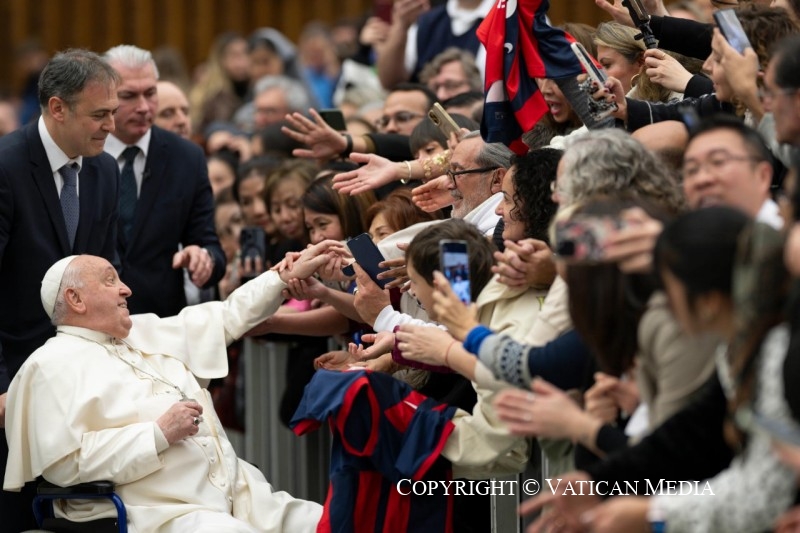
At the end of the audience, the pontiff greeted the thousands of faithful gathered under the sun, saying that he welcomed "with satisfaction" the preliminary agreement reached between Iran and the United States, which will be signed next Friday.
This memorandum is the “outcome of patient dialogue and negotiation.” For this reason, “I express my gratitude to the countries (including Pakistan) that have worked to facilitate the meeting between the parties and make this agreement possible”.
“I hope that this agreement may help to strengthen mutual trust, security and stability in the Middle East, by promoting paths of dialogue and cooperation among peoples,” he added.
Leo went on to mention the “distressing news” coming from Ukraine, scene of “so many innocent victims, aid workers killed, churches and cultural heritage sites devastated by fire.”
In bringing the audience to a close, he said: “My thoughts are with those who are mourning their loved ones, with the injured, and with those who, amidst the violence, continue to serve life with courage. I invite everyone to pray for an end to this war. Let us ask the Lord to open pathways to dialogue, to extinguish hatred, and to make a just and lasting peace possible.”
In his greetings to Italian-speaking pilgrims, Leo addressed, as he usually does, the young, the sick and the recently married, especially now, “on the threshold of the summer season, a time of tourism and pilgrimages, holidays and rest.”
He told young people, “While I think of your peers who are still taking exams, I hope you, already on vacation, can take advantage of the summer for useful social and religious experiences.” He urged the sick “to find comfort and relief in the closeness of your families,” and invited the newlyweds, “to use this summer period to deepen your understanding of the value of mission in the Church and in society.”
Last night at Castel Gandolfo, the Pope spoke briefly with the press as he left Villa Barberini, addressing another highly topical issue, that of "remigration”.
“‘Let’s send them away, so we can wash our hands of the problem’ does not seem to me the most Christian response,” he said. “We must truly respect people – look at the cases, and above all treat people as people with respect.”
Yesterday, upon hearing about the Iran-US memorandum, he said "thank God”, may it be “truly a solution to the war, that the war is really over and that we can move forward for the good of all. Eliminate nuclear weapons, yes, seek the good of all peoples, seek how to solve the problems also at the economic and social level that have been created in this time.”
Leo XIV was also asked about the episcopal consecrations without papal mandate by the Society of Saint Pius X, set to take place next 1 July in Écône, Switzerland, this despite the risk of schism feared by the Holy See.
"I am still considering making another appeal, to say: 'Do not do this. Let us try to live communion in the Church.' But it's their choice," he said, referring to contacts between the Society and the Dicastery for the Doctrine of the Faith.
“They must understand what it means for them and for the Church. Certainly, division among Christians is always a painful matter,” he added. “But they refuse to accept certain fundamental elements of the Church, beginning with various points of the Second Vatican Council. And if they make those choices, I am sorry. But we must move forward.”

.png)










