

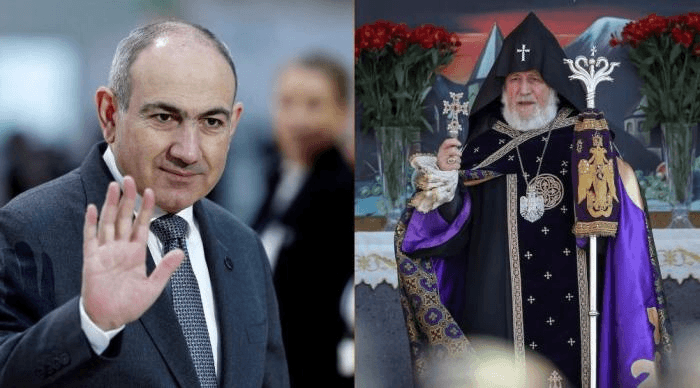
Moscow (AsiaNews) - A conflict has been ongoing for more than a year between the Yerevan government, led by Prime Minister Nikol Pašinyan, and the Armenian Apostolic Church led by Catholicos Karekin II.
This conflict is not limited to the territory of Armenia, but is also evident in Russia. In the city of Armavir in the southern Russian region of Krasnodar, a thousand people took part in a protest against Pashinyan's policy, which aims to remove the patriarch and ‘reform the Church’, considered the real enemy of the Armenian people with its current ‘immoral and corrupt’ leadership.
The participants in the Armavir rally are Armenians living in Russia, where they took refuge in the 1990s following the outbreak of civil war after the fall of the Soviet Union. For many Armenians, Russia remains Armenia's guardian, having partly saved it a century ago from the Turkish genocide, protecting the current territory of the Armenian republic and welcoming many Armenian refugees following the numerous conflicts that have taken place in the Caucasus.
The protest was centred around the Armenian church in Armavir, with red armbands symbolising the survival of the Armenian people and their struggle for independence, calling for “an immediate end to all pressure on the Apostolic Church, the release of imprisoned bishops and priests, and respect for the authority of the Patriarch of All Armenians, Catholicos Karekin II”. .
The organisers expressed their intention to ‘defend the Armenian identity and the traditional foundations of the Church from the destructive policy of Yerevan’, which is oriented towards the West and increasingly distancing itself from its alliance with Russia.
One of the leaders of the demonstration was the Armenian deputy of the Krasnodar Legislative Assembly, Armenjak Tozlan, who released a video in which he stated that ‘we cannot remain indifferent when we see that the historical memory of the Armenian people and its national symbols are being taken away, destroying its unity.’
Similar rallies have also been held recently in Moscow, St Petersburg, Sochi and other cities, always attracting large groups from the Armenian diaspora in Russia and with the support of the Russians themselves, starting with the clergy of the Russian Orthodox Church.
Some Telegram channels and social media sites such as Infoteka24 and Bagramyan26 have also reported threats and pressure being exerted to force local Armenians to participate in these protests. In the days leading up to the Armavir rally, there were reportedly phone calls demanding that people attend to avoid unpleasant consequences, although official reports on Russian websites such as Regnum, Jasno Novosti and Rambler make no mention of these circumstances, not even in the statements of the participants. The demonstration appeared to be very well attended, with sincere expressions of shared emotions, and was completely spontaneous, as is often the case in the Kuban province, an area with a large concentration of Armenians who gather around their churches as centres of national identity.
On the other hand, in Russia today it is not possible to organise public demonstrations without authorisation from the authorities, which is granted under very strict conditions and with very detailed coordination and objectives, so it is certainly not possible to speak of entirely spontaneous or random gatherings.
In addition to the ecclesiastical issue, one of the reasons why Putin's regime supports the Armenian protests is also the peace process between Armenia and Azerbaijan, with the opening of the “Tripp Corridor” entrusted to the Americans, which excludes the Russians from direct influence in the South Caucasus.
The Kremlin has many reasons to be irritated with Nikol Pashinyan's government, which has effectively abandoned the Eurasian military alliance Csto and wants to join the European Union, and the exploitation of the controversy against the Armenian Church is a strong argument for inciting the Armenian diaspora in Russia to defend Armenia's “traditional national values”, which must include recognition of Moscow's “paternal care” over Yerevan.














