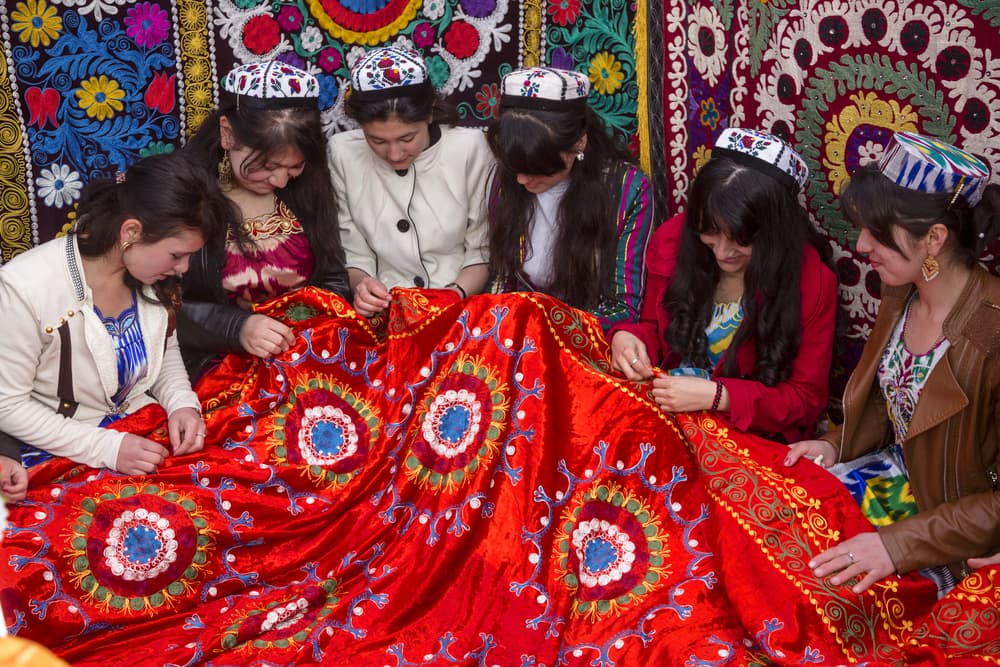
Dushanbe (AsiaNews) - This year, the national holiday of Nowruz coincided in Tajikistan with the end of Ramadan, sparking heated debates over the appropriateness of overlapping major folk celebrations with Islamic religious rituals. One of Tajikistan’s leading historians, Akbar Tursun, sought to explain in Asia Plus the reasons behind the relationship between popular self-awareness and religion.
As he observes, for Tajiks, Nowruz is “a bridge between the eras of social life”, not only as a symbol of the survival of ancient customs through the difficult times of the past, but also “the guarantee of the preservation of our generation’s historical life for the future”. The establishment of Nowruz as a national holiday was one of the most important decisions in the transition from the end of the Soviet era to the building of a true Tajik nation, in the contemporary understanding of the term.
In the generational transition of these events, the festival has brought these territories back to the “sources of the Iranian-Turanian civilisation”, one of the world’s oldest civilisations. In this way, “the horizon of Tajik patriotism has been broadened”, attributing a spiritual significance to the national unity of the Tajiks. Tursun observes that “unfortunately, differing interpretations clash between the Persian-speaking and Turkic-speaking clergy, who regard Nowruz as exclusively a Zoroastrian festival of fire worshippers”, which is unacceptable according to Muslim ritual norms.
The stances taken by senior representatives of Tajik Islam against Nowruz thus appear as a challenge to state ideology, and an attempt to promote the Muslim faith as superior to folk traditions. The expert also believes that there is no real contradiction between Nowruz and the principles contained in the sacred Muslim texts, but quotes the words of the Quran: “Why do you argue about what you do not know?”. The rejection stems mainly from the Salafi clergy, with its rigid and exclusive interpretation of the sacred verses.
The historian invokes the importance of the ‘human factor’, referring to the late 19th-century Islamic reformer Jamaluddin Asadabadi, the Afghan ideologue of ‘Pan-Islamism’, who discussed these issues with the French expert on Islam Ernest Renan, stating that ‘in essence, Islam has no flaws; all existing flaws are the consequence of the fact that we are Muslims”. In this, Asadabadi distinguished between the concepts of “Islam” and “Muslim”, between divine revelation to the Prophet and the human practice of religious principles based on the interpretations of the priestly hierarchy.
It is recalled that in the first century of Islam, during the Hijra which had broken tribal ties, Nowruz had been prohibited as a ‘pagan ritual’, but later the Arab caliphs rediscovered the value of the traditions of gifts given and received during Nowruz, a practice widespread in the courts of the Persian emperors. Furthermore, they realised that rather than banning non-Islamic folk practices, it was far more advantageous to grant permission to perform them in return for an additional tax. Finally, a political stance was adopted, as indicated by Emir Muzaffar of Bukhara, giving the Nowruz festival a formal character rather than the spontaneous folk traditions, following the defeat by the Russian Empire, which had seriously jeopardised his reputation among the people.
The emir himself had a large public bonfire lit to proclaim ‘popular peace’, overcoming all disappointment and contradiction. For Tursun, this means that ‘Muslims had attained the maturity of spiritual culture within the societies of these regions’, and the current Tajik president, Emomali Rakhmon, certainly does not shy away from comparisons with the ancient Turkic-Persian emirs.