








The Beatitudes in Algiers, rediscovering that God is truly great
Leo XIV arrived in Algeria, the first time a pontiff has visited the Muslim country, a bridge between Africa and the Mediterranean. In his address, he said that, “peace that is not merely an absence of conflict, but one that is an expression of justice and dignity.” About Algeria he said that, “A nation that loves God possesses true wealth”. For the pontiff, “fundamentalism and secularization” are “absurd polarizations”. Asked about Trump's insults, he said that he would continue “speaking out loudly of the message of the Gospel”
Algiers (AsiaNews) – The evangelical words of the Beatitudes were read in full beneath the Maqam Echahid, the Martyr's Memorial, which commemorates the fallen in Algeria’s war of independence from France.
To address the Algerian people directly, Pope Leo XIV chose the words of Jesus about the meek, the merciful, and those who hunger and thirst for justice, beyond all religious barriers.
Leo XIV's historic trip to Algeria began this morning in the pouring rain, the first by a pontiff to this overwhelmingly Muslim country, a bridge between the Mediterranean and sub-Saharan Africa. In the subsequent stages of this journey, Leo will visit Cameroon, Angola, and Equatorial Guinea.
“Algeria is a great country,” the pope said, “with a long history rich in traditions, dating back to the time of Saint Augustine and well before. It is also a painful history, marked by periods of violence. Yet, precisely thanks to the nobility of spirit that characterizes you – which I sense is alive even here and now — you have been able to overcome these trials with courage and integrity.”
Leo had already visited the country before, in 2001 and 2013, following in the footsteps of his great mentor, Saint Augustine, to whom he will pay homage tomorrow in Annaba, the ancient Hippo. Precisely because of its troubled history, the country holds a clear message for a world disfigured by conflict today.
“In this place,” Leo said, speaking in front of the monument that honours those who died during Algeria’s War of Independence, “let us remember that God desires peace for every nation: a peace that is not merely an absence of conflict, but one that is an expression of justice and dignity. This peace, which allows us to face the future with a reconciled spirit, is possible only through forgiveness.”
Ultimately, “The true struggle for liberation will be definitively won only when peace in our hearts has finally been achieved. I know how difficult it is to forgive. However, as conflicts continue to multiply throughout the world, we cannot add resentment upon resentment, generation after generation.” Instead, “The future belongs to men and women of peace.”
Against all those who are willing to do anything to accumulate “riches that fade away, deceive and disappoint, and which sadly often end up corrupting the human heart, giving rise to envy, rivalry and conflict,” the pontiff asked a question posed by Jesus two thousand years ago: ‘For what will it profit a man, if he gains the whole world and forfeits his life?’ (Mt 16:26).”
This “is a crucial question for everyone,” he said, addressing Algerian Muslims listening to him. “The dead whom we honor here have already given their answer. They lost their lives but in doing so, they gave them up for the love of their own people. May their example sustain the people of Algeria and all of us on our journey, for true freedom is not merely inherited, it is chosen anew every day.”
This message of peace comes with the conviction that the strong roots of Islam in Algeria are a value that, if lived in its true meaning, opens the way to brotherhood.
“A nation that loves God possesses true wealth, and the Algerian people cherish this jewel as one of their treasures. Our world needs believers like this – men and women of faith who thirst for justice and unity.”
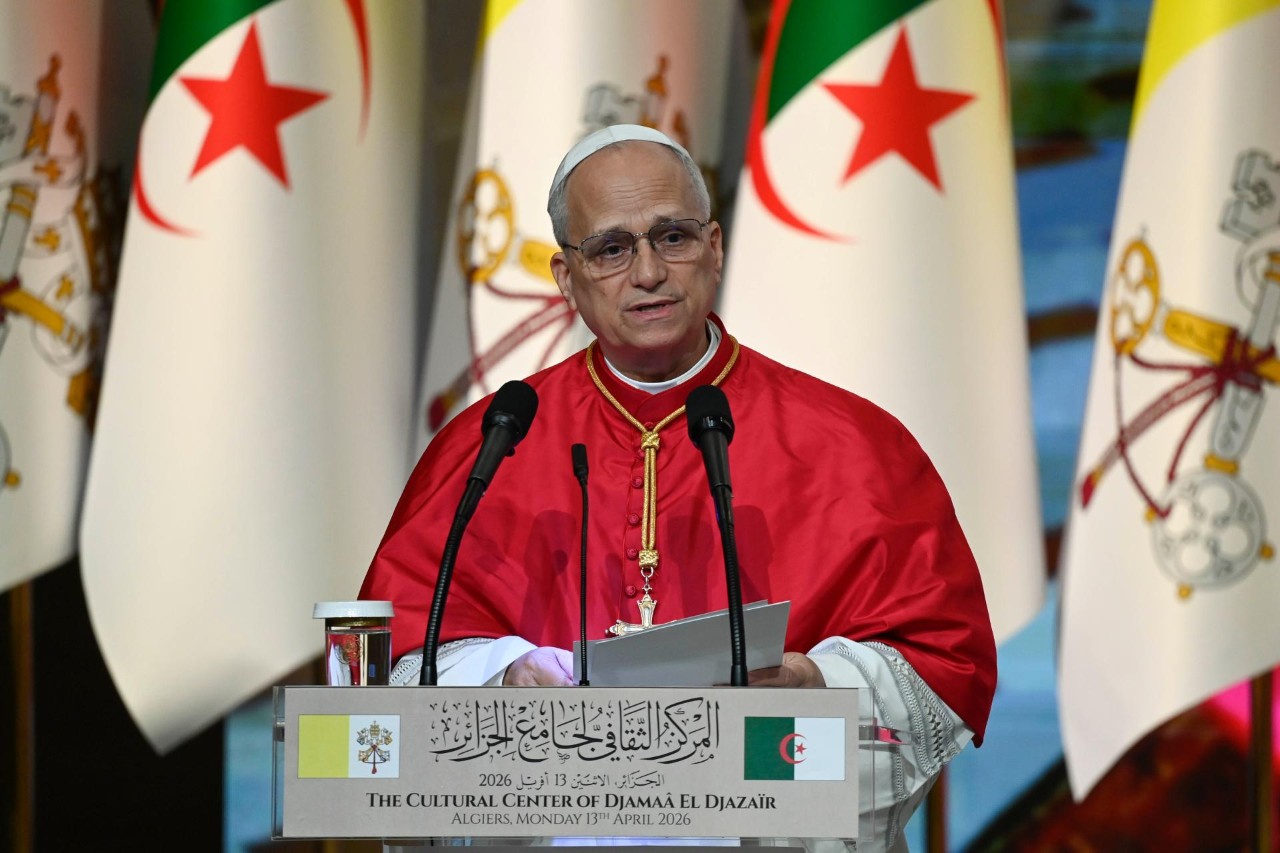
The pontiff reiterated the same point later, during the meeting with the authorities, representatives of civil society and members of the diplomatic corps which took place at the “Djamaa el Djazaïr” conference centre in Algiers, immediately after the courtesy visit to Algerian President Abdelmadjid Tebboune.
“We are brothers and sisters, for we have the same Father in heaven. The profound religious sense of the Algerian people fosters a culture of encounter and reconciliation, of which my visit also seeks to be a sign. In a world full of conflicts and misunderstandings, let us meet and strive for mutual understanding, recognizing that we are all one family!”
In his speech to the authorities, Pope Leo particularly extolled the deep sense of hospitality among Algeria’s Arab and Berber communities, but also the typically Muslim idea of sadaka, almsgiving, seen as a matter of justice to be restored to the poor.
“This view of justice is both simple and radical for it recognizes the image of God in others. Indeed, a religion without mercy and a society without solidarity are a scandal in God’s eyes.
“Yet many societies that consider themselves advanced are plunging ever deeper into inequality and exclusion. Africa knows all too well that people and organizations that dominate others destroy the world, which the Most High has created in order that we might all live together.”
The pontiff called on a country like Algeria, which is a natural bridge between North and South, East and West, which is also crossed today by migratory flows, to “engage in dialogue regarding the concerns of all and show solidarity with the sufferings of so many countries near and far, then you will be able to contribute to both envisioning and bringing about greater justice among peoples.”
He stressed that the Mediterranean and the Sahara Desert must be seen as “geographical and spiritual crossroads of immense significance”. Together with “the vast sky above them, “[they] whisper to us that reality surpasses us on all sides, that God is truly great, and that everything lives in his mysterious presence,” he said, alluding to the traditional Muslim saying, Allahu Akbar.
Later, the pontiff visited the Great Mosque of Algiers, acknowledging with this gesture his outreach to Islam.
Algerian society, however, has also experienced tensions between religious sentiments and modern life with the tragic history of Islamic terrorism in the 1990s as a reminder.
“Here, as across the world, opposed dynamics of fundamentalism and secularization tend to manifest themselves, causing many to lose an authentic sense of God and of the dignity of all his creatures. Consequently, religious symbols and words can become, on the one hand, blasphemous languages of violence and oppression, or on the other, empty signs in the immense marketplace of consumption that does not satisfy us.
“These absurd polarizations, however, must not dishearten us. They must be confronted with intelligence. They are a sign that we are living in an extraordinary time of great renewal, in which those who keep their hearts free, and their consciences alert, can draw from the great spiritual and religious traditions new ways of seeing the world and an unshakable purpose in life.
“We must educate people in critical thinking and freedom, in listening and dialogue, and in the trust that leads us to recognize in those who are different fellow travelers and not threats. We must work together toward the healing of memory and reconciliation among former adversaries. This is the gift I desire for you, for Algeria, and for all of its people, upon whom I invoke the abundant blessings of the Most High.”
Against the backdrop of these words and deeds, the petty controversy of the day unfolded today, sparked by US President Donald Trump's late-night post on his Truth Social account, filled with heavy-handed insults to the pontiff, calling him "weak”, and claiming that he was elected thanks to himself, pointless words that sparked a global outcry.
On the flight to Algiers, journalists even Pope Leo to respond to the president’s words.
"I have no fear,” Leo said, “with neither the Trump administration nor of speaking out loudly about the message of the Gospel”. This is “what the Church is called to do. We're not politicians. We're not looking to make foreign policy, as he calls it, with the same perspective that he might understand it. But I do believe that the message of the Gospel is a message that the world needs to hear today.”

.png)
25/02/2026 18:14










