Milan (AsiaNews) – There is an invisible thread linking the economic despair of unemployed young people in Africa, Asia and Latin America to the deceptive messages that arrive on our smartphones every day.
A simple text message or a job offer that seems too good to miss risks turning into the nightmare of ‘scam cities’, or online scam centres. Having proliferated rapidly across South-East Asia since 2020, these complexes – run by transnational criminal cartels linked to the Triads and the Chinese mafia – drive a criminal economy estimated to exceed 43 billion euros in the Mekong region alone, which spans Laos, Cambodia, Thailand and Myanmar.
According to United Nations data, the phenomenon has taken on the proportions of a geopolitical and humanitarian crisis, with at least 300,000 people forced to work in these facilities. Behind this immense financial network are not computer hackers, but digital slaves subjected to systematic violence – a situation which even Pope Leo XIV referred to in his encyclical ‘Magnifica Humanitas’.
To grasp the scale of this crisis, one must travel to Mae Sot, a small Thai town situated along the border marked by the Moei River. On the opposite bank, in Burmese territory, there are around sixty complexes clearly visible to the naked eye. Mechelle Moore, a New Zealander and executive director of the NGO Global Alms, describes these facilities as ‘commercial hubs for illicit activities’. These are self-sufficient strongholds, built in isolated rural areas and surrounded by territories controlled by armed ethnic groups or military factions fighting in the Burmese civil war that began in 2021, rendering them effectively impenetrable to the ordinary authorities.
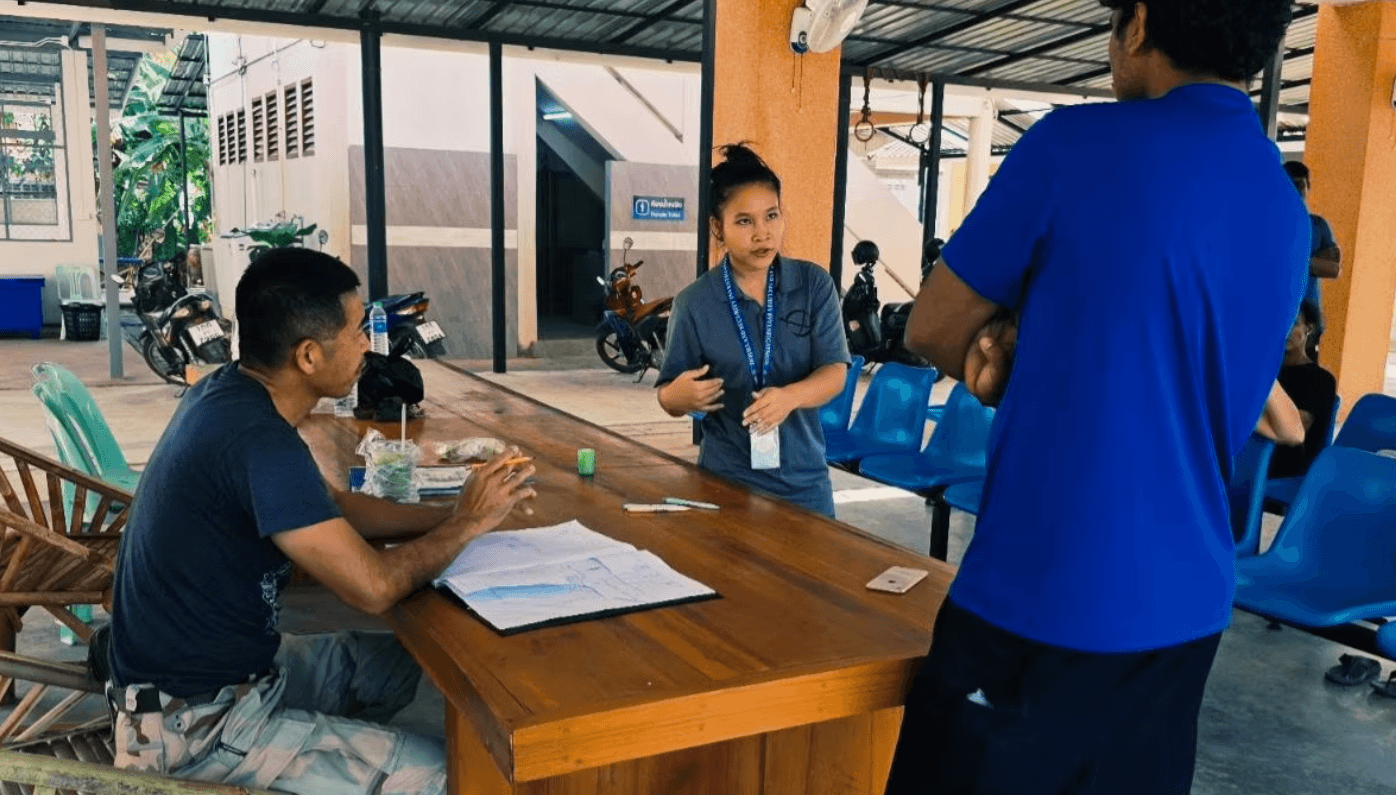
Global Alms, after years of work managing cases of gender-based violence and child trafficking, set up a dedicated anti-trafficking unit in 2022. “We offer an emergency helpline and a shelter for immediate accommodation, whilst our staff support each victim every step of the way,” explains Moore.
“When people leave the compounds, we help them with legal advice, explaining their rights and how the national referral mechanism works – the system through which Thailand identifies and protects trafficked persons – right through to supporting them in the repatriation process until they return home. “When the local police referred the first case to us involving a victim who had escaped from online scam centres, we realised the sheer scale of the problem,” Moore continues. “The phenomenon has grown at an alarming and unpredictable rate.”
From a fake job interview to a trap with no way out
The profiles of trafficked individuals defy the stereotypes associated with unskilled labour. Whilst those in Cambodia tend to have lower levels of education, the compounds in Myanmar select educated staff, often with higher education qualifications, capable of speaking foreign languages and using advanced software.
Recruitment takes place online via fake adverts for prestigious jobs in Thailand. After fake interviews on Zoom, the victims land in Bangkok and are transferred to Mae Sot with seemingly flawless logistics. “If any doubts arise, a recruiter is always on hand in the chat to reassure the person being trafficked,” explains Moore. The trap springs at night: suddenly picked up from their hotel, the victims are disoriented by constant changes of vehicle before being forced by armed militiamen to cross the Moei River into Myanmar. Within the compounds, those who refuse to cooperate witness the exemplary torture of other prisoners, and almost all of them give in.
‘Today, I believe that a significant number are aware of the risks but choose to try their luck anyway,’ analyses Moore. ‘They decide to take the risk because their economic situation is desperate and they have to support their families. When they realise they’ve been deceived, they’re the first to reach out for help, saying: “I knew there was a risk, but I didn’t think it would be this terrible – please help me get out”’ .
But escaping this labyrinth is almost impossible. Each compound houses between 30 and 40 independent companies, organised into rigid hierarchies linked to external superiors via video surveillance networks. Absolute anonymity reigns, explains Mechelle: only pseudonyms or nicknames are used, and the mobile phones given to the victims are completely reset, erasing any trace that might aid investigations. “Identities manage to remain secret for various reasons.
In Cambodia, much more is known about who owns the companies and runs the compounds, because they’re all registered as separate companies, and those registers can be consulted. But Myanmar is in the midst of a civil war: the compounds there are almost in a state of limbo, growing unchecked, and no public registers can be accessed. They operate anonymously; everyone uses pseudonyms.
When a victim escapes and names their boss, by the time you go to check, they’ve already vanished — and the names were fake anyway.” For this reason too, the geography of cybercrime is shifting into the Burmese hinterland, 10 or 15 kilometres from the border, making the centres militarily inaccessible to NGOs working to rescue victims. Many Burmese citizens work in the compounds to cope with the economic crisis: unlike those trafficked from other countries, they work in these compounds as cooks, translators or security guards, lured by high wages and absolving themselves of direct criminal activity. The fear is that Myanmar could slide towards becoming a permanent ‘scam state’, following the Cambodian model, Moore adds.
‘The escape routes are very few and dangerous,’ continues the director of Global Alms. ‘Many attempts to escape into the jungle end in tragedy or with beatings so brutal that they permanently disable the captives. One alternative is the payment of a ransom extorted from families, which traffickers disguise as reimbursement for flights and board, but which represents the commercial price paid to purchase the person within the trafficking network.’
In exceptional cases, influential diplomatic channels are mobilised to negotiate remotely with the leaders of armed groups – as China is able to do, exercising its political clout over the actors in the Burmese civil war and its commercial influence over the countries of South-East Asia. The victims remain held captive for one or two years, being released only when they have been reduced to a state of total physical and psychological exhaustion.
From the jungle to a new life: the story of a survivor
It is precisely the restoration of their names and humanity that lies at the heart of Global Alms’ work. Moore recalls the story of a young Ethiopian mechanic who, together with two compatriots, had attempted to escape by jumping from a second-floor window. Hunted down in the jungle by Chinese guards and local militias, he had been beaten so savagely that he was left paralysed on the ground with severe injuries to his pelvis and spine.
Believing him to be of no further use, the traffickers had driven him to Thailand, dumping him lifeless outside Mae Sot Hospital. With no documents, the young man was admitted to hospital. ‘When I received the report, I searched every ward until I found him,’ says Moore. ‘He didn’t speak English; we communicated only in Amharic via Google Translate. Months later, he confided in me that when I entered the ward, I had seemed like an angel to him, simply because I had said his name. In a system that had reduced him to an invisible number, hearing his own name had restored his humanity.’
After nine months of treatment, the young man was repatriated to Ethiopia. There, he set up a mechanical workshop in his family’s garage alongside his younger sister, turning it into a successful business. ‘We must bear in mind that these people come from situations of extreme poverty and vulnerability, with a desperate need to work,’ the expert explains, emphasising that a return to normality is far from immediate. “When they end up in a scam centre, they can remain there for between six and eighteen months, sometimes up to two and a half years, and when they leave, they often return to a situation worse than the one they left behind: they find themselves with huge debts and shattered families. Rebuilding a life after such an experience is an enormous challenge.”
The experience of Mechelle Moore – who also has a background in the Australian military administration and, during the pandemic, undertook university research in Canberra to help cover the NGO’s costs – highlights the need to move beyond bureaucratic approaches. “We always tend to look for the ‘perfect victim’, convinced that they must cry, speak or behave according to a rigid pattern,” she says. “But the reality of trafficking involves diverse individuals, each with their own response to trauma. Applying a methodology that is sensitive to traumatic experiences and welcoming these people with dignity and kindness is the only way to initiate genuine healing and lasting social reintegration.”
Romance scams, artificial intelligence and China’s role
Cyber-slaves are mainly involved in romance scams, in which the scammer builds up a fake romantic relationship over several months before convincing the victim to invest in bogus platforms or to hand over money voluntarily (a scenario that often does not constitute a criminal offence), or they carry out ‘task scams’, where victims are asked to pay increasing sums to unlock supposed online earnings.
More recently, criminal networks have begun to use translation tools and artificial intelligence. But Moore believes that new technologies will not reduce the number of digital slaves. According to the director of Global Alms, for criminal organisations already exploiting deepfakes and instant translation systems, the technology will act as a multiplier of exploitation because the aim of criminal organisations remains the maximisation of profit: ‘I don’t think for a moment that they will stop exploiting human beings out of the goodness of their hearts just because they now have AI at their disposal,’ she comments.
China’s role, she says, also remains ambiguous: despite official policies against cybercrime, the presence of officials who pass through the centres without dismantling them suggests the complicity of corrupt actors who benefit financially from the situation. “I’m not saying that China is a malicious actor, but there are individuals and companies that benefit from keeping the compounds running. You can have a government opposed to trafficking and cybercrime, and still have bad actors within that government who perpetuate the cycle. I think there are many bad actors involved, some of whom are Chinese, but they come from all over South-East Asia, from all over the world.”