Abu Dhabi (AsiaNews) – Passage charges. Doors open to "friendly" or at least non-hostile nations and governments, missiles and anti-cargo mines are for vessels flying the flag of the United States, Israel, and other countries fuelling the war.
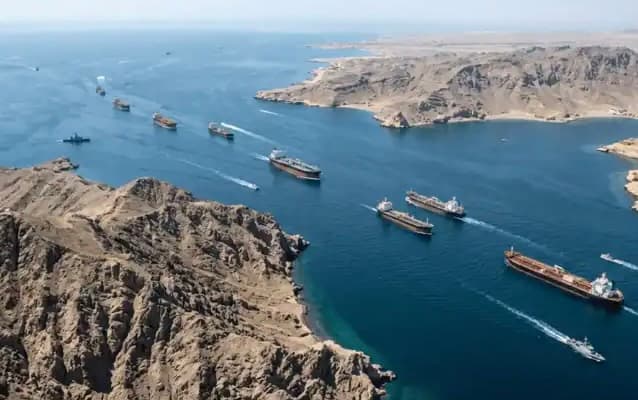
This scenario has been unfolding in recent days in the Strait of Hormuz and the waters of the Persian Gulf, a strategic area through which approximately 20 per cent of global oil transits – or did before the conflict – in addition to other goods and commodities.
Attacking the economic interests of global powers is one of the weapons, if not the most powerful weapon, Iran is using in response to Israeli-American attacks – a strategy that targets refineries and oil production centres in Gulf nations, like Bahrain and Kuwait, as well as Hormuz, a key maritime choke point, a timely issue after the recent attacks on cargo ships, resulting in sailors killed or missing.
The Strait of Hormuz is a stretch of sea approximately 60 km long and 30 km wide that separates Iran from the Oman’s Musandam Peninsula – which is in turn surrounded by the United Arab Emirates (UAE) – and connects the Persian Gulf to the Gulf of Oman (Arabian Sea).
Its shape, and the depth of its waters, allow the passage of large oil tankers, and it is used by major Middle Eastern producers to export crude oil and natural gas, as well as engage in trade.
According to estimates by the Energy Information Administration (EIA), the annual energy trade is around US$ 600 billion.
The oil comes from Iran, Iraq, Kuwait, Qatar, Saudi Arabia, and the United Arab Emirates, carried by some 3,000 cargo ships each month, primarily for Asian markets and the continent’s largest economies, such as China, India, and Japan.
According to EIA data, in recent years, up to 82 per cent of crude oil and hydrocarbons leaving Hormuz have supplied Asian markets – China alone buys approximately 90 per cent of Iranian oil, with Tehran exporting approximately 1.7 million barrels per day.
Considering the current situation, in Asia some governments have decided to take action and sign deals with Iran to ensure safe passage through troubled and mined waters.
A government source in New Delhi recently reported that Tehran has agreed to allow Indian-flagged vessels to pass through the strait, which provides the South Asian nation with 40 per cent of its imports of crude oil.
However, there is no official news, partly because the Indian Ministry of External Affairs and the Islamic Republic's embassy in Delhi have not released any statements on the matter, and an Iranian source has denied the claim.
The issue remains open and the situation fluid, analysts explain, but it is equally clear that the route is strategic for India’s energy interests.
Furthermore, the issue of energy overlaps with that of strategic alliances; in this perspective, it is worth remembering Indian Prime Minister Narendra Modi's recent trip to Israel and the warm meeting with Prime Minister Benyamin Netanyahu, the main proponent of the war against Iran.
Hence, India is engaging in a delicate balancing act. Despite a recent strengthening of its ties with the Jewish state, it must safeguard its domestic interests, and the Strait of Hormuz is essential for its energy needs.
At present, the situation remains fluid, with 28 ships with 778 sailors still operational in the area, while India has provided a safe haven for 183 Iranian sailors from a ship that docked after the outbreak of the war.
The green light for "safe passage" granted by Iran to Bangladesh has been confirmed with Dhaka as well, where the government is intensifying its efforts to maintain a stable fuel supply in the face of the escalating conflict in the Middle East.
Tehran recently authorised Bangladeshi ships through the strait, thanks in part to agreements reached during a meeting between Bangladeshi Energy Advisor Iqbal Hasan Mahmud Tuku and Iranian Ambassador to Dhaka Jalil Rahimi Jahanaba.
The talks focused not only on the strait, but also on strategic issues related to energy cooperation and maritime transit.
In a situation of great difficulties, with the Bangladeshi government already forced on implementing austerity measures and ordering school closures, help could come from India and China, who have expressed their willingness to help Bangladesh with fuel.
Thus, the list of countries that have reportedly received approval for passage is longer. In the early days of the war, China was the only country to receive explicit authorisation for its vessels from Iran.
The blockade of oil and gas shipments through the strait is a nightmare scenario for the global energy system and represents one of the most severe disruptions to energy supply ever experienced.
In fact, reserve capacity elsewhere in the world is insufficient to fill the gap in the event of further, more severe disruptions from the Middle East.
Until shipments resume, refineries around the world lack sufficient crude oil and will have to rely on their reserves to continue producing and supplying fuel to transportation and industry.
Compounding this is the rising price, with a barrel reaching US$ 119 recently, a four-year high.
Meanwhile, Japan too has entered the energy game, announcing its intention to release part of its oil reserves as early as 16 March, in response to soaring prices and without waiting for an internationally coordinated response.
“Crude oil tankers remain virtually unable to pass through the Strait of Hormuz,” Prime Minister Sanae Takaichi emphasised yesterday when announcing the decision. “Crude oil imports to Japan are expected to sharply decline from late this month,” she added.
Japan therefore intends to draw the equivalent of 15 days of private sector reserves and a month of state reserves.
The release will total 80 million barrels, the largest volume ever, according to the Industry Ministry, the first time Japan has independently released its national reserves.
The prime minister explained that the country will implement emergency mitigation measures using subsidies to keep retail gasoline prices at around 170 yen (US$ 1.07) per litre on average nationwide, should further increases occur.
Finally, the government plans to reinstate the gasoline subsidy programme that ended last year, with payments applicable to shipments made starting 19 March; similar measures will be extended to diesel and kerosene.






.webp&w=3840&q=75)