








A new website on the history of MEP missionaries in China
The portal promoted by the IRFA provides scholars with materials and inventories of documents held in Paris on the presence of French missionaries in various Chinese provinces from 1684 to 1955. It is a valuable source for understanding the religious, social, and political history of modern China.
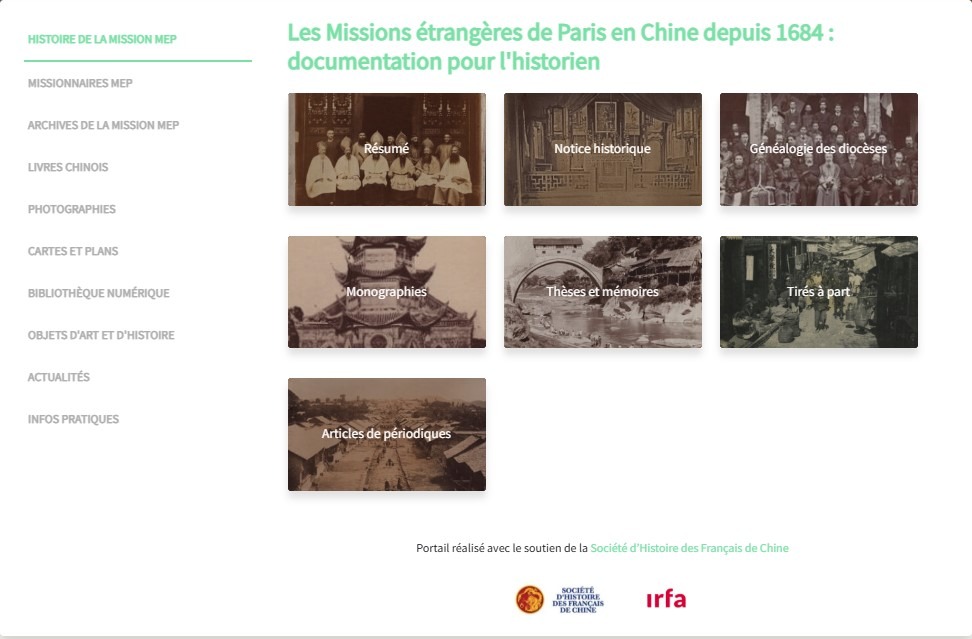
Paris (AsiaNews/Agencies) – The Institut de recherche France-Asie (France-Asia Research Institute, IRFA) recently launched a new online portal entirely dedicated to the more than 170-year history of the Missions étrangères de Paris (Paris Foreign Missions, MEP) in China, entrusted with the preservation of the historical heritage of the experience of the missionary institute founded in France in 1658 and still present in 15 countries in Asia and the Indian Ocean.
China represents an important part of the MEP’s history, whose missionaries were present in the great country between 1684 and 1955 with as many as 1,226 missionaries.
Before the forced end of this experience due to persecution and expulsions decreed by Mao's communist regime, they carried out their ministry in the provinces of Sichuan, Yunnan, Guizhou, Guangdong, Guangxi, and Manchuria, setting up numerous dioceses.
This gives the archives in Paris great importance, which will now be made available to researchers worldwide.
In 2025 and 2026, significant archival work led to the classification of 98 boxes of documents relating to the Catholic mission in China between 1773 and 1952.
This inventory is now available online on the new portal, offering scholars a valuable tool to explore the history of the presence of French missionaries in the country.
The archive's content is divided into three main sections.
The first consists of correspondence between the MEP missionaries in China and their superiors or apostolic delegates. These letters recount daily life in the missions: requests for financial support, permits, land purchases, but also difficulties related to war and instability. The documentation for the period 1949-1952, marked by the rise of the communist regime and the expulsion of foreign missionaries, is particularly rich.
The second section contains documents on Catholicism in China collected by archivists, including reports on persecutions, pastoral visits, diplomatic relations, and press articles. These documents also provide information on relations between French and Chinese authorities and between China and the Holy See.
The third section is dedicated to the archives of four MEP martyrs in China: Fr Jean-Martin Moyë (1730-1793), Mgr Gabriel-Taurin Dufresse (1750-1815), Fr Auguste Chapdelaine (1814-1856), and Fr Jean-Pierre Néel (1832-1862). It contains their letters, biographies, and documents relating to their beatification process.
In addition to these three sections, the missionaries' personal dossiers complete the picture by offering a broader view of their work.
Overall, the collection represents a fundamental source for understanding the religious, social, and political history of modern China.
In addition to the archive inventory, the new portal – along with essential historical information on the MEP's presence in China – contains brief biographical notes on all the French missionaries who carried out their apostolate in China, an inventory of the 25,000 photos and maps produced by the missionaries, and a presentation of 35 period Chinese books held in the MEP library in Paris.
Some publications by the missionaries in China will also be gradually made available for consultation. It is already possible to browse online some issues of the periodical La Veritate, which reported news from the Sichuan mission in the early 20th century.

.png)
22/05/2022 14:26










