Milan (AsiaNews/Agencies) – Indian Prime Minister Narendra Modi’s trip to Israel has attracted considerable attention in recent days, both for its timing and its political significance, boosting the relationship between New Delhi and the Jewish state, cemented by trade and military agreements.
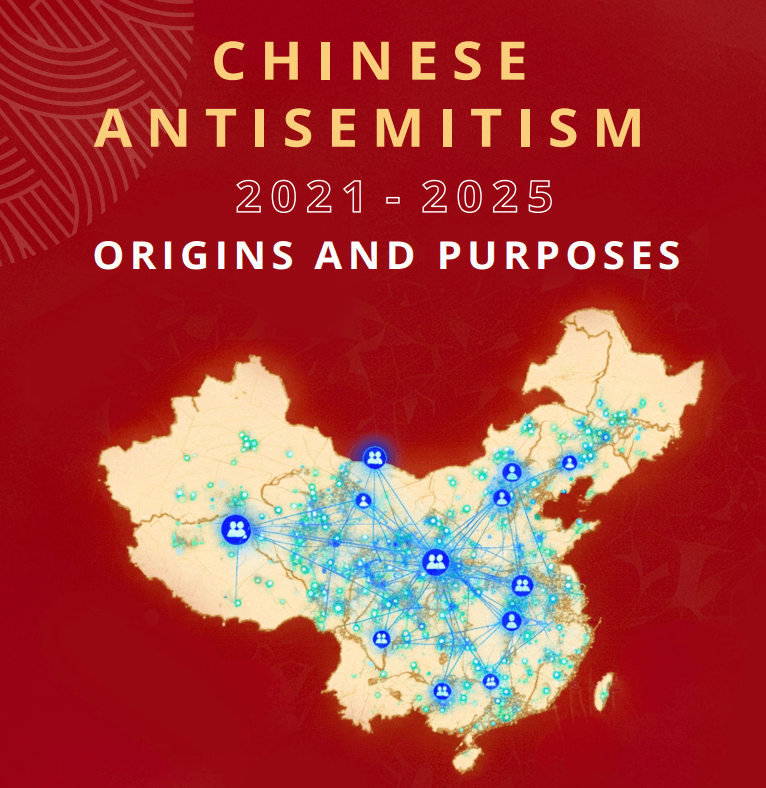
Concurrently, a report was released recently in Israel that, for the first time, casts a cloud over relations with the other great Asian giant: China. At its core is a noteworthy allegation concerning the Jewish world, namely that Beijing is now one of the major centres for the propagation of antisemitism.
The claim comes from the Jewish People Policy Institute (JPPI), a think tank founded by the Jewish Agency, which oversees relations between Israel and diaspora communities.
According to the report by Professor Shalom Salomon Wald, a historian specialising in relations between China and Israel, waves of antisemitism swept through Chinese official and social media after the Gaza conflicts of 2021 and 2023-2025.
Wald argues that these campaigns were authorised, if not directly promoted, by the Chinese government in the pursuit of strategic political objectives and were based on traditional anti-Jewish stereotypes, something unprecedented in a context like China.
This is ostensibly linked to the Chinese media's portrayal of the war between Israel and Hamas, fuelled by the tendency to confuse Israel, Jews, and Judaism as a single entity.
Universities are also described as important incubators of antisemitism, like what happens in the West, along with social media platforms used by commentators and influencers.
Hence, this raises the fear that China could become a new driver of antisemitism in the Global South and even in the West, negatively influencing the country's younger generations and future leaders, to the point of dampening the interest in Jews and Israel that, according to Wald, was present in the country.
Among the main factors nurturing Chinese antisemitism are tensions with the United States, where Jews are believed to have an influential role; the search for alliances with Arab and Muslim countries, Iran, and Russia; the need to find scapegoats for internal problems; opposition to the Western global order; and the global spread of antisemitism as a cultural phenomenon.
With this as the starting point, perhaps the most interesting insight the JPPI’s study offers is a criticism of the Israeli government for failing to pay attention to the China factor and its lack of a coherent, long-term political strategy.
Decisions, Ward argues, are made by the prime minister and the government only when the agenda allows, and this represents a limitation in dealing with a power like China, accustomed to planning on broad strategic horizons.
The prevailing orientation is to avoid political friction and prioritise economic cooperation, also because the alliance with the United States inevitably limits Israel's room for manoeuvre.
In this context, the study instead suggests reverting to a long-term vision, inspired by the approach of David Ben-Gurion, who, as early as the 1950s, called for building ties with the major Asian powers, despite political hostility.
One priority identified is precisely the fight against antisemitism in Chinese media and universities. It proposes engaging Jewish communities around the world and organisations like Yad Vashem, as well as urging Western governments to express a clear position.
It would also be crucial, Ward adds, to systematically monitor expressions of antisemitism and understand which sectors of the Chinese bureaucracy tolerate or promote them.
The document also recommends integrating the issue into diplomatic dialogue with China and revitalising cultural and academic exchanges. While maintaining the “One China” policy, it recommends not abandoning cultural ties with Taiwan.
More generally, for the JPPI, Israel should consider ways to boost its image of resilience and strategic relevance in the eyes of China’s leadership, a prerequisite for building a more balanced and lasting relationship.