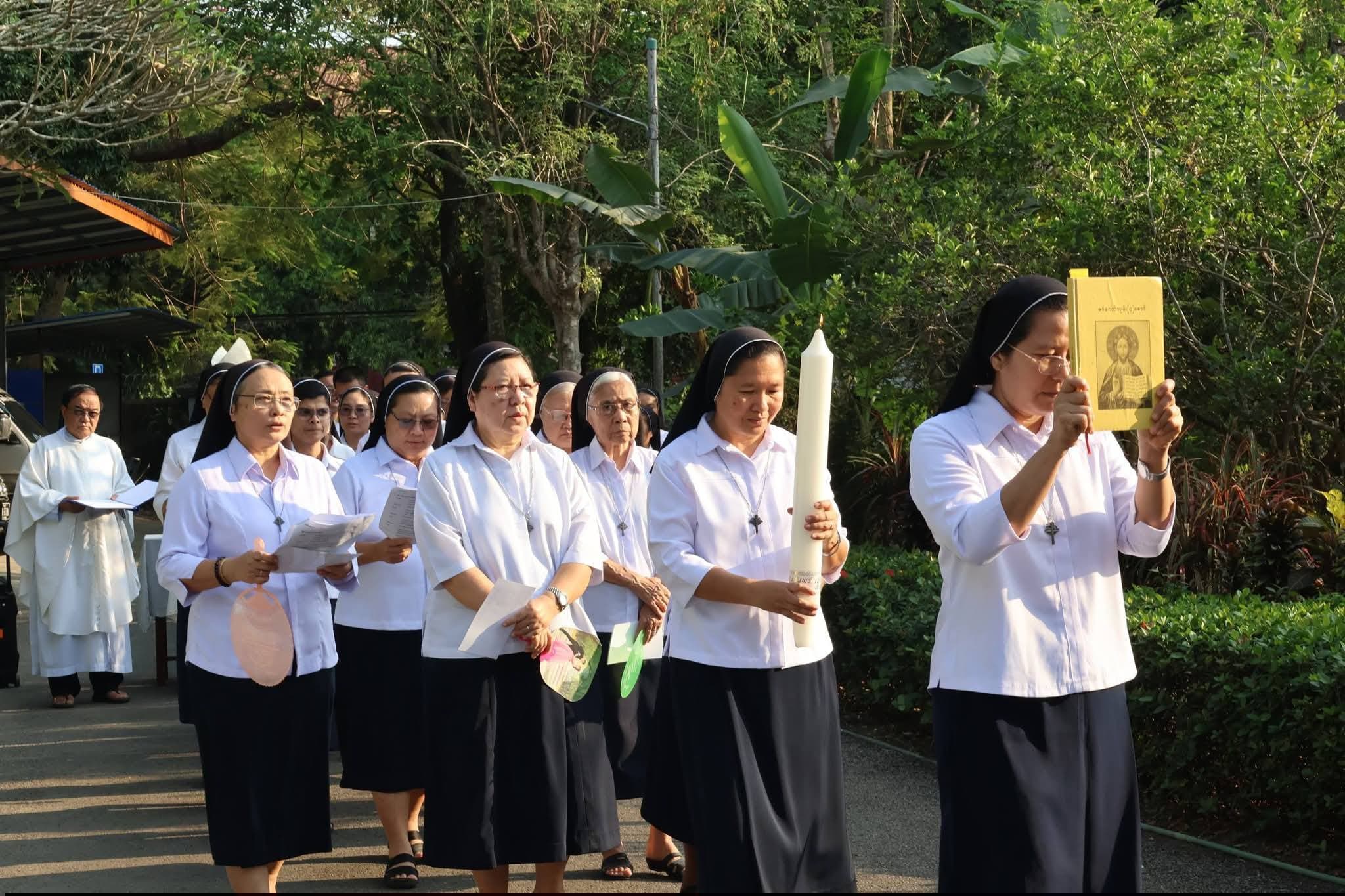
Yangon (AsiaNews) - For 160 years, the Sisters of Our Lady of Charity of the Good Shepherd have been working in Myanmar to serve the poor and needy with dedication and compassion. Since 1865, their mission – which encompasses education, healthcare, missionary work, social services and pastoral care – has been a living and fruitful witness to the Gospel.
Today, over 50 sisters work in nine communities across Kachin State, Eastern Shan State, Kayah State, Mandalay Division, Bago Division and Yangon Division. The sisters provide young women with education and vocational training. They work in the healthcare sector and assist HIV-positive children and those whose parents are HIV-positive or drug-dependent. Furthermore, dedicated to child protection, they work on the prevention of gender-based violence.
They care for women at risk of human trafficking and street children. They are actively involved in prison ministry, social welfare and advocacy programmes focused on human rights and dignity, gender equality, pro-life issues, environmental sustainability, justice and peace. In Myanmar, they promote interfaith dialogue, particularly with Buddhists, who form the majority in the country, to foster understanding and cooperation on social issues affecting vulnerable populations and communities.
One of their centres is located in Myit Nge, central Myanmar, where the sisters care for around 40 boys and girls from conflict zones. Four paid teachers and two nuns work there. The centre, known as “Kalay Saunt Shout Yae Gayhar” (child-friendly space), was founded in 2021 to assist students affected by the Covid-19 pandemic and the political conflict following the 2021 military coup.
As a result of these circumstances, the education of many young people has suffered. The sisters help them to continue their education and build their future amidst many challenges. Sr. Amy Martina, director of the centre, explained that the children’s parents are poor and have been deeply affected by the country’s current tragic situation.
Meanwhile, in Loikaw, an area currently affected by the conflict in Myanmar, the Sisters of the Good Shepherd are assisting displaced people from various villages who have fled due to the ongoing violence. Families in Loikaw are living in makeshift accommodation due to the long-standing instability, reports Sr. Florence, who works in a shelter for women and girls who are victims of domestic violence.
The population of Loikaw lives in precarious conditions, without emergency healthcare or means of subsistence, whilst fighting between the People’s Defence Force (PDF) and the national army continues with gunfire and prolonged shelling around the city. In the Daw U Khu area too, the sisters are helping displaced families in Buddhist monasteries.
In Mandalay, the former royal capital of Myanmar, the sisters run the “Rose Virginie Empowerment Centre for Young Women”, where they offer women vocational training courses to ensure they have a livelihood and a future. The centre is designed to help women who are victims of abuse or human trafficking. The centre’s aim is to help women earn a living and lead a dignified life, said Sr Chaw Su Aung, the coordinator.
The centre offers courses in bookkeeping, IT and cooking. It teaches time management and self-control, as well as raising awareness on issues such as human trafficking, women’s rights and exploitation. After completing the course, women and girls are placed in safe and suitable environments. There are around 50 women of Catholic, Baptist, Buddhist and Muslim faiths, hailing from conflict-torn areas such as Kachin State and other ethnic strongholds, including Kayah, Chin and Karen States.
The Sisters of the Good Shepherd in Myanmar celebrated 160 years of presence on 12 March 2026. Cardinal Charles Maung Bo, Archbishop of Yangon, presided over the Mass of Thanksgiving. In his homily, the cardinal thanked God and the sisters for their service to the country, amidst difficult challenges. “Their journey bears witness to a love that knows no bounds and a mission that continues to flourish,” he said. “May the spirit of the Good Shepherd continue to guide their steps for many years to come.”
“Today marks a fundamental milestone for the Catholic community and the people of Myanmar. We have gathered in prayer and joy for the Mass of Thanksgiving, celebrating the 160th anniversary of the arrival of the Sisters of the Good Shepherd in our beloved country,” said Sr. Rebecca Kay Thi Oo, head of the Good Shepherd Unit for East Asia, which includes Myanmar, Thailand, Cambodia and Vietnam.
She also paid a grateful tribute to the pioneers and her fellow sisters who followed in their footsteps, courageously serving people with love and dedication. “These 160 years are a milestone for all of us to renew our commitment to God, as we continue our mission of justice, mercy, respect, human dignity and reconciliation to create a better society,” said Sr Rebecca Kay Thi Oo.
Since the Sisters of the Good Shepherd first set foot in Myanmar in 1866, they have been a symbol of hope, compassion and selfless service. For 16 decades they have walked alongside marginalised people, offering empowerment to women and girls, quality education, holistic development to young people, comfort and protection to the vulnerable, as a spiritual reference rooted in the heart of the Good Shepherd.
In 1835, in Angers, France, Saint Mary of Saint Euphrasia Pelletier (1796–1868) founded the Congregation, which was approved in the same year by Pope Gregory XVI. It was Bishop Paul Ambrose Bigandet, the first Apostolic Vicar in Lower Burma, who asked the sisters to go there. After their arrival in 1866, they faced enormous challenges posed by numerous ethnic tribes and other populations: poverty, civil wars between ethnic groups, illiteracy and corruption, as well as natural disasters such as droughts and floods. Furthermore, the country lacked advanced agricultural techniques and had inadequate communication and transport systems.
In the 1960s, the country embraced Burmese socialism and a campaign of nationalisation, which paved the way for an anti-Western trend, including xenophobia, and repressed missionaries. These measures dealt a severe blow to the country’s economy and exacerbated poverty. In 1973, some Sisters of the Good Shepherd returned to the country to restart the mission, teaching catechism and English in seminaries. Since then, they have continued their pastoral work in various dioceses, right up to the present day.