








On hunger strike in prison, Chow Hang-tung: "Don't forget Tiananmen”
In a message written from prison, the lawyer on trial alongside Lee Cheuk-yan and Albert Ho for the 4 June vigils in Victoria Park speaks of the importance of resilience in remembering the 1989 massacre in Beijing, whilst the Hong Kong authorities cover the void left by the crackdown with a sea of market stalls. “4 June is a matter of principle, our most reliable safeguard against the perpetuation of dictatorship and the cult of power.”
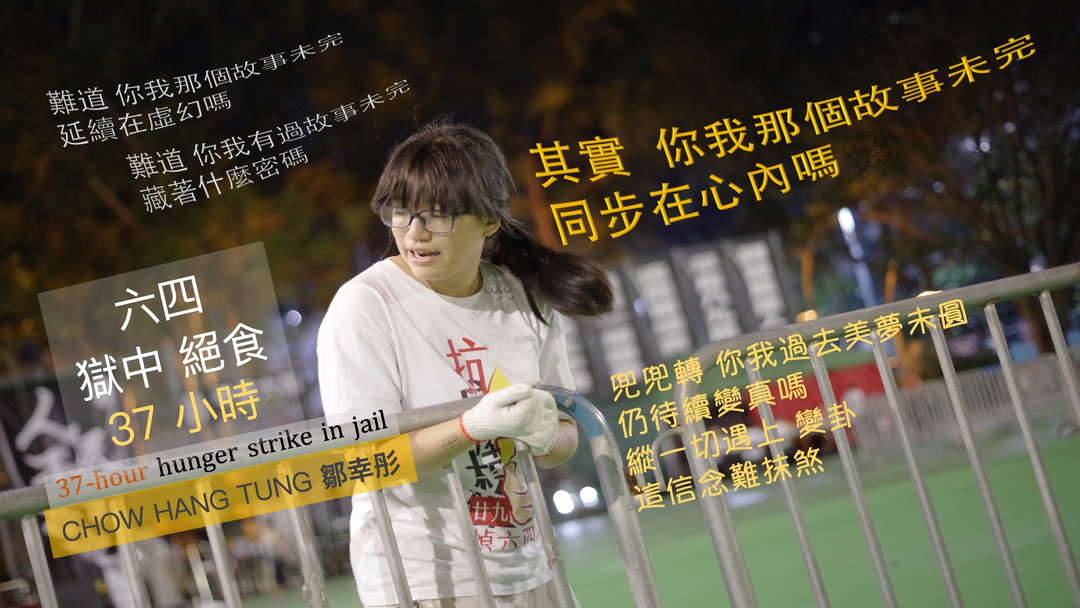
Hong Kong (AsiaNews/Agencies) – In Hong Kong – as has been the case for several years now – preparations are underway in Victoria Park for the fair organised by the local government on 4 June to fill the space and prevent the void from being visible, in the very spot where, every year, local civil society used to gather for a night-time vigil to commemorate the Tiananmen Square massacre of 4 June 1989 in Beijing. This continued until 2019, before the People’s Republic of China cracked down with an iron fist to halt all such demonstrations in the former British colony.
This year, the anniversary falls during the ‘lull’ between the end of the trial and the (long) wait for the verdict in the case against trade unionist Lee Cheuk-yan, lawyer Chow Hang-tung and former MP Albert Ho, the organisers of the Hong Kong Alliance in Support of Patriotic Democratic Movements of China, which organised the annual 4 June gathering in Victoria Park. The first two – who have not pleaded guilty to charges of “inciting subversion” under the notorious National Security Law – face a 10-year prison sentence (where, incidentally, they have already been held for more than four years). From her cell, Chow Hang-tung – a 41-year-old lawyer from the new generation of activists, who defended herself in court – has shared a reflection reposted by the curators of her profile on the social network Patreon, which we publish below. In the text, she speaks of the resilience required to continue commemorating 4 June despite the severity of Beijing’s repression, and also announces a 37-hour hunger strike – one hour for each of the years that have passed since the 1989 massacre, when tanks brutally crushed the Chinese youth’s thirst for freedom.
On 19 May, after delivering my closing submission in court, I returned to prison to find news reports stating that Starbucks Korea had sparked public outrage by using a massacre from 46 years ago as a marketing gimmick. The group’s chairman hastily apologised, and the CEO was even dismissed. Yet, in my city - as if in a parallel universe - not only are candlelit vigils deemed criminal, but year after year, people openly hold markets and put on festive displays on the anniversary of the massacre at the very sites of remembrance, without a shred of shame or remorse. These organisers face no consequences; instead, they even receive substantial government funding.
Here, conceivably, lies the line between civilisation and barbarism
A society that loses its freedom of speech never just loses a few articles or events -- it loses its very soul. Morality is born of the human heart and dies at the hands of power; it is born of choice and dies in the face of uniformity; it is born of inquiry and dies in the face of blind obedience.
‘Power corrupts’ is a hackneyed phrase, but when the will to power permeates everything, and becomes the supreme criterion for human actions and decisions -- the decline of society becomes inevitable. Conversely, resisting the encroachment of power, or even attempting to put it back in its cage, requires a steadfast return to fundamental human values, reclaiming our humanity from its clutches step by step.
This legal battle is one such attempt: it is a demand that I do not speak words I do not believe, do not do things I ought not to do, and do not dwell on success or failure.
Is it difficult? Yet, this is nothing more than basic human nature. Who is born with an inherent desire to speak insincerely or act against their own conscience? Being one’s truest self ought to be the easiest, most natural thing in the world.
I harbour no grand ambitions. The utopia I envision is simply a place where everyone can live comfortably and freely, where life is a little more authentic and a little easier. Yet, like a funhouse mirror, the excessive concentration of power has always warped human nature. Checking that power and ending dictatorship is therefore non-negotiable; there is no room for retreat or evasion.
To preserve the memory of June 4th is to safeguard that very same baseline of human decency. When we take that extra step in accordance with our conscience, the reach of authoritarian power shrinks by that very measure.
June 4th is a matter of principle. By standing firm on it, we can build the resilience much needed to resist the corrosive effects of power. This resilience is our most reliable safeguard against the perpetuation of dictatorship and the cult of power.
This year marks the 37th anniversary of the June 4th massacre, and I will continue to hunger strike for 37 hours while imprisoned.
Please do not forget:
Behind the glitter of power and dictatorship lies the blood and broken dreams of ordinary people.For in amnesia lies the demise of democracy. They can lock us up, they can't do on our souls.
Now that the story of the Hong Kong Alliance is told, let’s take up the baton and lead the way forward.
In the struggle between memory and the rewriting of it... our story is far from over!
* A Hong Kong lawyer who has been in prison since 2022 for being one of the organisers of the vigils commemorating the Tiananmen Square massacre

.png)
05/02/2025 18:35










