








Pope: If the defence of life is obscured, ‘the most vulnerable will be the first victims’
Leo XIV, in his speech to the Spanish parliament, said that only by lifting their gaze can they “remember that every decision by public authorities affects real people.” In the country where the School of Salamanca first theorised the universal value of human dignity, from conception to the natural end of life, safeguarding this principle is urgently needed, the more so given the challenges posed today by new technologies, migration, and the return of war.
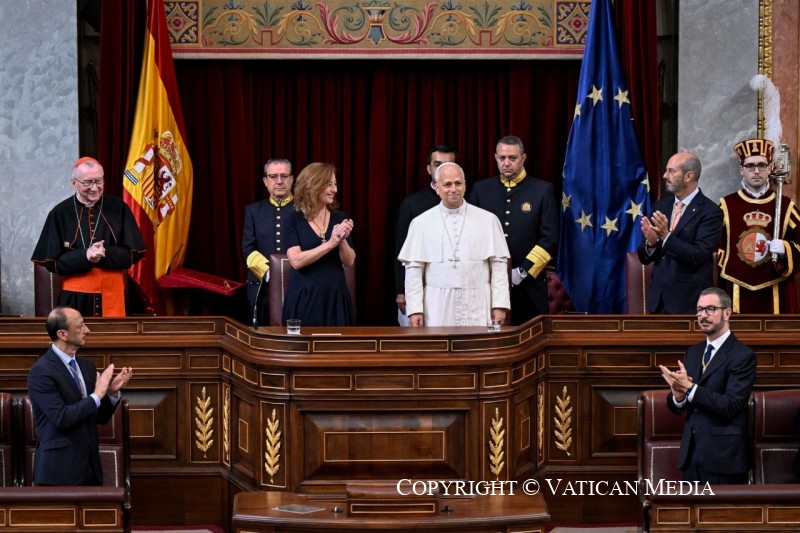
Madrid (AsiaNews) – Pope Leo XIV spoke this morning before a joint session of the Spanish parliament in Madrid, covering a wide range of topics.
In his address, he invited the lawmakers “to lift your gaze” and not “turn away from reality, but to remember that every decision by public authorities affects real people, especially those who have less power to make their voices heard.”
Indeed, “high-mindedness consists precisely in looking more deeply at what is at stake in every public decision" and for that reason, "alongside technical solutions and legal reforms," politics today also needs a "moral renewal."
Before his speech, the pontiff met with Prime Minister Pedro Sánchez early in the morning at the nunciature. Afterwards he travelled to the Palacio de las Cortes (Parliament House), where he was welcomed by the speakers of the Congress of Deputies and the Senate, Francina Armengol and Pedro Rollán.
Speaking about his presence in the country, he said that it was as a show of closeness to Spain and a contribution to the public debate oriented towards the common good.
Addressing the parliamentarians, he said that the Church "walks alongside humanity," sharing its hopes and sufferings, and that its intervention in public life takes place with full respect for the autonomy of democratic institutions.
The pontiff raised a fundamental question: What idea of the human person inspires laws, and what kind of society do they help build? To do so, he urged his interlocutors to seek a rich and profound answer in Spain's own history, the fruit of the interaction of faith, reason, law, and culture.
Quoting the great writer Miguel de Cervantes, he said that “freedom… is one of the most precious gifts that heaven has bestowed upon men," while the legacy of thinkers like Miguel de Unamuno testifies to the awareness that human beings cannot be reduced to mere cogs in the social or economic order.
A central part of the speech was dedicated to the School of Salamanca and the ideas of Francisco de Vitoria. For Leo, faced with the challenges of the discovery of the so-called New World, some Spanish theologians and jurists asserted the universal value of human dignity and the moral limits of power.
From that reflection, he said that the idea of a universal human community was born, the totus orbis, founded on the recognition of the rights and duties of every person, even though, he admitted, "society and the Church herself did not always live up to these insights”.
Looking at contemporary challenges, Leo XIV again pointed out that technological advances and artificial intelligence are today's new worlds that require ethical discernment.
Technology, he observed, is not neutral, but reflects the intentions of those who design and use it. This requires constant questioning of the role of the individual, the dignity of work, solidarity, and the common good.
In this context, the pope reiterated the principle that “every truly just society is built upon the recognition of the inviolable dignity of the human person,” which precedes any decision by the State and cannot depend on the majorities of the moment.
Turning to the defence of life, Leo asked: “Can a community that casts into the shadows the unborn child, the elderly, the sick, those who suffer in silence, or those who depend entirely on the care of others be called fully just? The defense of human life is neither a partisan issue nor a confessional interest: it is a goal of civilization.”
“Every human life must be recognized and safeguarded from conception to its natural end, in every circumstance of its existence. When this certainty is obscured, the most vulnerable are the first victims, and the law loses its deepest meaning: to serve and protect every person,” he said.
“For this reason, the moral greatness of a nation is manifested, above all, in its capacity to accompany, protect and love those lives that are most fragile.”
In his speech, the pope also devoted considerable time to the family, defined as the natural foundation of the community, and the "first school of humanity," and to education, which must help young people seek the truth and develop critical thinking while respecting parents' right to choose their children's education.
On the topic of migration, Leo noted that millions of people are forced to leave their homelands due to war, poverty, and climate change. “This reality,” he said, “goes beyond any purely demographic or economic analysis: it constitutes an eminently moral and legal issue.”
Hence, he called for policies that put people at the centre, offering legal and safe entry, dignified reception, and real opportunities for integration, without forgetting everyone's right to remain in their homeland.
The final part of the speech was dedicated to peace. In a world marked by conflict, polarisation, and mistrust, the pontiff asserted that peace requires dialogue, mutual respect, and institutions capable of fostering encounter.
He expressed concern about the return of the arms race, noting that “Weapons may impose a temporary silence; but they can never build a genuine and lasting peace.” Hence, political leaders should “disarm language”, making sure that democratic debate does not degenerate into permanent hostility.
Lastly, he defended religious freedom and freedom of conscience as pillars of a democratic society, and ended by urging Spain to preserve its cultural and spiritual roots, and continue to be a land of dialogue, solidarity, and hope.

.png)
27/02/2019 15:08










